
Jovanovic: They are trying to break the SOC; the world knows to whom Our Lady of Ljevis belongs
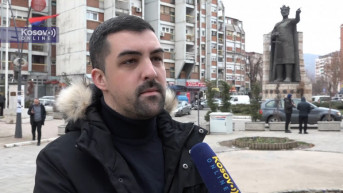
Professor of history at the University of Pristina with a temporary seat in Kosovska Mitrovica, Luka Jovanovic, commented on the writings in "Koha", stating that the Church of Our Lady of Ljevis had been built on the "foundations of a pagan Dardanian sanctuary." He emphasized that such claims are unfounded as there was no scientific and archaeological evidence, all to break the SOC in Kosovo.
He also referred to today's statement from the Visoki Decani Monastery, where they had raised the question of whether there was evidence for what they claimed.
"Of course, there is no such evidence because such articles and writings can only be found in the media. Surprisingly, Koha is involved, as a media outlet that has published relevant texts, and why they allowed something like this to be written. The question arises as to why something like this cannot be written and published in a scientific journal. Precisely because there is no scientific evidence for it, neither written nor material evidence. What we could see actually needs to be tied to a broader story that we have seen in the past few months, and that is that every church in Kosovo, in one way or another, is connected to the Albanians. We used to have examples where they called certain churches Catholic, and even Albanian Orthodox. What we see today is that they associate it with antiquity, returning to that old story, that they are the only autochthonous ones here and that they are the only masters of everything in Kosovo, including cultural heritage, whether it be Roman, Byzantine, Serbian, Turkish, or Jewish", he emphasizes.
Jovanovic claims that this is a wrong narrative that leads to nothing good.
"The gentleman who wrote that article is an absolutely unknown person. I found it interesting to see that he is from the University of Zagreb, and when we consider that a good number of Albanian historians who were educated there worked in Zagreb for some time and that there, precisely in that Department that dealt with antiquity, was led by the famous Zef Mirdita. He gained a scientific reputation but also used his scientific reputation for Albanian independence and created an indigenous story about Albanians. That story, colloquially, 'holds no water', and today no nation can be associated with some ancient, especially Albanians cannot be associated with Illyrians, Dardanians, and Autariates, nor with many ancient peoples who lived here a few thousand years ago, whom the Romans subdued and incorporated into their state system", Jovanovic adds, recalling that the Illyrians assimilated into the Romans.
He states that the Monastery of Our Lady of Ljevis, like many other temples built by King Milutin, was erected on older foundations.
"It was precisely normal for the peoples who embraced Christianity to transform their pagan temples into Christian ones. However, proving and claiming, as this gentleman claims in the article, that Our Lady of Ljevis was built on the foundations of a Dardanian pagan temple is pointless. The question arises, how do you claim that it is a Dardanian temple, how do you know it is a pagan temple, because maybe another object is in question, and have you conducted archaeological research? We know very well that they haven't. Again, I will emphasize, that such writings and nonsense can only find a place in yellow journalism, never in scientific literature because there is no scientific journal that would publish something like this", Jovanovic claims.
Talking about it and usurping Our Lady of Ljevis, Jovanovic says, serves two purposes.
"The first one is: 'If it's yours, why did you burn it in March 2004?'. Second, one cannot talk about temples being built on the foundations of pagan sanctuaries because that was quite normal. An analogy cannot be drawn that a temple is someone's property if it is built on the foundations of an older culture", Jovanovic emphasizes, drawing a parallel between Notre Dame and a Gallic pagan temple.
Our interlocutor believes that one should react every time cultural heritage, the memory of a people, and its past are threatened.
"We can see that such revisionist intentions have always been present when significant changes were underway. It is extremely indicative to me why they are now attacking the SOC in various ways. It's as if they are looking for a model on how to approach the separation and theft of Serbian churches and monasteries in Kosovo and Metohija. We had examples, of whether to approach from the side of Catholicism, autochthony, Islam, or something else, but a model is still being sought, and the question is what they will present in the end. The world is aware of whose cultural heritage it is, and that is the main problem for the Albanians. Now the narrative needs to be changed and questioned, in order to, as some experts have stated publicly, lead to the breaking of the Eparchy of Raska and Prizren, whether through its division, abolition, or establishment of an independent church. We can see everywhere where the Serbian territory was contentious, they came to the point where the church was the first to be targeted, and, as in the case of Montenegro and North Macedonia, they attacked the church and what the people cared about the most", he said.
Jovanovic emphasizes that such claims should always be refuted and voices should be raised, but assistance should be sought from UNESCO and other religious communities.
"Absolutely, every time scientific evidence should be presented and questions should be raised about scientific truth and whether there are material, written sources for any scientific claim", Jovanovic concluded.
0 comments