
Milanovic: We expect the Serbian Government to intervene as soon as possible to protect Cyrillic in Kosovo
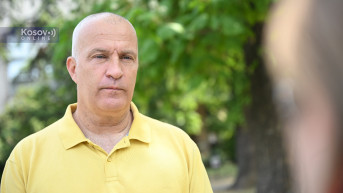
The Council for the Serbian Language has recommended that the Government of Serbia intervene with UNMIK and other international institutions to ensure the protection of the Cyrillic script in Kosovo. The president of the Council, Professor Aleksandar Milanovic from the Faculty of Philology in Belgrade, says the specific trigger for this recommendation was the fact that all road signs and place names, both in the northern and southern parts of Kosovo, as well as all inscriptions by Kosovo institutions written in Serbian, are rendered in Latin script.
"This is in direct contradiction even with what is stated in the laws of the so-called state of Kosovo. The fact is that the legal use of the Serbian language and Cyrillic script is prescribed there as part of a standardized framework, yet despite what the law says, everything written in Serbian is actually in Latin script. All of us who have recently visited Kosovo and Metohija – and that includes a good number of the Council’s members – witnessed this firsthand. From the administrative crossing points to, say, the northern part of Kosovska Mitrovica, all Cyrillic signs have been replaced with Latin ones, which is unacceptable," Milanovic told Kosovo Online.
He adds that not only is the official script of the Republic of Serbia and the native script of Serbian citizens and Serbs in Kosovo under threat, but the Serbian language itself is also being endangered.
"This happens, if in no other way, through the renaming of Serbian places and the alteration of Serbian anthroponyms and toponyms—everything that represents a trace of Serbian culture—transposed into the Albanian language in a form that is not authentic," Milanovic explains.
The Council for the Serbian Language, he says, expects the Government to accept their recommendation and act swiftly to protect the Serbian language and Cyrillic script in Kosovo and Metohija.
"We believe that a public act by our state—sending an official letter to UNMIK and other international institutions—could trigger an alarm within the Council of Europe, especially given that the so-called state of Kosovo has applied to the Council of Europe for various benefits, including full membership. Since the Council of Europe expects all minority rights, including linguistic rights, to be respected, our idea is not just to provoke a response from UNMIK—which often results in no action—but to prompt some level of pressure from the Council of Europe and other European bodies that could ensure the implementation of the very laws Kosovo claims to uphold," he says.
Based on conversations with Serbs living both north and south of the Ibar River, Milanovic notes that all of them reacted strongly to the removal of Cyrillic, regardless of their level of education, political affiliation, or any other factor.
"They experience this as a form of identity-based pressure, a forced detachment from their roots. That alone makes it clear that we expect the violation of the rights of the Serbian national minority in our province to be addressed in an adequate manner," Milanovic concludes.

0 comments