
NGO CASA survey: 99.4 percent of Serb respondents oppose integration of Serbian education system into Kosovo system
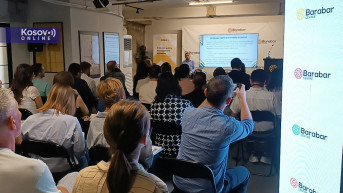
The NGO Center for Affirmative Social Actions (CASA) today presented a survey at the Barabar Center in Pristina entitled “Difficult Questions Ahead: The Kosovo Serb Education System,” authored by Ramadan Ilazi and Ognjen Gogic, which found that as many as 99.4 percent of respondents from the Serbian community opposed the integration of the Serbian education system into the Kosovo system.
The report, “Difficult Questions Ahead: The Kosovo Serb Education System,” examined the issue from two perspectives: the Albanian perspective, based on a survey of 500 Albanians regarding the education system of Kosovo Serbs, and the Serbian perspective, based on responses from 300 Serbs.
Views of the Serbian community
The survey showed that as many as 99.4 percent of respondents from the Serbian community opposed the integration of the Serbian education system into the Kosovo system, while almost 40 percent of the parents surveyed were considering leaving Kosovo if their children were required to be educated within the Kosovo system.
In place of author Ognjen Gogic, the report was presented by Tijana Grujic of NGO CASA. She stressed that education was an issue of great importance to the Serbian community because it constituted a fundamental human right and also concerned the most vulnerable segment of society—children and young people.
Grujic said that maintaining the status quo would be acceptable to the majority of Serbs.
“The most significant finding here is that 99.4 percent of respondents oppose the integration of educational institutions. It is very interesting that we also do not have a clear-cut answer within the Albanian community: 25 percent of respondents from the Albanian community oppose integration, while only one-third support it. Furthermore, 91.3 percent of respondents said that maintaining the status quo was the most acceptable option, meaning that the entire education system should continue to operate within the Serbian system,” she said.
The survey also showed that the Serbian community lacked confidence in Kosovo institutions regarding education.
“When respondents were asked whether they believed their right to education would be respected by Kosovo institutions in the event of integration, three-quarters said they had no confidence whatsoever, while another 23.3 percent said they had very little confidence. This brings us to 97.3 percent of respondents who have virtually no confidence that Kosovo institutions would respect their educational rights if integration were to take place,” Grujic added.
Furthermore, 98 percent of respondents believed that the quality of education would deteriorate in the event of integration.
“When asked what they would do if integration took place, almost 75 percent of respondents said they would not keep their children in these schools. Half said they would enroll their children in a similar educational institution in Serbia, while the other half said they would leave Kosovo,” she stated.
Regarding the legal framework, Grujic said that Kosovo laws had been drafted in a manner that could apply if educational institutions were only now being established, whereas an education system already existed that had operated continuously throughout all these years, with educational institutions that had been established and functioning for decades.
Speaking about agreements reached within the Belgrade-Pristina Dialogue, she said that the 2013 agreement envisaged education as one of the direct competencies of the Association of Serb-majority Municipalities.
“The 2015 agreement further elaborates financial support from Serbia and a model for ensuring transparency of transferred funds, while the 2023 agreement provides for specific arrangements and guarantees to ensure an appropriate level of self-management for the Serbian community, together with a reaffirmed commitment to implement previously reached agreements,” she stressed.
According to Grujic, a key legal and practical problem was that implementing integration under the current Kosovo legislation would disrupt the educational process because the framework did not provide mechanisms for recognizing students’ acquired rights and qualifications or the employment status of staff, including issues related to pensions and years of service.
Views of the Albanian community
The survey from the Albanian perspective showed that 88 percent of Albanian respondents believed that Serbs should have the right to education in their mother tongue, while 79.6 percent believed that this right should be exercised within the Kosovo curriculum.
At the same time, the majority believed that all universities in Kosovo should meet the accreditation and quality standards prescribed by the Kosovo system.
Teachers and professors from Serbia were acceptable to the majority of respondents only if they possessed work permits.
Ramadan Ilazi, the author of the section of the survey involving Albanian respondents, said that the principal difference between the Serbian and Albanian communities regarding the education system concerned institutional authority.
“The central finding of the analysis and the data is that Kosovo Albanians support education, and that is not the problem. The main difference in perception, at least according to the survey and analysis we conducted, concerns institutional authority. The issue is not the language, but whether these schools operate within Kosovo institutions and what integration actually means. When we say that we need to integrate the Serbian-language education system in Kosovo, what does that mean in practice? Potentially, this could be a straightforward process or an extremely complicated one. Our reading and interpretation of the laws currently in force is that integration means legalization and legitimization rather than assimilation or merger,” he said.
He also said that Kosovo’s Ministry of Education had established three years earlier that there were no major differences between the two education systems, except with regard to history and geography.
According to him, the legal framework allowed Serbs to use textbooks from Serbia, subject to certain procedures and oversight by the Ministry of Education. The law also provided for local governments to have competencies in education.
Six common recommendations
Executive Director of NGO CASA Miodrag Marinkovic said that, after conducting the research and identifying the perceptions of both sides, six common points had been identified that could serve as an initial basis for further discussions.
The first recommendation was that any potential integration must not amount to assimilation.
“The idea is to resolve this issue by providing a legal basis for the existing system, and certainly not through assimilation. Both sides should be offered a way to reconcile their positions and express their concerns throughout the process,” Marinkovic said.
The second recommendation was to conduct a comprehensive legal review and ensure legal clarity before any potential change of status.
“The existing Kosovo legal framework contains a number of provisions concerning education. That means half of the work has already been done. Certain legal guarantees for the Serbian community are already part of Kosovo law. Those guarantees should provide a sound and strong foundation, but they should not define the limits of possible solutions,” he said.
The third recommendation concerned appropriate coordination with the Kosovo Serb community and the avoidance of unilateral measures.
“This is the key conclusion: any future process concerning the status of the Kosovo Serb education system should be based on genuine consultations with and responses from the Kosovo Serb community,” Marinkovic said.
The fourth point concerned the Association of Serb-majority Municipalities and consideration of its role in future institutional arrangements.
“Recommendation number four states that the role of the Association of Serb-majority Municipalities should be considered in future institutional arrangements,” he said.
The fifth recommendation called for full and mutual recognition of educational diplomas and qualifications, while the sixth concerned the promotion of clear and balanced public communication.


comments