
Petritsch: A dual revolution is underway - digitalization and autocratization
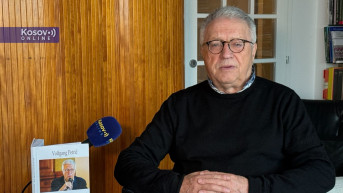
In the world, there is a dual revolution underway, on one side sparked by digitalization, which on the other - leads to autocratization in many countries, says former Austrian diplomat Wolfgang Petritsch, who will present the Serbian edition of his book "Shift of Eras - Our Digital-Authoritarian Age" in Belgrade on Thursday.
Petritsch, former EU Envoy for Kosovo, explains that his work deals with the development of the world order after 1989, that is, after the end of the Cold War.
It was published in Vienna a few years ago, and now it has been printed in the Serbian language.
"The book discusses the liberal world order that developed after the Cold War, the relations between the United States and Europe, as well as Europe and Russia. I depict the rise of China and the role of other continents. Specifically, I speak about Africa in an unusual way, which is often seen as a continent of disasters or emigration. I have tried to portray the potential of that continent," Petritsch said.
He pointed out that his thesis was that there was a new setting of guidelines underway, both in politics and technology.
"Our digitized world is only at the beginning of the revolution, which will develop for many more years. Since the book was published, many things, as I predicted, have been developed, such as 'Chat GPT,' artificial intelligence, and we see the role of social networks. I wrote the book a few years ago, and much of what I predicted has already happened. Not only in the digital field but also in the regression of democratic structures and the imposition of autocratic systems. An example is China, which many continents want to follow," Petritsch added.
He said that it was undoubtedly true that the new cyberspace played a decisive role in election campaigns and manipulations, but it also contributed to strengthening political arguments.
"We are currently in the phase of regulating that space, where the EU is making a significant contribution. Probably, when it comes to formulating rules in digitalization, the EU is leading the world. In the anarchy of digitalization, it is necessary to change social rules, but also industrial rules. When you think about the role of microchip production, how important digital elements are in warfare. In the United States, negotiations are underway on how to limit and regulate, control these systems. This wide range of digitalization represents a change of era," Petritsch added.
Asked how much the "shift of eras" due to digitalization had affected the Western Balkans, he said that the region was still somewhat behind because conventional issues still played a significant role there.
He pointed out that Eastern Europe had developed faster, as there had been a peaceful transition from a communist to a capitalist system.
"Due to the ten-year war resulting from the dissolution of Yugoslavia, the Balkans experienced significant setbacks. For real progress in the digital sphere, these states need to overcome historical conflicts. Only when historical conflicts are overcome, will the region be able to fully focus on economic issues and issues of new technologies, which bring new jobs," the former diplomat said.
He adds that the Western Balkans could be a region of "start-ups" if old problems were resolved, such as "remnants of the Yugoslav era."
"A region with a high level of education has good prerequisites, and at the same time, it can stop the brain drain because primarily young people engaged in new technologies are emigrating. In this way, it is also possible to bring back young people who could then transfer the knowledge gained in Europe and the USA," Petritsch believes.
When asked how the new era had affected the EU, he noted that the influence was clearly visible, almost in every sphere of life and political development in the EU.
"We know that compared to the USA and certain Asian countries like Taiwan, Europe is lagging in this area, but there are many areas where Europe can compete globally," Petritsch states.
On the other hand, he emphasizes, the EU has become a global mechanism when it comes to regulating that area.
"There lies the strength of the EU, which is not a military union - in rules in the economic and digital spheres, to ensure that new technologies are used for the benefit of people, not against them," he emphasized.
When asked if China was evolving into the world's largest power, he expressed the belief that the country was facing problems that hindered its path.
"China has made significant progress in various areas, approaching the EU and Europe in some, but I think Beijing will focus more on itself due to internal political and social issues. Just the demographic development is catastrophic, due to the aging population resulting from the 'one-child policy,' which is now proving to be a problem. It is also a question of how such an advanced industrial state, which has managed to lift hundreds of millions of people out of poverty, can create a middle class that would accept a dictatorial regime. These internal tensions must be resolved for a real rise to occur," Petritsch explains.
He stated that the aging of society in the future could hinder innovation.
"From history, we know that these are always the most dangerous transitional phases that large states face," he noted.
Petritsch emphasized that it would be important for Europe, as well as the USA, not to enter into confrontation with China, but also not to enter into cooperation "naively," but to clearly communicate to Beijing that cooperation can only occur if they adhere to Western standards and there must be reciprocity.
In this regard, he explained that it was acceptable to have Chinese investments in the region, citing the example of the bridge in Peljesac, but that they must be in line with legal, social, and labor standards.
Similarly, he stressed the need for reciprocity and that European companies in China must have the opportunity to invest without discrimination.


0 comments