
Popovic: The destruction of Serbian cultural heritage in Kosovo has been ongoing for decades; things are worse than in the 19th century
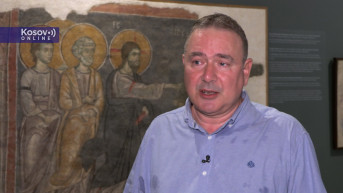
The destruction of Serbian cultural heritage in Kosovo has been a process that has lasted for decades," says Dr. Bojan Popovic, a museum advisor from the National Museum in Belgrade, in an interview with Kosovo Online. He observes that it is absurd that things were better in the 19th century than they are in the 21st century.
"This has always existed. We are in the Balkans, and this phenomenon exists worldwide—it's the concept of damnatio memoriae, the destruction of parts of history that one does not like. But I want to emphasize that it's absurd that things might have been better in the 19th century than they are in the 21st. In fact, things have worsened since NATO troops arrived, rather than improving, and this process has not stopped but has accelerated. Clearly, someone is giving a push in that direction," Popovic assesses, adding that it can always be prevented.
As he emphasizes, where there is a will, there is a way.
"This is simply a matter of giving the green light for such actions to be taken, and as long as that remains the case, it will continue, " he believes.
Regarding the National Museum in Belgrade, it has been collecting cultural assets of the Serbian people since its founding, so its collections include a large number of items from the Kosovo region, Popovic notes.
"We can freely say that this collection is even larger than the actual size of the region itself, at least because it was central and possibly the most important area for the Serbian people. What needs to be mentioned is that from the very beginning, the National Museum never aimed, as has happened in some neighboring countries, to deprive churches of their treasuries. Therefore, the museum has left the churches' jewelry and essential items, those accumulated and preserved there for centuries, while what came to the museum mostly arrived from private collections, through archaeological research, and in many other ways, " our interlocutor points out.
Considering that the National Museum is the central institution for cultural assets of exceptional significance, it houses, as he reminds us, the most important cultural treasures.
"To mention just a few works: for example, the original frescoes from the Church of the Virgin of Ljevisa, which date back to the 13th century, from the time when Serbian rule extended to the region of Prizren. Then, there is stone sculpture, specifically the famous full sculptures from the Banjska Monastery in several sculptural parts. Also, part of the famous flooring from the Holy Archangels Monastery near Prizren. Additionally, some icons, such as the Transfiguration icon from Budisavci or the Annunciation icon, which perhaps originates from the Holy Archangels Monastery near Prizren," Popovic adds, noting that this is just "a drop in the ocean."
In addition, the National Museum has an entire hall dedicated to materials from Novo Brdo.
"Although Novo Brdo was researched for only two seasons, again for political reasons and correctness, an abundance of material was discovered in the 1950s, and this material is also housed in the National Museum. It provides testimony about this city, rich in silver and gold, which was one of the most important in the Balkans and one of those famous mining towns that, it can be said, emerged suddenly and remained highly significant for centuries thereafter," he notes.
The National Museum also includes the Gallery of Frescoes, which contains copies of frescoes, with a significant portion of that collection being replicas from Kosovo.
"There is also a collection of epigraphy, meaning cast inscriptions, which is particularly important because, as with the fresco copies, the originals no longer exist today, either due to natural forces or human intervention," says Popovic.
He reminds us that the National Museum, "despite being somewhat restricted in its actions," also deals with the heritage that still remains in Kosovo.
"What is important to know is that it is of global significance that some of these important monuments have been internationally recognized as endangered heritage sites. As a museum, we first and foremost try to draw attention to the art of Kosovo and Metohija, not only because of its importance but also because of its endangered status. As cultural leaders, we must point out and explain to both our public and the global community that this is something that must be preserved and requires immense attention," he explains.
He adds that this is primarily done through a large number of exhibitions.
"We had a major central exhibition titled 'Kosovo and Metohija: Endowments and Gifts.' Additionally, in numerous other exhibitions that may not have any clearly visible title, such as 'Serbia, the Land of Frescoes,' there is always a significant segment dedicated to the monuments of Kosovo and Metohija. For example, when I traveled abroad with that exhibition, I encountered, in only one place, what I would describe as closed or partially closed doors. They refused to open the exhibition in the end because they realized that some of the works were from the territory of Kosovo and Metohija. And that was a problem for them," Popovic recalls.
Moreover, the museum is constantly involved in documenting and monitoring what is happening in Kosovo to the extent that it is possible.
"And we are always ready, if circumstances change and if any law or some 19th-century European values come into play, to finally allow access to the numerous mined churches and conduct archaeological work. In this context, we can assist with the, unfortunately now movable, cultural assets, such as fragments of frescoes, by processing, fitting, and documenting them," he states.
comments