
Radonjic: The National Theater of Pristina shares the fate of the Serbs in Kosovo
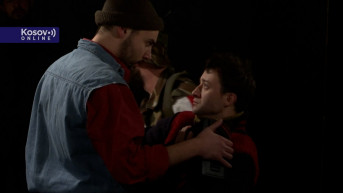
The National Theatre in Pristina, based in Gracanica, shares the fate of the Serbs because, in 1999, it was expelled from its main stage along with 40,000 Serbs from Pristina. However, the Serbian drama does not end there.
The National Theatre in Pristina was officially established in 1948 when the Serbian drama was founded under Milutin Jasnic. A year later, Serbian actors, along with amateurs and Albanian actors, established the Albanian drama. From then until 1999, it operated as a bilingual theater with performances in both Serbian and Albanian languages.
"Unfortunately, after 1999, the National Theatre in Pristina was forced to flee with the Serbs from Pristina. Until 2004, it remained in a kind of hibernation. In 2004, by the decision of the Government of the Republic of Serbia, it resumed its work under the management of the director Nenad Todorovic. He inherited only a shoebox with work records and practically started rebuilding the National Theatre in Pristina from scratch. Initially in Leposavic, where we received a two-room apartment for two offices, then in Mitrovica, where we obtained a house for administrative and legal headquarters without a stage. In 2014, we moved here to Gracanica, where, with the goodwill of the municipal leadership and the Gracanica Cultural Center, we gained the use of this stage, which is now our new main stage", Predrag Radonjic, Director of the National Theatre in Pristina based in Gracanica, says in an interview with Kosovo Online.
Due to the unusual conditions in which it has functioned and continues to function, this theater has become the subject of interest for many media outlets, both local and national, as well as international.
"It is indeed a kind of challenging circumstance, but at the same time, it is a kind of challenge that injects an additional sense of resilience and energy to survive, work, and live despite everything, despite all those burdensome circumstances. To some extent, it has strengthened us, and perhaps it may seem unusual to others, but we simply started to love our peculiar situation, finding strength precisely in it", Radonjic said.
Although in 2014, the Pristina Theater got its main stage in Gracanica, the ensemble regularly visits other places in Kosovo.
"After premieres here in Gracanica, we visit all the other places in Kosovo and Metohija where conditions allow for the performance and where we have our audience, even in places without conditions, in the yards of returnee houses, in church courtyards and monasteries. We perform wherever our people are and there's a need for our plays to be staged. We are also quite present in other parts of Serbia and abroad", Radonjic emphasized.
Actress Jasmina Stoiljkovic claims that all members of the National Theater Pristina, based in Gracanica, have a special task in the development of culture among the Serbs in Kosovo and throughout Serbia.
"The National Theater really excels in these activities and is directed towards our Serbian audience in Kosovo and Metohija wherever they are and however many there are. I've been in the theater since 1994, and since 1996, I've been in a permanent position. So, our theater before 1999, when, due to well-known socio-political circumstances, the Serbs simply had to leave, they were expelled from their institutions, and we were thus expelled from our beautiful building in Pristina. In that whole period, we had a fantastic theater, a real institution under our roof, in excellent conditions for actors. We had excellent production; even then, the best Serbian directors worked in our theater, the production was fantastic, and we had wonderful guest performances, fantastic festivals, and great successes at those festivals. After 1999, we were cut off in our flight, but thank God, we regrouped in 2004 and embarked on our new mission", Stoiljkovic said.
A particularly emotional moment for all members of the Pristina Theater was in 2004 when Serbian drama returned and embarked on a tour with the play "Never Despair", directed by Nenad Todorovic.
"Imagine now, suddenly, the whole musical appears in our theater, making its famous tour of Kosovo and Metohija. We performed for one woman, the only remaining old lady in the Urosevac area. The entire theater went to her yard and played a theater performance just for her. So, our role is really special somehow. That moment was full of emotions, of course, from the side of the respected Mrs. Smilja Bajcetic, and, of course, it was especially emotional for us. We played for four women in the courtyard of the church in Gjakova, we played in Peja, where the audience came more from the outside to support our effort to play a theater performance right in the courtyard of the abandoned church in the middle of Peja. So, we are fighting, and we would love, and somewhere our idea is to unite our struggle with the struggle of our Serbs in Kosovo and Metohija to stay and survive", Stoiljkovic said.
Actress, writer, director, and drama educator Radmila Knezevic states that she is honored to have been a part of the National Theater of Pristina for 25 years. She emphasizes that it is one of the oldest cultural institutions in Kosovo that still endures.
"On October 7, we celebrated 75 years of existence, so this theater, as stated in the brochure for the jubilee 'Despite Everything', has undergone various beautiful and ugly things and events. It lived together with these people, and as the people lived, so did the theater. Everything ugly that happened to us, the ordinary people, also happened to the theater and all other institutions. However, despite everything, it managed to survive, continue to exist, and still create good and beautiful plays", Knezevic highlighted.
The National Theater of Pristina has also launched a children's stage, providing the youngest with the opportunity to enjoy premieres and experience the charms of drama.
"When we started that children's stage, working on plays like 'Two New Year's Trees', 'Sleeping Beauty', and others, now every year, we have one children's play, and these are truly the most emotional moments. When you see all those children eagerly waiting to watch the play, to meet the actors, to take pictures with those characters afterward. Personally, those are the most intimate moments for me, perhaps somewhere even the saddest because I am also a child from Kosovo and Metohija. I remember those events when theaters came to us, and we watched plays, so somewhere, not only me, but everyone in the ensemble saw themselves, happy and joyful. When it's time to get into that van and leave, we are quite sad, and we often cry. It's wonderful that our theater is reviving that children's stage and our children are educated in this way, creating future theater audiences in our communities, and perhaps some new actors who will come and replace us", Knezevic said.
The National Theater of Pristina concluded the season with the play "So Hot Was the Cannon", based on the novel of the same name by Vladimir Kecmanovic and directed by Nenad Todorovic.



0 comments