
Report on the political rights of Serbs in the region: Poor position of the Serbian community in Kosovo
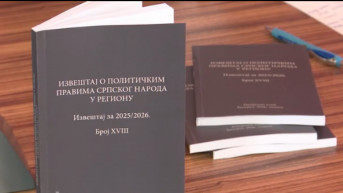
The position of the Serbian community in Kosovo remains poor, with Serbs being denied equal protection under the law and meaningful participation in government, according to the Report on the Political Rights of the Serbian People in the Region, presented by the Progressive Club.
According to the report, responsibility for this situation lies with the authorities in Pristina because of their failure to implement previously reached agreements, as well as with parts of the international community, particularly Berlin and London, RTS reported.
One of the report's conclusions is that, in many countries across the region, Serbs are unable to exercise even the minimum level of political rights, while somewhat more favorable conditions exist in the Republic of Srpska and Montenegro. The authors recommend stronger institutional support and greater investment in Serbian communities throughout the region.
"I have to say that Croatia is the source of all the problems faced by Serbs in the Balkans because, even before 1918, it established a model for depriving Serbs of their rights. Unfortunately, since joining the European Union, Croatia has been a country facing serious identity issues, which it seeks to resolve by deepening and expanding hostility toward the Serbian people," said one of the report's authors, historian Cedomir Antic.
Because of the poor state of the political rights of Serbs in the region, the report's cover had been black for almost a decade. This year, however, the authors chose a lighter color, explaining that it reflects improvements in the status of Serbs in the Republic of Srpska and Montenegro.
They note that Serbs in Montenegro participate in government, that the property of the Serbian Orthodox Church is no longer under the level of threat it previously faced, but that one important demand remains—that the Serbian language, spoken by more than 43 percent of the country's citizens, be granted the status of an official language.
The situation in the Republic of Srpska is described as relatively favorable, apart from what the authors characterize as political pressure from Sarajevo.
"In the Federation, however, the situation is different. Although Serbs are a constituent people there, they enjoy only a minimal level of rights. The use of the Serbian language is very limited, and Serbs are significantly underrepresented in state institutions, accounting for less than one percent of the public administration," said another author of the report, Lazar Janosevic.
According to the authors, Romania and Hungary would deserve white covers because, in those countries, Serbs enjoy the full range of minority rights, from political representation to the use of their language.
At the opposite end of the spectrum, they place Slovenia and Albania.
"In both countries, the rights of Serbs are not respected. Moreover, neither Albania nor Slovenia recognizes Serbs as a national minority. In both countries, Serbian children do not have access to education in their mother tongue through the regular school system but only through supplementary courses held alongside regular classes," explained another report author and representative of the Progressive Club, Igor Vukovic.



0 comments