
Tomanovic: I've been searching for the truth for 26 years – My husband was abducted in front of KFOR’s eyes
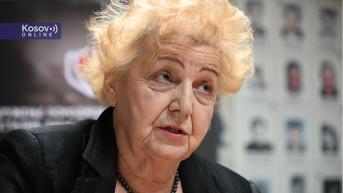
"Every June 24 is a day of immense sorrow for our family," begins Verica Tomanovic, president of the Association of Families of the Kidnapped and Missing Persons from Kosovo and Metohija. Her husband, Andrija Tomanovic, was kidnapped on this very day 26 years ago, in front of the main gate of the Clinical Hospital Center (KBC) in Pristina, and since then — not a single trace or piece of information has surfaced.
Andrija Tomanovic was one of the most prominent surgeons in Pristina — head of surgery at KBC Pristina, a full professor at the Faculty of Medicine, and a member of several international surgical associations.
According to the information gathered so far, he was abducted around 1 p.m. on June 24, 1999, at the hospital gate, which at the time was heavily guarded by KFOR forces. And that’s all anyone knows.
Since then, Verica Tomanovic has been tirelessly reaching out — without success — to every international organization and domestic institution imaginable, including KFOR and UNMIK.
She keeps all the relevant documents carefully — letters, requests, and pleas to help her find her husband. She has never received a response.
“In the days following June 24, 1999, I contacted the UN Office in Belgrade, the International Committee of the Red Cross, and even the then-commander of KFOR, General Michael Jackson. He never replied, though he had promised in Kosovo Polje that all citizens would be safe regardless of ethnicity. All I have is a copy of my letter — that’s all that remains of that officer’s promise,” she says bitterly.
Among the many documents is also a letter written by their grandson, pleading for his grandfather to come home.
She last spoke with her husband early that morning.
“He said he hadn’t slept all night, that the situation in the city was catastrophic. He’d watched from the window as shops were vandalized, furniture and carpets stolen, apartments broken into... The stores were across from our home. The next day we heard that one of our neighbors had been killed on the street,” she recalls.
Just a day earlier, on June 23, after spending 78 consecutive days in the hospital, mostly in the operating room, Andrija went home briefly to rest.
“He never cared about anyone’s ethnicity or religion — only about saving lives. He worked in that hospital for 32 years. He trusted people, he believed in the international mission — and then we lived through hell,” Verica says, struggling to speak.
There is a photograph of Andrija smiling — the smile of a man born in Dubrovnik who had found happiness in Pristina. The last family photo shows him holding his newborn grandson.
“We were his biggest supporters, proud of every life he saved. Is this — being kidnapped in front of colleagues, and the silence of patients he once treated — the gratitude for all those lives? How do I explain to myself the silence of Albanians, who, for nearly three decades, have refused to speak up about their doctor Andrija, whom they were once proud of?” she asks in pain.
She says her husband had no doubt about staying in Pristina after the withdrawal of Serbian forces on June 9, 1999.
“Some colleagues left, but others — mostly doctors, his former students, and part of the hospital staff — remained with him at KBC Pristina,” she explains.
Andrija called the family one more time that day, at 1 p.m.
“He phoned my daughter and said, ‘Jelena, I’m very tired. I’m going home to rest a bit.’ A friend had promised to drive him home — about 15 minutes from the hospital. He usually walked to work, he loved walking, but because of the tense security situation and many unfamiliar people in town, it wasn’t safe… But he never made it home,” she recalls.
He told their daughter that he’d had several meetings that day at the Dean’s office with KBC doctors and KFOR officers.
“Suddenly, many unfamiliar people appeared in the hospital, and the British took over management of the facility,” Verica explains.
After speaking with his family, Andrija headed toward the hospital exit, which was heavily guarded by KFOR soldiers.
“There was a KFOR checkpoint in front of the main gate, and right beside it a UÇK (KLA) checkpoint. Each hospital department in the KBC complex had a British military post. I believe they witnessed the abduction but didn’t intervene. They didn’t move to save him from the two young men who forced him into a car parked right outside the hospital,” she recounts.
That moment marked the beginning of a 26-year ordeal for the Tomanovic family.
“We expected him to call around 2 p.m. when he got home. But he didn’t. We started calling him every 15 to 30 minutes. No one answered. That evening, we began calling relatives and colleagues still in Pristina. We called deep into the night. Some said they didn’t know anything. Others said they weren’t on duty that day. Some said they had already left Kosovo…” she recalls, her face contorted in pain.
The next morning she called the hospital — and then those who were supposed to guarantee safety for all.
“The hospital receptionist said Andrija hadn’t shown up. When I got transferred to Surgery, an Albanian man answered and told me he didn’t know anything — that he had spent the last ten years in America… I called the British officer who had taken over the Surgery Department — he also said he knew nothing. Then I started calling KFOR police. For the first three days, a British officer answered. He was polite and said Andrija’s disappearance had already been reported but encouraged me to keep calling. On the third day, he told me not to call anymore — he’d been reassigned,” she says.
In the following weeks and months, she contacted every international organization she could.
“My husband was a humanitarian, a former vice-president of the Red Cross of Serbia, and a member of the International Surgical Association… On behalf of my children, I respectfully asked for help to find him,” reads one of the handwritten letters she addressed to KFOR commander Michael Jackson.
She never received a reply.
“I went to international offices in Belgrade — the UN office, the International Committee of the Red Cross, the Red Cross of Serbia...” she lists.
None responded. And that silence has lasted for 26 years.
“That silence hurts more than any wound,” Verica says.
She is convinced that the truth about her husband’s fate is known — but there is no will to reveal it.
“If someone wanted to tell the truth, they would. It’s being hidden for reasons unknown to me. Since founding our association in 2000, we’ve reached out to every relevant institution, in Serbia and abroad, to embassies… We’ve been to Washington, we were received by former French President Jacques Chirac, by then-UN Human Rights Commissioner Jiří Dienstbier. Every Thursday, we visited the UNMIK office in Belgrade. They all promised to do everything in their power — but nothing happened. Even EULEX, which investigated the Yellow House, never gave us any reports, though we asked for them for the sake of our loved ones,” Tomanovic explains.
She adds that in 2004, the association requested that KFOR hand over all documentation on kidnapped and missing Serbs in Kosovo to Serbian institutions — but that never happened.
“All those investigation reports from 1999 and 2000, when most Serbs were kidnapped, were taken back to their countries. Some countries allowed access to those files, but others — like the UK — still haven’t. They were responsible for security in Pristina and the surrounding area and were obligated to record every incident,” she says.
She sees a glimmer of hope in the possibility that the International Committee of the Red Cross might be allowed to collect all relevant field documentation to help the families of about 1,600 missing persons — both Serbs and Albanians.
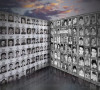
“There are still 570 missing Serbs whose fate remains unknown,” Tomanovic says as she shows us the “Serbian Wailing Wall” — an office where the walls are covered with photos of missing Serbs from Kosovo.


0 comments