
UNS: Media in Kosovo facing financial uncertainty after withdrawal of foreign donors
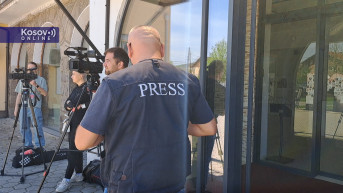
In front of the "Missing" monument in the courtyard of the Cultural Center in Gracanica, Serbian-language media workers in Kosovo marked World Press Freedom Day today at 11:55 a.m. by reading the UNS proclamation.
Ivana Vanovac, President of the Journalists' Association of Kosovo and Metohija, said that this year's World Press Freedom Day finds the Serbian journalistic community in Kosovo still burdened by numerous long-standing issues. She noted that the period between last year's and this year's Press Freedom Day has shown that media-related problems are becoming increasingly varied and equally severe.
“We begin with the issue of journalists’ safety, where there is an alarmingly apathetic attitude from all security institutions. This is perhaps best illustrated by the case of the Tanjug editorial team, who received serious and concrete threats via email from an address located in Kosovo. Despite all our appeals, we received no adequate response from security institutions in the area. We are also witnessing a deterioration in financial stability and the general economic foundation on which the journalistic and media community in Kosovo rests,” Vanovac stated.
She emphasized that the withdrawal of funds from a number of foreign donors is a major problem for media outlets in Kosovo.
“This has, on one hand, worsened the situation for journalists, and on the other hand, we’ve had the case of the competition run by the Ministry of Information of the Government of the Republic of Serbia, in which we discovered certain irregularities. We demanded that the competition be annulled and that there be a reassessment of which media outlets are truly active in Kosovo, who operates there, and who is genuinely of value to the public,” she said.
Vanovac also pointed out that the issue of non-compliance with the Law on the Use of Languages remains unresolved, as does the lack of any progress in reopening investigations into missing journalists.
“If there’s any positive development to highlight from the past year, it would certainly be the annulment of the Law on the Independent Media Commission, which was a decision of the Constitutional Court. Fortunately, a lot of effort, energy, and discussion was invested in this issue over the past year, and that decision gives us at least a small reason to breathe a sigh of relief,” Vanovac said.
She also noted that media professionals continue to face intimidation and disruptions, sometimes even threats, while working in the field—and that, in many cases, the individuals involved are members of the Kosovo Police.
“Our colleagues, aside from reporting to the public, have no intention of demanding public statements from us. They don't want to speak publicly about these matters because they fear it would only make their situation worse—not only in terms of how they operate and report but sometimes in more serious ways,” Vanovac added.
Zivojin Rakocevic, President of the Journalists’ Association of Serbia, stated that this is clearly not a day to celebrate media freedom, but rather a day to tally up the many freedoms that have been lost—and even then, he said, there wouldn’t be enough paper to write down everything that has happened to the journalistic community in the past year.
“There isn’t enough time to list all the unresolved issues from the past. How can we speak from a place where 17 journalists and media workers were abducted and whose fates remain unknown? How can we talk after the annulment of the verdict in the Slavko Curuvija case, with no sign of remorse or justice from those involved? How can we speak amid daily pressures and attacks, from the perspective of an entire community that represents one of the few, if not the only, remaining windows into pluralism and freedom? How can we speak when institutions—especially the Ministry of Information of the Government of Serbia—are committing injustices and creating division? How can we speak when media is something being limited and ghettoized? And finally, how can we speak when entire systems are becoming propaganda machines, and the free individual is forced to listen to competing propagandas and judge the truth accordingly? The world is unrepairably worse than it was last year, and the world of media freedom is in darkness this year,” said Rakocevic.
On this occasion, the UNS proclamation was read aloud to the assembled media workers by Jelena Markovic, the association’s secretary in Kosovo. The proclamation states the following:
"The Serbian judiciary continues to demonstrate its inability to prosecute the killers of journalists and those who ordered the killings. Even after several decades, the perpetrators and masterminds behind the murders of journalists Slavko Curuvija and Milan Pantic have not been identified or punished, nor have the circumstances surrounding the death of Dada Vujasinovic been clarified. The same goes for the killings and abductions of journalists and media workers in Kosovo from 1998 to 2005.
In 2024, the Journalists’ Association of Serbia (UNS) recorded 111 cases of threats to journalists and media workers. UNS’s database documented 33 threats, 29 cases of pressure and insults, and 13 physical attacks last year. In November alone, 15 journalists and media crews were physically attacked, insulted, or obstructed in their work, including eight while reporting from protests in Novi Sad and Belgrade.
The rise in attacks, insults, and pressure on journalists this year is alarming. From the beginning of the year to date, UNS has recorded 51 cases of endangerment—nine more than in the same period last year. In just four months, there have been eight physical attacks on journalists—seven more than in the same period last year.
UNS also recorded more cases of obstruction of work than in the same period the previous year—nine compared to six. While there were no journalist arrests last year, this year there have already been three.
Between two World Press Freedom Days, Amnesty International reported that forensic analysis revealed that Serbia’s Security Intelligence Agency (BIA), using Israeli Cellebrite technology, had unlocked the phones of activists and journalists it had summoned or detained for questioning, and then installed a domestic spyware program named "NoviSpy" onto those devices.
When threats and pressure are compounded by the ineffective response of state authorities and the poor economic conditions of media workers, it becomes clear why, once again on this May 3rd, we must say that it is difficult to be a journalist in Serbia.
The mandates of REM Council members expired on November 4 last year, in accordance with the Law on Electronic Media. The Serbian National Assembly failed to announce a call for new members within the legal timeframe, leaving REM unable to function. Even if new members were selected by the end of May, it would be seven months overdue.
Out of 180 countries, Serbia ranked 98th in the 2024 World Press Freedom Index, a drop of seven places compared to the previous year, according to Reporters Without Borders (RSF).
In the first year of project co-financing through the Unified Information System, journalists and media in Serbia faced serious operational issues with the platform, along with a lack of transparency. Municipalities and cities were again late in launching media funding competitions, and the Ministry of Information and Telecommunications delayed the formation of candidate lists for evaluation commissions.
In Kosovo and Metohija, journalists face a reality marked by insecurity, targeting, police repression, and restricted freedom of movement. For example, this May 3rd is being marked with a ban on the entry of RTS journalist Svetlana Vukmirovic into Kosovo, as well as inappropriate actions by police.
Some media workers have recently reported pressure from the Kosovo Police, asking UNS not to react publicly, as they do not trust the institutions in Kosovo and Metohija that are supposed to protect them.
The journalistic community in Kosovo and Metohija is also facing additional financial uncertainty following the withdrawal of foreign donors and irregular distribution of funds through the Ministry of Information and Telecommunications’ (MIT) media project competition for electronic outlets in Kosovo. UNS called for the annulment of the competition, noting that significant funds were awarded to organizations unknown to the media community.
Even 20 years after the March Pogrom in Kosovo and Metohija, we are still witnessing scandalous reporting from the website of Radio Television of Kosovo (RTK), in both Serbian and Albanian, which continues to distort facts and misinform the public.
The year between two World Press Freedom Days has also been marked by serious violations of the Serbian Journalists’ Code of Ethics."
UNS therefore demands:
- That competent authorities efficiently investigate all threats to journalists and media workers, and regularly inform the media and public about the results;
- That the judiciary ensure the murder of Milan Pantic does not reach the statute of limitations for criminal prosecution;
- That the Criminal Code be amended to include more forms of attacks on journalists as criminal offenses;
- That effective institutional protection be guaranteed for journalists against pressure from public officials, media owners, and other power holders;
- That public funds be distributed fairly to preserve media pluralism and ensure quality public information;
- That the Ministry of Information and Telecommunications, through efficient inspection oversight, monitor whether local governments comply with their obligations and deadlines for announcing media co-financing competitions and conducting the competition process;
- That the Serbian National Assembly finally appoint new members to the REM Council;
- That Kosovo institutions and international administration in Kosovo urgently form an International Expert Commission to investigate the murders and abductions of journalists and media workers in Kosovo from 1998 to 2005; UNS demands that journalist associations be represented in this commission.

comments