
OSCE 50 years after the Helsinki Act remains blocked due to violations of that document

Fifty years after the adoption of the Helsinki Final Act, the Organization for Security and Co-operation in Europe (OSCE) remains paralyzed by a blockade that has persisted since the start of the war in Ukraine. Neither Finland, which chaired the organization this year, nor the 32nd Ministerial Council held over the past two days in Vienna, managed to change that situation.
The Ministerial Council was marked by calls to uphold the principles of the Helsinki Act, above all those concerning territorial integrity and sovereignty.
Representatives of Western countries repeatedly stressed in their addresses that respect for the territorial integrity and sovereignty of states is key to security—while accusing Russia of violating those principles through its attack on Ukraine.
How these calls for respect of territorial integrity and sovereignty apply apparently only to Ukraine was illustrated by the fact that the speech of Albania’s Foreign Minister Elisa Spiropali went unanswered.
She stated that, since stability and security are important throughout Europe and in order to achieve sustainable safety and progress in the region, Kosovo should be recognized “as an independent and sovereign state.”
This is not the first time Albania has lobbied for the recognition of Kosovo.
At previous ministerial meetings, as well as on several occasions at the OSCE Permanent Council, Albania has sought recognition of Kosovo and its admission to the organization.
A few weeks ago, when the Permanent Council discussed the report of the OSCE Mission in Kosovo, the Albanian ambassador requested that the frequency of reviewing reports on Kosovo be reduced—a proposal supported by some Western countries, but rejected due to a lack of consensus.
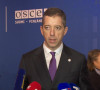
The extent to which the issue of territorial integrity and sovereignty—principles that were not respected in Serbia’s case, as Serbian Foreign Minister Marko Đurić emphasized in Vienna—represents a global problem is evident from the second day of the Ministerial Council, when Morocco and Algeria, both Mediterranean Partners for Cooperation, “exchanged” accusations over who is occupying whose territory.
Furthermore, Turkey’s blockade of Cyprus’s candidacy to assume the OSCE Chairmanship in 2027 also shows that the war in Ukraine is not the only issue paralyzing the OSCE. Territorial disputes between other member states are equally obstructive, leaving the OSCE Troika—comprising the current, previous, and incoming chairs—without a full slate of members.
At the Ministerial Council, the question of the 2027 Chairmanship remained unresolved, meaning a solution will have to be sought in the period ahead.
The ministers’ statements in Vienna demonstrated that the OSCE remains divided. For an organization that makes decisions by consensus, this division leads only to a continuation of the blockade.
The harm this causes the OSCE is best illustrated by the fact that the organization has not adopted a budget for the past four years—not even at the end of Finland’s chairmanship—which undermines the functioning of its institutions and missions.
Switzerland’s ambassador to the OSCE, Raphael Nägeli, whose country assumes the chairmanship on January 1, appealed for constructive engagement by all 57 participating States in order to adopt the budget.
He stressed that the OSCE is a unique platform for dialogue and said that Switzerland fully understands the calls for modernizing the organization.
“We have heard the demands for reform and we are ready to consider them, but it is impossible to carry them out without all 57 member states. The focus of our chairmanship will be on results. And to implement reforms, we need a budget. We call on all member states to engage constructively on this issue,” Nägeli said.
He added that respect for OSCE principles is the basis for sustainable peace in Ukraine, and noted that Switzerland understands that the OSCE must prepare to potentially support the post-conflict phase once peace is established.
Switzerland will formally assume the OSCE Chairmanship on January 15, at the first meeting of the Permanent Council after the winter recess, where it will present its detailed priorities.
At the final press conference, neither Finland’s Foreign Minister nor the OSCE Secretary General participated, as is customary. Instead, Finland was represented by Deputy Foreign Minister Pasi Rajala and the Director of the OSCE Conflict Prevention Centre, Kate Fearon.
Rajala told the media that the Ministerial Council discussed the future of the OSCE, and that during its chairmanship Finland encouraged a “Helsinki Plus” dialogue through which the organization’s principles were reaffirmed.
Those principles, he noted, include respect for state sovereignty, territorial integrity, non-use of force, and human rights. Rajala emphasized that these principles are not only the foundation of the OSCE but must remain at the center of any dialogue on Europe’s security.
Regarding the results of the Ministerial Council, he acknowledged that no agreement was reached on the Chairmanship for 2027 or on the budget.
“We spared no effort to achieve agreement on Cyprus’s candidacy to chair the OSCE in 2027 and on the budget. We worked hard, and now all we can do is focus on supporting Switzerland in achieving progress on these issues,” he concluded.

0 comments