
A free labor market within the framework of the Open Balkan is an opportunity for new investments and regional progress
The government of North Macedonia last week ratified the agreements for free access to the labor market within the framework of the Open Balkan, which finally removes all barriers to the smooth flow of labor between members of the Initiative, economic experts, political leaders, and businessmen from Serbia, North Macedonia, and Albania, as well as international representatives agree that this will contribute to the faster progress of the three countries and the creation of a unique business environment attractive to foreign investments.
Agriculture, construction, tourism and catering, craft activities, as well as the IT sector, modern technologies, and engineering are just some of the areas that are expected to benefit and fill work capacities, thanks to "unique work permits", i.e. ID certificates "Open Balkan" which will be available on the e-administrations of the three countries.
The single market will indirectly to a certain extent lead to a reduction in the process of emigration within the Open Balkan as a whole because young people will get new business opportunities in areas that are geographically closer to their families.
On the other hand, an open labor market allows young people to start a sustainable business with their colleagues from the region.
The single labor market is more attractive for foreign investors, regardless of whether it is a new investment in Serbia, North Macedonia, or Albania because workers can be recruited from the whole region without paperwork and institutional barriers.
The President of Serbia, Aleksandar Vucic, and the Prime Ministers of North Macedonia and Albania, Zoran Zaev and Edi Rama signed the Agreement on Free Access to the Labor Market in the Western Balkans in Tirana on December 21, 2021, as part of the "Open Balkan" regional cooperation initiative.
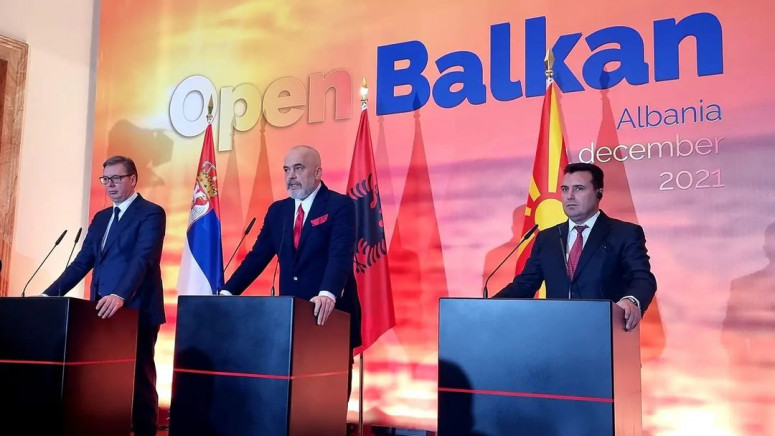
That agreement enables the introduction of a single work permit for those three countries, and on that occasion, the leaders also signed the Agreement on connecting the electronic identification system of citizens of the Western Balkans.
The agreement on conditions for free access to the labor market enables citizens to work in any of the three countries without obtaining work permits, barriers, applications, and waiting, without administrative costs.
The agreement on conditions for interconnection of electronic identification schemes, on the other hand, foresees access to the electronic services of the national portals of the three countries through the creation of electronic identification "Open Balkan" for realizing the possibility of access to the labor market in those countries.
On that occasion, Vucic said that with this initiative, borders were being opened and a better future was being created for young people.
"By expanding the labor market, we will attract more companies from the West and the East, because we will be able to offer more and better-educated workforce from all three countries. I guarantee that in the coming years, we will see a significantly greater attraction of direct foreign investments here," he pointed out.
He emphasized that before the signing of the agreement, he had spoken with businessmen from Albania and recognized their sincere desire to invest in Serbia and North Macedonia, adding that he also knew many people from Serbia who wanted to invest in Albania and North Macedonia.
Prime Minister Rama said that this connection sent a clear signal that this region was becoming more dynamic and attractive for business, because the faster flow of goods, services, capital, and citizens would be a new practice.
At the same time, the Open Balkan received strong American support, and US Ambassador Christopher Hill recently pointed out that Washington supported the initiative of regional integration.
"What this region needs is an even deeper regional integration, because if you are a company that looks from the side where to put its production facilities, it looks to make sure that it is not the market of only one country, but that there are several countries. So the initiatives like the Open Balkan are absolutely excellent initiatives," the American ambassador said.
Professor of the Faculty of Economics in Tirana and expert on work and employment Erion Muca evaluates the agreement on the free labor market as a positive step because it would further ease the bureaucracy for seasonal employment, which is massive in the countries of the region.
He points out that the mechanisms of how to implement these agreements in practice should now be considered.
Muca said that it was necessary to resolve additional issues regarding the functioning of pension funds and the recognition of pensions, as well as the recognition of diplomas and work qualifications.
"One of the problems that need to be worked on is the recognition of work qualifications, mainly of craftsmen with professional qualifications, where through a certificate the abilities that he has in each of these three member countries of the Open Balkan are officialized," he told Kosovo Online.
Muca believes that the benefits of this project within the Initiative will first be felt in the sector of information and communication technologies because the member countries have had an exchange of common experiences and knowledge so far.
Also, he says that progress will be made in the tourism sector, where, in the entire region, there is a great demand for labor, which has recently exceeded the seasonal limits.
As one of the advantages of the open labor market, Muca sees that students will be able to work seasonal jobs during their studies outside their country, which, he adds, creates the possibility to increase the number of people studying and educated staff.
"There are many cases in Albania where students go to work in Serbia or North Macedonia for a few months between exams, and then come back," he said.
The free market will also open up new opportunities for industry and production in the countries of the Open Balkan, he says.
"Companies and entrepreneurs in these three countries have a relatively high level of technological development and modernization, and these values also require specialists who are not always on the market of some of them, so these experts, who may be Albanians, upon the request from companies in Macedonia or Serbia will go to offer their experience," Muca said.
When asked in which sectors Albania had a labor deficit and which workers were expected, Muca points out that there are not enough workers in the clothing industry, where people with basic vocational training are currently employed, in the construction sector, and also in tourism.
According to his words, in Albania, there is a need for employees and cooperation in "call centers" because "a part of Italian and German companies stopped cooperation".
Also, there are jobs for programmers in Albania.
"Many foreign companies are operating in Albania that offer jobs in these areas where they encounter difficulties in finding workers," he said, emphasizing that these companies, therefore, organized professional training within the companies, in order to educate and profile young people for their needs.
However, the implementation of the agreement on the creation of a common labor market within the framework of the Open Balkan in practice was awaited for North Macedonia to ratify these agreements in the parliament.
Last Monday, the Parliament of North Macedonia unanimously adopted the Law on Confirmation of the Agreement on Conditions for Free Access to the Labor Market in the Western Balkans, as well as the Law on Confirmation of the Agreement on Interconnecting Schemes for Electronic Identification of Citizens of the Western Balkans.
The national coordinator for "Open Balkan" and regional initiatives in North Macedonia, Marjan Zabrcanec, recently stated that everything was ready for the implementation of the abolition of work permits between North Macedonia, Serbia, and Albania.
"If you have an IT company from Skopje and your employees work online for Tirana or Belgrade, there will be no need to obtain work permits, they will be able to work and act according to the rules of the other two countries. To receive a salary from Serbia or Albania, and even to be pension and health insured in Serbia and Albania," Zabrcanec explains.
He said that there was already information that some of the big companies that needed manpower were waiting for the start of this project to attract workers from all countries.

"The fear of citizens leaving the country is not justified, because this is multidirectional. If someone goes to work in Serbia, others from Serbia will come to work here," Zabrcanec said.
He also referred to the benefits of tourism that the country would have from the initiative.
"One of the initiatives of the Open Balkan is the 'packaging' of the region as a region that is attractive for tourism, for gastronomy, a region with good food and attractive for good wine," Zabrcanec said.
Speaking about the importance of the "Open Balkan", Zabrcanec pointed out that the initiative itself contributed to the acceleration of regional integration.
The Chamber of Commerce of Serbia told Kosovo Online that the agreements did not provide for member countries to exchange information on free labor, but only regulated the way of accessing the labor market within the Open Balkan, based on which the right to work for citizens of all three countries was being equalized in any country within the Open Balkan.
The procedure prescribed by the technical protocols that have been agreed upon but not yet signed is that a citizen of one of the three countries of the Open Balkan accesses their e-government with a request to issue an Open Balkan ID number.
"It is expected that after this week's ratification of the Agreement in North Macedonia, which was a condition for signing, the technical protocols will be signed in the next month or two. After filling out the form online and with an identification biometric document (passport or identity card), the e-administration issues an Open Balkan ID number based on which the right to work in another Open Balkan country can be exercised," the Serbian Chamber of Commerce says.
After receiving the Open Balkan ID number, a citizen who wants to either look for a job or establish an employment relationship in another country applies for a "work permit" with the help of the Open Balkan ID number on the e-government service of the country in which he wants to establish an employment relationship.
He fills out the form again and gives his Open Balkan ID number, and based on that, he is granted a work permit and a residence permit, that is, it is approved that based on his Open Balkan ID number, that citizen can reside and look for work or establish an employment relationship in the same way as a local a citizen in that country.
"Companies, that is, employers do not need to provide anything. The employer does not have any administration other than the one that is implied when establishing an employment relationship with a citizen of the country in which it operates when the employee provides the previous two steps," the Serbian Chamber of Commerce said.


comments