
Kosovo’s new political reality: Can PDK and LDK survive under new leaders, and is it time for a new opposition?
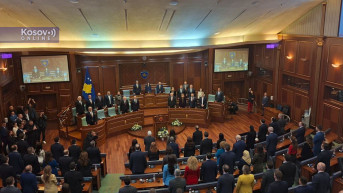
Kosovo’s new political reality is something that PDK and LDK will have to adapt to, while recent developments have further weakened both parties, Kosovo Online’s interlocutors agree.
Written by: Veljko Nestorovic
Instead of heading to elections at the last minute, the political parties reached an agreement on amendments to the Law on the Specialist Chambers and the election of a new President of Kosovo. However, after Justina Shiroka Pulja recently returned the law to the Assembly for reconsideration, the question arises as to whether PDK ultimately came away empty-handed.
Following Bedri Hamza’s departure, Vlora Citaku has been mentioned as a possible successor at the helm of PDK. However, supporters of the party continue to hope that an appeal before the Specialist Chambers in The Hague will overturn the judgment against Hashim Thaci and that he will return to take over the party once again.
As for Lumir Abdixhiku, following the latest parliamentary elections, it is difficult to expect him to remain at the helm of LDK. Even Vjosa Osmani’s return to the party did not help, while Pristina Mayor Perparim Rama has been mentioned as one of the most serious candidates to succeed him.
Analyst Melazim Koci is convinced that Bedri Hamza’s resignation as PDK leader and calls for changes at the top of LDK signal further divisions within the opposition.
Koci told Kosovo Online that the opposition in Kosovo was already weak and that the announced changes could further undermine its position.
“The problem with Kosovo’s opposition lies in its inability to unite at key moments when confronting the ruling Self-Determination Movement. Kosovo’s political scene needs new political forces—that is, parties capable of bringing together the younger generation, which, in my opinion, is not adequately represented,” Koci said.
He added that Kosovo’s current opposition offered little indication that it would be capable of successfully challenging the dominant Self-Determination Movement even after leadership changes.
“Accordingly, I expect that any new parties that emerge in the coming period could represent forces capable of successfully challenging the Self-Determination Movement,” Koci said.
Political analyst Ognjen Gogic told Kosovo Online that PDK and LDK must adapt to Kosovo’s new political reality, as Kosovo Prime Minister Albin Kurti has consolidated his hold on power. With neither parliamentary nor local elections currently on the horizon, Gogic sees this as an opportunity for the two parties to redefine their roles.
Regarding PDK, Gogic said it had been clear that something was happening because Kosovo President Justina Shiroka Pulja did not immediately sign the amendments to the Law on the Specialist Chambers. Against that backdrop, he considers the timing significant, as Bedri Hamza resigned one day before she returned the law to the Assembly.
“In a way, this represents a political defeat for him because he was the one who strongly advocated the adoption of that law. It was his political project, and he was the political sponsor of those amendments. When it became clear that PDK had to back down and reconsider its position, he did not want to be the first to bear the consequences; in other words, he assumed part of the political responsibility for that outcome,” Gogic said.
According to him, there is another factor in Hamza’s case, as he never intended to remain at the helm of PDK for an extended period.
“From the outset, he positioned himself as a leader who would bridge a certain period until Hashim Thaci’s anticipated return from The Hague. He took over the party while the proceedings in The Hague were still underway, expecting that Thaci would return at some point and that he would then be able to step aside,” Gogic said.
Gogic therefore believes that PDK must completely redefine its policies, but that there are currently no visible forces within the party willing to assume that responsibility.
“For that reason, the leadership position could prove to be more of an unwanted role than a position over which there will be a major contest,” he said.
Regarding the Democratic League of Kosovo (LDK), Gogic believes that both LDK and PDK must adjust to the new political reality.
“Kurti has consolidated his hold on power and, unless circumstances change, should remain prime minister for the next four years. Neither parliamentary nor local elections are currently on the horizon.
“These parties therefore do not need to rush, as there is no indication of new elections that would require them to reorganize urgently. Both PDK and LDK spent a long time calculating during the year-and-a-half period in which Kosovo went through successive election cycles. That period was marked by waiting for the outcome of the proceedings in The Hague. It seemed that everyone wanted to put political processes on hold, buy time and postpone decisions until it became clearer how the proceedings in The Hague would end. Now that it is clear that Thaci will not return to Kosovo in the foreseeable future, both parties face the task of redefining their roles. This applies to both PDK and LDK,” Gogic concluded.
He also recalled that Abdixhiku had survived two attempts to remove him this year and that the party is, in fact, due to hold new internal elections next year.



0 comments