
News from the past
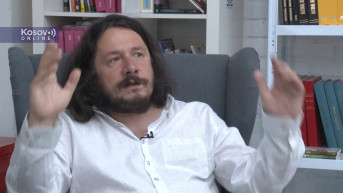
Writing for Kosovo Online: Muharem Bazdulj, writer and journalist
You must have noticed that for years the beginning of each new day in the Serbian public has been devoted to the so-called leafing through the newspapers. Every television has a morning program, and in every morning program “leafing through" is the key content. As newspaper circulations began to decline, the importance of "leafing through" for television schemes grew. As a good friend of mine says, soon no one will really read newspapers anymore and only a few copies will be printed in order to have something to leaf through on television.
I have an idea that I really like, so I would like to patent it here, as they say. My idea is that the morning program should not read newspapers printed that morning, but newspapers printed twenty, thirty, forty, or fifty years ago. It would be more interesting, and more would be learned about today's time.
Here, let's say, this morning (via the Internet, of course) I was browsing "Slobodna Dalmacija" from April 20, 1983, and on the third page I found a short news item with the supertitle "In the great hall of the Split Gripe" and the title "Bjelo Dugme is visiting", and the text reads as follows, "As part of the promotional tour of their latest album 'Lullaby for Radmila M.', the popular group Bijelo Dugme will perform on April 22 at Gripe. (...) The organizer of the concert is the agency 'Dalmacija-koncert', and it starts at 8 pm".
Four full decades have passed since the release of the Bijelo Dugme album "Lullaby for Radmila M.". Today we know that it is the last album of Bijelo Dugmet on which Zeljko Bebek sang. Today we know what the song "Forget if you can" means in the overall oeuvre of Bijelo Dugme. Today we know that "Kosovska" was and remains the only mainstream Yugoslav pop-rock song in the Albanian language.
By the way, the topic of Kosovo appeared in various ways in the musical popular culture of Yugoslavia in the eighties of the twentieth century. Among the songs with such inspiration are often mentioned Bajaga's "Rimljani", two songs of the Zabranjeno Pusenje group: "Cejeni odlaze" and "Na strazi prod Prizren", as well as Balasevc's "Ne lomite mi bagrenje".
All of them, however, from the Albanian perspective, had one fatal flaw, in all of them the Albanians were the object, not the subject. Bregovic's "Kosovska" was different: in it, Albanians got their own language and voice. In it, equality was symbolically recognized for Albanians.
I don't know how the Albanian accent sounds from an Albanian perspective, but the meaning is understandable:
Tonight, please be ready
I will come to you late
Open the closet and choose the best dress
Do your hair, beauty
As you know
Put a peony flower on the lock of your hair
I would like you to be the brightest of all
Do you know that everyone will be there together?
It will be fun for both of us
Let's go together, one, two, three
Then comes the chorus, and in the chorus are those "mandolins", which are the only word that is equally understood by the Albanians and Serbs. They actually understand "rock and roll" too, but that's because of English.
Thirty-eight years after he wrote the song in the Albanian language, Bregovic performed at a music festival in the town of Korce in Albania. The performance was not without controversy. At that moment there was neither Yugoslavia nor the Bjelo Dugme group for years and decades, but Bregovic was undesirable for individuals.
The argument of the opponents was the song "Kalashnikov" from 1995 because it was supposedly the "anthem" of the expulsion of Albanians from Kosovo in 1999. It was forgotten that back in 2006, Bregovic received the award "Honorary Citizen of the City of Tirana", and that it was presented to him personally by the then mayor – Edi Rama.
Seemingly paradoxical, it turned out that most of the attacks on Bregovic came from Kosovo, and not from Albania itself. People who had experienced Bregovic's attempt to "incorporate" the Albanian language into the popular culture of the Yugoslav mainstream accused him of chauvinism?!
In recent weeks and months, newspapers have been writing daily on Kosovo topics, that is, on Serbian-Albanian relations. It sounds counterintuitive, but there is absolutely nothing new to learn from those articles. In order to learn something new, one should actually carefully read old newspapers. Because, as William Faulkner said somewhere, the past was not only not dead, but not even gone.
The current situation in Kosovo is the result of complex relationships from a whole series of past historical epochs. In some of those eras, there were not even newspapers in today's sense of the word. Perhaps in those eras, songs played the role of newspapers. Perhaps the function of the song is something that connects the Serbs and Albanians metaphysically and metanarratively. And that's why Bregovc's poem in Albanian is a more important and precious artifact and historical document.



0 comments