
Parlic: As long as the holy places survive, so does the Serbian identity
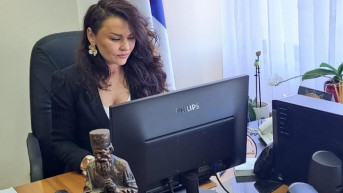
Faith had always been the lifeline of the Serbs and the primordial to which they had always returned. Proof of this was the Serbian sanctities in Kosovo and Metohija, of which there were more than 1,300. It was of great importance to strengthen national consciousness and spiritual unity, Milena Parlic said, assistant director of the Office for Kosovo and Metohija in the Sector for cooperation with the Serbian Orthodox Church and care for cultural heritage.
In her interview with Jedinstvo, Parlic pointed out that the multiple destructions of Serbian cultural and historical wealth had been happening for years, and that by restoring the sanctuaries, the parishes in the ethnically cleansed cities were also being restored, which was one of the most important goals of the Office for Kosovo and Metohija and the Eparchy of Raska and Prizren, which had proved to be the most effective.
What is the importance of the Serbian Orthodox Church, i.e. Eparchy of Raska and Prizren, its sanctuaries in Kosovo and Metohija and what do they mean to the Serbs in these difficult times full of fear and uncertainty?
The church has always offered shelter to unhappy, betrayed, sick people, and their faith in God was a way for them to overcome the most difficult adversities in life. The people need peace, and where else will they find it than in a sanctuary, a synonym for unsullied and safe. Equality before God and the same suffering is what firmly unites the Serbs as brothers and sisters who are inextricably bound by a difficult past and an uncertain future.
What means do you use to fight against the destruction of Serbian cultural and spiritual treasures in Kosovo and Metohija, and which have proven to be the most effective in the fight to preserve identity?
In the years that are behind us, during the period of conflict in the territory of Kosovo, we have witnessed the multiple destructions of Serbian cultural and historical treasures. We need to mention that after the war conflicts in Kosovo and Metohija, 150 Orthodox sanctities were burned, 35 in just two days during the March Pogrom. We restored 90 percent of the destroyed sanctities during the Pogrom. In addition to the state, the Eparchy of Raska and Prizren and our Bishop Teodosije pay great attention to the restoration. By restoring the sanctuaries, the parishes in the ethnically cleansed cities are also restored, and this is one of the most important goals of the Office and our Eparchy (a living church), which has proven to be the most effective.
In addition to the necessary material resources provided by the Government of Serbia and the competent government institutions for the reconstruction and restoration of the Serbian national treasure in Kosovo and Metohija, I would single out the renovated seminary in Prizren, the church of St. George, the lodgings of the monastery of the Holy Archangels in Prizren, the soup kitchens that the Office continuously helps, the newly formed economy in Badovci near Gracanica, thanks to which we employ almost 50 young people... Also, strengthening national consciousness and spiritual unity is of great importance. Therefore, in addition to the policy of survival and preservation, with our daily actions on the ground, we do everything to create a sense of belonging to the community of the Serbs in Kosovo, as well as the sympathy of the citizens of Serbia with the Serbs in Kosovo and Metohija, because this is what strengthens unity and the desire to preserve tradition and all that that it represents an inseparable part of our identity. One of the means to preserve identity is the celebration of important Orthodox holidays such as Vidovdan, or dates of suffering from recent Serbian history such as the March Pogrom, the mass suffering of our people.
In what kind of relationship is the persecution, disenfranchisement, and slavery of the Serbs in Kosovo with the centuries-old construction and survival of monasteries, churches, and other holy places in the southern Serbian province?
Despite the complicated position of the Serbs throughout history, the fact that their position is difficult and their rights invisible, no matter how much they were persecuted, oppressed, and expelled, what could never be destroyed and conquered is the Serbian spirit. Faith has always been the lifeline of the Serbs and the primordial to which they have always returned. Proof of this is the Serbian sanctities in Kosovo and Metohija, of which there are more than 1,300. I believe that this is in some way part of Serbian stubbornness - "you cannot destroy as much as we can rebuild". Regardless of everything, Serbian holy places outlive history and their place is exactly where they were created. Serbia, the Serbian Orthodox Church, and the citizens, just like every remaining Serb in Kosovo, are doing everything to preserve what is sacred, because as long as the holy things survive, so does our identity.
Where is the position of the Office for Kosovo and Metohija in the fight for the survival of the Serbs and the centuries-old holy places in Kosovo and to what extent do you manage to resist the attacks?
The position of the Office has always been where it is today, on the ground with our people, for better or for worse. The issue of Kosovo and Metohija is of primary importance for the country, and the Office as part of the Government of Serbia has never and will never falter in the fight for the survival of the Serbs and holy places. Despite daily pressures, violations of basic human rights, harassment, arrests, usurpation, and daily pretensions to bring centuries-old cultural heritage under the so-called "Kosovo", we manage to resist. By presence, care, construction, renovation... And the best confirmation of all of the above is the Prizren Theological Seminary, and generations of young theologians not only from the area of Kosovo and Metohija but from all over Serbia. Of course, the fight for preservation still lies ahead, but thanks to the policy of the Government of Serbia, with truth and justice, love, and hope, I believe that we will succeed.
Could the reactions of members of the international forces in Kosovo to the attacks on Serbian churches and monasteries have been more effective, and do you manage to convince them of the cruelty that is perpetrated against the Serbs?
The question that should be addressed to them and to which I cannot answer from my position is why they did not get involved enough in that regard. Why did the German contingent of KFOR withdraw and leave Prizren in flames on March 17, 2004. And not only Prizren but also Devic, the church of St. Nicholas in Pristina, the Virgin of Ljevis, and all other holy places. A shining example is certainly the Italian members of KFOR, who did not retreat in those days but stayed and preserved the people of Decani and the Patriarchate.
The point of certain missions was not to prevent, but to silently observe and evacuate. Those who remained in their homes were, unfortunately, killed. And as for assurances, I deeply believe that they themselves know how much injustice has been inflicted on our people.
It is less known that Albanians train specialists in the field of cultural identity. What is the Serbian side doing and how is it managing to preserve its cultural and spiritual identity, which is continuously exposed to attacks, desecration, and seizing?
Since my roots are in Kosovo and Metohija, I can understand why they do it. In the absence of a true cultural and religious identity, Albanians are forced to create it artificially. The oldest mosques are Turkish (for example, Prizren, Pristina) and as such belong to the Turkish national identity. Albanian mosques were built only after the Second World War. In the preservation of cultural and spiritual identity, the Office, in cooperation with other state institutions of the Government of Serbia and the Serbian Orthodox Church, makes maximum efforts to preserve our religious and cultural heritage. Certainly, all of us who are employed in those same institutions do our best with our personal examples to truthfully show our Serbian identity that they are trying to take over and appropriate.
Do you believe in the equal survival of the cultural identities of the Serbs and Albanians in Kosovo and Metohija in such difficult circumstances for the Serbs?
Just as the Serbian identity survives unequally in the sphere of political and social life in Kosovo and Metohija, I believe that the cultural identity will and must survive in Kosovo and Metohija to any extent, despite the danger of collapse to which it is continuously exposed, bearing in mind that all the opulence is scattered in Kosovo and Metohija - our past that we must protect.
Given that you come from Kosovo and are almost constantly in the southern Serbian province, tell us why, in your opinion, the old Serbs chose the territory of Kosovo as the best place to live and stay?
The movement of people and their settlement was caused by necessity. The territory of Kosovo and Metohija met the needs of plains, rivers, mountains, and climate. While there were movements in Europe, we inhabited empty areas. The values that truly bound the population to the territory were their lives, the houses they built, and the churches and monasteries they built. The sanctuaries they built determined the identity of the nation they belong to, and through them, we derive the reasons for our existence.
Serbian history is woven into Kosovo and Metohija, Serbian rulers made churches and monasteries a tradition that we are not renouncing. Almost 170 years before the discovery of America, the Serbian rulers left behind the Gracanica monastery, and it is superfluous to talk about other sanctuaries that were built long before it.
Do young people, within the educational system of Serbia, have the possibility of knowing and fully believing in their own cultural and spiritual national identity?
They have, but I don't think it's enough if they can't visit Kosovo and Metohija, feel, and be convinced of everything they learn through our educational system. I believe that an additional effort should be made to educate the new generations more on this issue, because the Serbian national identity is indisputable and should be strengthened as such, and this is exactly what the Office for Kosovo and Metohija is working on with other line ministries of the Government of Serbia.


comments