
Abolishing Serbian institutions in Kosovo: Is the EU “turning a blind eye” or simply powerless against Kurti’s actions?
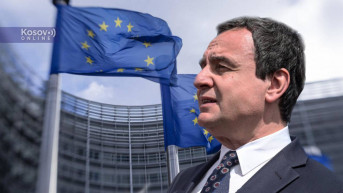
Never before have there been more press releases and yet less concern in Pristina over strong reactions from the international community to the shutdown of Serbian institutions. For most interlocutors of Kosovo Online, this signals that the EU lacks an effective mechanism — “a stick or a carrot” — to halt unilateral moves and bring events back to the negotiating table in Brussels. They warn that, under such circumstances, the outgoing Kosovo administration will continue with these actions regardless of the institutional crisis in Kosovo.
Written by: Djordje Barovic
“The closure of institutions undermines efforts at de-escalation,” said EU High Representative for Foreign Affairs and Security Policy Kaja Kallas during her visit to Pristina.
She noted that the EU is gradually lifting measures against Kosovo, but full removal depends on de-escalation in the north.
Earlier, an EU spokesperson also called on the Kosovo government to avoid “escalatory measures.” He was clearly referring to the recent series of raids and shutdowns of Serbian institutions, culminating in the police entering the public utility company “Vodovod Ibar.”
“We call on the outgoing Prime Minister Kurti and the authorities in Kosovo to stop these closures, show restraint, and avoid further escalation,” the EU spokesperson stated.
In the following days, Kosovo police shut down the National Employment Service, the Sports and Youth Institution, the Sports Hall, the Red Cross of Kosovo and Metohija, the City Museum, and the Library in North Mitrovica.
In a series of statements from embassies in Pristina following these actions, the German embassy told Kosovo Online that “such police operations risk deepening local tensions and undermine efforts to build trust with the affected population.”
A week later came a cold shower.
German Ambassador Jörn Rohde said on the Rubikon program on Klan Kosova TV that “para-state structures must disappear.”
“It’s now officially clear who supports Kurti in shutting down Serbian institutions, banning the dinar, and denying rights to Serbs in Kosovo and Metohija! A brutal violation of international law and UN Resolution 1244!” said Petar Petkovic, Director of the Serbian Government’s Office for Kosovo and Metohija, reacting to the German diplomat’s statement.
Carrot and Stick
Historian Stefan Radojkovic told Kosovo Online that the core of the problem lies in the lack of a “carrot and stick.”
The European Union lacks a mechanism to pressure Pristina — either by punishment or reward — to stop unilateral moves. He also stressed that the wave of shutdowns of Serbian institutions in Kosovo should be seen as an attempt by Self-Determination leader and acting Prime Minister Albin Kurti to gain favor with the domestic public.
“He assesses that, domestically, it’s more important to show consistency in his beliefs and to retain his shrinking voter base. There's a downward trend, though not enough yet to make him irrelevant or marginal among Kosovo Albanians,” Radojkovic said.
He emphasized that the EU has shown it has no effective mechanism to stop unilateral actions.
“That’s why embassy pressure has increased. It’s no longer the EU applying or enforcing sanctions against the Pristina administration, but bilateral conversations between embassies and Pristina officials. The subtle message is that the EU lacks the capacity to push Kurti to behave better — it has neither a ‘carrot’ nor a ‘stick’,” Radojkovic explained.
He noted that Pristina is blocked from joining the Council of Europe and might face other consequences for unilateral moves, but that’s the full extent of the EU’s influence.
“Kurti’s administration has essentially concluded that it’s more important to retain political positioning, presenting himself as incorruptible and devoted to the Albanian cause — some would say to a Greater Albania. And ultimately, it is the Serbian community in Kosovo and Metohija that suffers the most. The Brussels Agreement is effectively dead — something Kurti even promised,” he said.
He added that this policy directly results in non-implementation of the Brussels Agreement by Pristina.
A possible sanction would be blocking EU accession talks, but Radojkovic underlined that the EU also faces a “carrot deficit” because it has already signaled that any future enlargement will be limited to Montenegro or Albania.
“Both Belgrade and Pristina are aware that failure to implement the Brussels Agreement carries no real consequences since no enlargement is planned. There might be some effects on donations, investments, and Council of Europe membership, but essentially Kurti’s administration is using this period to strip all meaning from the future Association of Serb-majority Municipalities by ensuring there may no longer be any Serbs in Kosovo and Metohija,” he added.
He believes Kurti will try to remain a “relevant factor.”
“His thinking is short-term: to delay forming the assembly and show resolve to his electorate. This mirrors the current political crisis in the Pristina administration,” Radojkovic stated.
Kurti’s key concern now is whether he can win the support of Vjosa Osmani or if Kosovo will face a transitional government leading to local elections in the fall and the election of a new president early next year.
“This is why he can’t afford to back down. He must show determination both to the outside world and by being extreme toward Serbs. These two issues appear linked when it comes to Pristina’s international integration,” Radojkovic explained.
Dialogue Crisis
Behlul Kamberi, a researcher at the Musine Kokalari Institute, sees the core issue as a breakdown in EU-mediated dialogue.
He has no doubt that Albin Kurti will continue dismantling Serbian institutions in northern Kosovo despite EU criticism.
“We’re not in a new situation. Kurti continues enforcing authority by shutting down what are called ‘parallel institutions of the Republic of Serbia’ in northern Kosovo. He’s doing it alone, through Kosovo’s institutions, while the international community insists it be handled through Serbia-Kosovo dialogue in Brussels. But nothing changes,” Kamberi said.
He stressed this situation proves the dialogue process is in crisis.
“The goal was for Serbian integration and the dismantling of Serbian institutions in the north to be achieved through Brussels dialogue. That held until two years ago. But with the dialogue’s collapse, institutions are now being shut down in the name of the rule of law. This shows a serious crisis,” Kamberi said.
It’s also evidence of EU inefficiency and unimplemented Brussels and Ohrid agreements.
“Until there’s progress on implementation, we’ll continue to see Kosovo’s government trying to integrate the north by force of law, while more northern Serbs disengage from institutions. And Western diplomats will keep issuing statements calling for dialogue — but the situation on the ground won’t change,” he warned.
He concluded this is an “institutional vacuum” and EU ineffectiveness on the ground, which is why the Pristina administration will keep shutting down Serbian institutions.
“This will continue until the Kosovo-Serbia dialogue becomes effective again and agreements start being implemented,” Kamberi stated.
Unpredictability and Consequences
Zoran Savic from NGO Aktiv believes that Pristina’s recent unilateral actions prove that EU sanctions against Kosovo are ineffective and that Albin Kurti will continue taking unpredictable steps that harm the Serbian community.
“Clearly, EU measures aren’t producing results. The outgoing government continues closing Serbian institutions without any backup, and the people suffer. They’ll now have to seek all these services in central Serbia,” Savic said.
He added that whether the new EU administration will bring change remains speculative.
“All we can do now is wait and see whether the new EU leadership — with Kaja Kallas and Sorensen as facilitators — will bring progress and restore dialogue. That’s all we have left to hope for,” Savic said.
He warned that during his last term, Albin Kurti proved “unpredictable,” and the lack of a firm international response means the Serbian community in Kosovo should expect more instability.
“As we’ve seen in the past four to five years, Kurti is truly unpredictable. Last week alone, three or four institutions were shut down in one day. Since there’s been no strong response from the EU or embassies in Pristina, we can really expect anything,” Savic concluded.

0 comments