
How will Kallas shape the Dialogue – What was signaled during her visit to Belgrade and Pristina?
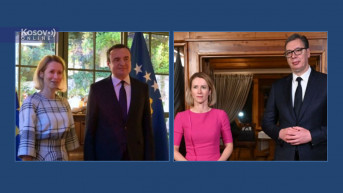
A long list of meetings, vague messages, and no breakthroughs – the Ohrid Agreement remains in force, and both sides are expected to implement it. How negotiations will proceed remains unclear. This is the summary of EU High Representative for Foreign Affairs and Security Policy Kaja Kallas’s visit to Belgrade and Pristina, as seen by Kosovo Online’s interlocutors regarding the Brussels Dialogue.
Written by: Dusica Radeka Djordjevic
“We must sit with both sides separately and see how to move forward,” Kallas said yesterday in Pristina. She indicated her willingness to invest her time and energy into the normalization process.
What works in that process and what doesn’t, she said, is something she cannot yet judge, but she was clear on one issue: the closure of institutions in northern Kosovo supported by Serbia “undermines efforts toward de-escalation.”
“It’s important to witness what’s happening on the ground and hear what people are saying,” Kallas stated, which is why she visited North Mitrovica, where she toured a local court and schools. She believes that the return of Serbian judges is a key challenge for the judiciary in that part of Kosovo, and stressed that the presence of international actors on the ground is vital for an accurate understanding of the situation—since “one side says one thing, the other side says another.”
Kallas announced that she will soon invite representatives from Belgrade and Pristina to Brussels. Former ambassador and member of the Forum for International Relations, Branka Latinovic, told Kosovo Online that the most important message from Kallas was that continuing the dialogue is her personal priority and that she is committed to it.
“The visit itself was short, considering the number of meetings she had. There was no room for elaboration—it seemed like a personal and team-level fact-finding visit, to form proposals which will likely be revealed when real dialogue resumes,” Latinovic explained.
Still, she emphasized that Kallas sent a strong message in Pristina to current and future authorities: de-escalation is essential, and the current conduct cannot create the conditions for dialogue.
“The visit to Belgrade and Pristina was a continuation of her April regional tour, and her statements were quite reserved—what we often call 'wrapped in diplomatic packaging'—probably because she held the Belgrade press conference alone and didn’t want to make statements that the other side couldn’t respond to. That likely explains the vague comments in Pristina as well. There, she didn’t have a relevant counterpart, given the institutional deadlock caused by the failure to form the Assembly after repeated votes,” Latinovic added.
Familiar Messaging
Professor of International Relations Afrim Hoti stated that Kallas’s messages in Pristina echoed those of previous EU leaders. She reiterated that it is the responsibility of both Belgrade and Pristina to implement the agreements already reached and then look forward—essentially to pause historical grievances.
“The main message is about continuing the dialogue because there is clearly no alternative to finalizing the talks between the two sides,” Hoti told Kosovo Online.
Referring to Kallas’s statement that de-escalation in northern Kosovo is a condition for lifting EU punitive measures, Hoti pointed out that while everyone talks about de-escalation, some EU countries recognize that the north is currently relatively calm and secure.
“It seems the Kosovo government has taken some steps, but more will be needed in the coming weeks and months. I believe there will be close cooperation between Kosovo’s institutions—once they are formed—and the EU. The process will begin, even if some countries are not entirely enthusiastic about it,” Hoti said.
Low Expectations in Belgrade
After Kallas's rather vague remarks in Belgrade, foreign policy analyst Mirko Dautovic commented that the Balkans and the dialogue are unlikely to be among her top priorities, given that her primary focus will be on Ukraine and Russia, as she is from Estonia.
“She won’t take the same approach as Josep Borrell, who comes from a country that doesn’t recognize Kosovo’s independence. She will likely delegate the dialogue to someone else. When the delegations meet, she might open the sessions as a host, but I doubt she’ll be hands-on in the talks,” Dautovic told Kosovo Online.
He noted that her statement in Belgrade, in which she referred to Serbia’s relationship with its “closest neighbor” and added that normalization with Kosovo is fundamental for Serbia’s EU future, reveals her own view that Kosovo is an independent state, shaped by Estonia’s recognition of its independence.
“I think that just slipped out—it’s unlikely she’d openly say the EU recognizes Kosovo, but she clearly personally believes in that recognition. I don’t think she’ll aggressively push the dialogue in that direction, but the entire framework points to that being the eventual EU expectation from Serbia. I don’t think she meant to provoke—it’s simply her perspective,” said Dautovic.
In Belgrade, Kallas met with Serbian President Aleksandar Vucic, Prime Minister Djuro Macut, Foreign Minister Marko Djuric, Parliament Speaker Ana Brnabic, opposition parties, and youth representatives. In Pristina, she met with acting Prime Minister Albin Kurti, opposition figures including the Serbian List, the KFOR commander, and civil society organizations.
"Old Songs" in Skopje
From Pristina, Kallas traveled to Skopje, where she stated that North Macedonia belongs in the EU, acknowledging that the path to membership is not easy, but praising the country as a reliable partner.
However, former Macedonian ambassador and analyst Risto Nikovski assessed that Kallas subtly conveyed that Macedonia is part of the EU only if it complies with the bloc’s demands.
“I’d say she was singing the same old songs—comparing her to the famous Maria Callas. Kallas told us what [former EU Commissioner] Hahn once did: there will be no EU membership without capitulation, just in a more discreet tone. So, there’s nothing new, and we shouldn’t expect anything new. The ball is in Macedonia’s court, and if we want to get out of this dark tunnel, Macedonia must take radical steps. That means scrapping the Second Protocol with Bulgaria and rejecting the unacceptable negotiation framework, which ensures Macedonia will never join the Union, as well as discarding the demand to change our Constitution,” Nikovski told Kosovo Online.
He added that there were no changes in her message for the rest of the Western Balkans either. “We’re all in the waiting room—and we’ll be there for a long time. Maybe we’ll never leave it,” Nikovski concluded.

0 comments