
Anniversary of the 1999 Military-Technical Agreement: What did the peace from Kumanovo bring?
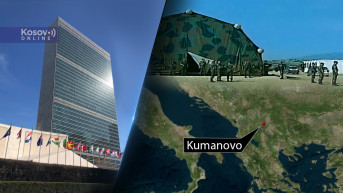
On June 9, 1999, after 78 days of war, the sounds of battle ceased, and the representatives of the then Federal Republic of Yugoslavia and NATO signed the Military-Technical Agreement, committing themselves to a “cessation of hostilities.” Interviewees from both Pristina and Belgrade agree that the greatest value of the Kumanovo Agreement was the end of the war and the killing. Still, 26 years later, they remain deeply divided over who won or lost and what the effects of the achieved peace were.
Written by: Djordje Barovic
The day after the Serbian Parliament adopted the peace plan—an initiative of the US, EU, and Russia for the deployment of international forces in Kosovo under a UN mandate—negotiations to end the war began in North Macedonia.
The agreement was signed on June 9 at the Kumanovo military airbase and was based on ten points from a document previously adopted by Yugoslav President Slobodan Milosevic, Finnish President Martti Ahtisaari, and former Russian Prime Minister Viktor Chernomyrdin. The Kumanovo Agreement detailed specific arrangements for ending hostilities, and the day after it was signed, NATO Secretary-General Javier Solana ordered a halt to NATO’s military operations in Yugoslavia.
The last NATO missiles were fired on June 10 near Kosovska Kamenica and the barracks in Urosevac.
The Kumanovo Agreement was signed on one side by British General and first KFOR Commander Michael Jackson, and on the other by Yugoslav Army General Svetozar Marjanovic and Police General Obrad Stevanovic. None of the signatories are alive today.
General Obrad Stevanovic passed away on April 8 of this year.
He had previously stated for Kosovo Online that General Jackson understood the situation on the ground but was unable to prevent the exodus of non-Albanians that followed the withdrawal of the Yugoslav army and police from Kosovo.
Benefits and Consequences
One of the participants in the negotiations, former Chief of the Yugoslav General Staff General Branko Krga, vividly remembers the talks in Kumanovo in 1999.
In an interview with Kosovo Online, he emphasized that the agreement had both positive and negative aspects, but that its most crucial benefit was ending the war.
“The only good side is that the war was stopped. The agreement halted the fighting, and the killing of innocent civilians, soldiers, and police officers ended. The downside is that the agreement was not fully implemented, and not all provisions were enforced,” Krga said.
He pointed out that the Kumanovo Agreement clearly stated KFOR’s obligation to disarm the KLA and other armed groups and to ensure the return of all displaced persons, particularly Serbs.
“Not only were they not returned, but they were further expelled. That continues to this day,” Krga noted.
He also cited the failure to enable the return of the army and police as agreed in the document.
He revealed that negotiations in Kumanovo lasted five days because NATO initially refused to allow a follow-up UN Security Council resolution on Kosovo.
“They wanted us to accept the agreement without their obligation to adopt a resolution on Kosovo and Metohija. We insisted we wouldn’t accept it without the assurance that a resolution would be passed. Once they agreed, a few remaining technical issues—like the size of the security zones—were resolved quickly,” said Krga.
Asked about Kosovo's current status 26 years later, Krga said it depends on one’s perspective.
“From Serbia’s standpoint, there should be no doubt—Kosovo is an integral part of the Republic of Serbia. Resolution 1244 confirms that clearly. It provides for substantial autonomy and self-governance, and that’s what our diplomacy, politics, and media should insist upon. We have a legal basis to demand that Kosovo be returned to Serbia’s constitutional and legal system. Of course, the reality is somewhat different,” he stressed.
He added that the situation for the Serbian community in Kosovo has become increasingly unbearable.
“We see how the authorities in Pristina treat the Serbian people, especially now in northern Kosovo, where it’s almost unbelievable that they’re being evicted from their homes and civil, humanitarian institutions are being shut down. That violence is not condemned by those responsible—UNMIK, KFOR, EULEX,” Krga emphasized.
Substance and Effects
On the other hand, political analyst and former Kosovar politician Azem Vlasi sees the Military-Technical Agreement from Kumanovo as, “in essence and in effect,” a capitulation for Serbia and a day of liberation for Albanians—the end of “Serbian rule” in Kosovo.
“The Kumanovo Agreement essentially represents the capitulation of the Serbian army to NATO after a 78-day intervention. For Kosovo and Albanians, that is the Day of Liberation,” Vlasi told Kosovo Online.
He added that the end of the war in 1999 also marked the end of a regime in Serbia.
“For Serbia, it was the end of Milosevic’s brutal rule over Kosovo and the Albanians, after great suffering under that regime. It marked the end of Serbian authority in Kosovo and the end of illusions and lies Milosevic used to deceive Kosovo Serbs into thinking things would improve for them while Albanians were suffering under his imposed rule since 1989,” Vlasi said.
According to him, Milosevic’s regime created a deep division between Albanians and Serbs, the consequences of which are still felt by Serbs.
“Kosovo has been free from Serbia for 25 years, and a state for 17 years. It is still undergoing full consolidation, but it is a state. The most important thing is that all citizens should be safe, free, and equal before the law, without discrimination. Kosovo is on its way to becoming a true state by Western democratic standards. And in such a country, life will be better for all of us,” Vlasi concluded.
Pandora’s Box
At the time of the agreement, Yugoslav Foreign Minister—and now President of the Belgrade Forum for a World of Equals—Zivadin Jovanovic said that the Kumanovo Agreement, followed by UN Security Council Resolution 1244 in 1999, “ended the first war on European soil since World War II.”
“These documents ended the first war on European soil since WWII. That war opened Pandora’s box for NATO interventions worldwide. It marked the peak of the Western military alliance’s arrogance, rooted in its post–Cold War victory status,” Jovanovic told Kosovo Online.
He emphasized that the Kumanovo Agreement was part of a “package” of three documents: the agreement reached on June 3 by Milosevic, Ahtisaari, and Chernomyrdin, and UN Security Council Resolution 1244 adopted on June 10.
“They form a whole—a package where no part can be understood in isolation. Together, they guaranteed Yugoslavia’s sovereignty and territorial integrity, while providing Kosovo and Metohija with wide autonomy within the FRY, and later Serbia as its legal successor,” Jovanovic said.
He acknowledged that none of these documents were “easy” for Serbian interests.
“Not all positions were respected, but we must understand the context—when the West was at the peak of its arrogance, and Serbia and Yugoslavia were under sanctions, with no allies. Not even Russia gave us the support we had hoped for,” he explained.
Jovanovic added that the failure to implement key provisions of the Kumanovo Agreement and Resolution 1244 is still visible today, 26 years later.
“We see that even now, ethnic cleansing of Serbs continues, their persecution persists. All of this happens under the shadow of other events, which responsible actors try to push to the margins,” he said.
He sees the root causes in the West’s double standards regarding treaty implementation.
“Our experience is that the West, during negotiations, makes concessions—such as provisions on sovereignty, autonomy, or military return. But in the implementation phase, they apply a selective approach, still assuming they are the most powerful, above reproach, and not bound by any signed document,” Jovanovic concluded.


0 comments