
Anniversary of conflict in Eastern Europe: Is the Kosovo issue awaiting the end of the war in Ukraine?
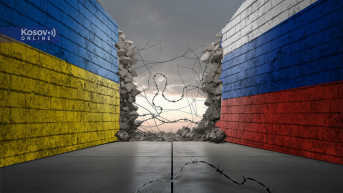
On this day two years ago, the war in Eastern Europe began. Although many experts predicted it would be a "blitzkrieg" operation, the conflict between Russia and Ukraine shows no signs of abating and produces increasing human casualties and global divisions with each passing day. Kosovo Online interlocutors agree that this war has not only changed the European Union but also the world. However, they interpret two key dilemmas differently: how this conflict has affected the dialogue process between Belgrade and Pristina and whether the Kosovo issue will await the "victor," namely the end of the war in Ukraine.
Former EU Envoy for Kosovo Wolfgang Petritsch assesses for Kosovo Online that the escalation of the situation in Kosovo is, in a way, collateral damage caused by the war in Ukraine.
Petritsch says that the conflict between Russia and Ukraine has, not only metaphorically, spread to Europe, i.e. to the rest of the continent.
"I hope it will never spread physically and militarily, but the EU supports Ukraine with billions of euros and weapons, and Germany, which has traditionally stayed out of such war conflicts since 1945, is now engaged in helping and is directly involved in this confrontation," Petritsch said.
He points out that Europe and partly NATO, are directly and indirectly involved in this confrontation, which is not just a conflict between Ukraine and Russia but also involves the United States and Europe on one side, and Russia on the other.
"It would be dangerous if this new constellation were to affect all open issues, including Kosovo," Petritsch warned.
He does not believe that there could be direct intervention by Russia in Kosovo, adding that NATO also has no increased interest in engaging there. Nevertheless, he believes that especially this year and the next, due to the upcoming elections in the EU, the US, and many other countries, special attention must be paid to the security situation.
"Caution is paramount. I fear that there will be no progress in the dialogue between Belgrade and Pristina due to the upcoming elections in the EU and the new composition of the European Commission. Therefore, security issues are now at the forefront. KFOR in Kosovo is already increasing its forces. More attention is paid to prevent events like the one in Banjska from happening again," Petritsch says.
Therefore, it is important to appeal to Pristina and Belgrade to exercise restraint and to ensure that elements that do not wish well for the region do not come to the forefront.
"It is important to realize that Russia is currently not a positive partner in the region. Based solely on the war in Ukraine, its political-diplomatic capabilities are limited. This is a problem we must face. Therefore, in a way, the escalation of the situation in Kosovo is collateral damage from the war in Ukraine," Petritsch emphasized.
In response to the observation that Russia uses Kosovo as a precedent for intervention in Ukraine, while Kosovo Prime Minister Albin Kurti continually accuses Serbia of being an extended arm of Russia in the Western Balkans, Petritsch says that it is necessary to avoid inflammatory rhetoric.
"An appeal is needed to avoid extremism in both words and political rhetoric now. This brings no benefit to either side, primarily not to the people living in Kosovo. The Serb minority in Kosovo lives under very difficult conditions. It is always necessary to care for the most vulnerable. Care must be taken to prevent things from spiraling out of control. Nothing would be more dramatic than to have some kind of second-war front in Kosovo or the Balkans. This must be prevented at all costs," Petritsch emphasized.
He also notes that the war in Ukraine has brought about a new reality in Europe.
"We are faced with a new shocking reality that war has returned to Europe. Thirty years ago, we had this in Yugoslavia, and then it was a huge shock, but overall limited only to the region," Petritsch concluded.
Professor at the Department of History, Faculty of Philosophy in Belgrade, Aleksandar Zivotic, was one of the few experts who, at the beginning of the war in Ukraine on February 24, 2022, stated that it would not be a "blitzkrieg" operation by Russia, but a multi-year war that would simultaneously have very broad and serious implications globally.
He explains that this conclusion was reached by all good observers of the situation.
"I believe that this conflict will last for a long time. It will go through different phases of more or less intense combat actions, but the essential end of this conflict is not foreseeable at this moment. Of course, this forecast seems pessimistic, but the circumstances compel us to reason this way. Each of us would like this war to end right now, but the situation on the ground, the relations among the actors, both direct and indirect, indicate that there is no mood for achieving peace in the foreseeable future," Zivotic concludes.
Commenting on the two years since the start of the war between Russia and Ukraine, an analyst from Pristina, Afrim Hoti assesses that this conflict has produced geopolitical consequences and led to the repositioning of major players.
"We are witnessing major changes, especially in the field of security. On the one hand, there has been a homogenization of Western powers, a 'westernization of the world,' and on the other hand, there is a visible turning of Russia towards other major powers like China," Hoti says.
In such geopolitical circumstances, Hoti believes that both Serbia and Kosovo are fortunate due to their geographical positions as they belong to Europe.
"At the same time, they can wait for Europe to solve the problem on its eastern borders," Hoti concludes.
The President of the Council for Strategic Policies and former Minister of Defense, Dragan Sutanovac, says that the war in Ukraine has not only changed the international community's approach to the dialogue between Belgrade and Pristina but has also produced changes worldwide.
"Western countries were definitely not aware of the dangers that various intelligence agencies were pointing out. The leaders of the Western world, including Zelenskyy, did not expect something like this to happen, even though they had experience, both from Georgia and from Ukraine in 2014. They practically found themselves unprepared, which is perhaps best seen now, considering that for years, both the Bush, Trump, and Obama administrations have been warning NATO and EU member states that they are not allocating enough money to what they have committed, primarily for their security," Sutanovac says.
He is not optimistic that the conflict in Eastern Europe could end soon, and he believes that 2024 will be a year of great challenges for the whole world.
"The elections in the US, the relations between the US and China, the situation in the Middle East, and then the situation in Ukraine. These are all things that will not end quickly," Sutanovac concludes.
However, the interlocutors of Kosovo Online interpret in different ways to what extent this war has facilitated or complicated the negotiations between Belgrade and Pristina, and whether, as many warn, the outcome of the dialogue on Kosovo will be affected by the end of the war in Ukraine.
For Professor Aleksandar Zivotic, the war in Northern Europe has not fundamentally slowed down or changed the decision of the US and the EU to end the dialogue and normalize relations between Belgrade and Pristina, but it has brought that process into a "new phase."
"The attitude of the international community towards the so-called Kosovo issue has not fundamentally changed. These are processes that have been going on for many years, we can freely say decades. However, the moment that influenced the transition of this process into a new phase is the fact that there has been a re-composition of certain structures in Europe, and in that way, the process of negotiations between Belgrade and Pristina has entered a new phase, which primarily implies a kind of acceleration of what has been seen so far. Fundamentally, the Western world has not changed its attitude towards the Kosovo issue, however, what it insisted on before, it now insists on much more strongly, quickly, and forcefully. Essentially, all of this stems from the belief that the war in the East has led to new divisions, the creation of a new Iron Curtain, and everything essentially west of that line of formal demarcation, the West simply considers a space of its exclusive influence," Zivotic emphasizes.
The fact that the war in Ukraine has shifted the attention of the US and the EU towards Eastern Europe, according to Zivotic, by no means implies that the issue of Kosovo has fallen to the bottom of their priority list.
"It can be freely said that it is near the top of those priorities. If we take into account the most severe live conflict in Eastern Europe, the Western Balkans today represent the second zone of possible conflict escalation, and not only of an ethnic nature but also on a much broader scale. Therefore, the issue of Kosovo is quite high on the list of priorities of the Western world, primarily because it considers that conflict potentially dangerous within the zone it regards as the zone of its exclusivity," Zivotic says.
When asked whether Pristina had used the conflict in Ukraine to launch a "counteroffensive" against Serbia, Zivotic emphasizes that Pristina has exploited Europe's desire to shape the Western Balkans in a way that suits the EU.
On the other hand, Pristina wants to take advantage of the changes in Serbia's foreign policy position.
"The fact that Serbia is the only European country that has not imposed sanctions on Russia despite officially condemning the existing conflict, as well as other circumstances related to the events in the East and Serbia's position, are being exploited by Pristina to portray Serbia as a regional threat, as a diminished Russian ally threatening neighbors in the region. In this way, they influence the creation of a desirable image of Serbia in the West," Zivotic emphasizes.
He stresses that the issue of normalizing relations between Belgrade and Pristina is to some extent connected with the end of the war in Ukraine.
"In one part, these are two separate processes, but they are two processes that run in parallel and occasionally have points where they merge into an integral part of one process. During the period when the conflict in Ukraine is heading towards a 'prolonged conflict,' it will be of great importance to the Western world to channel existing conflicts in Kosovo and Metohija in a direction that suits them, primarily achieving what they euphemistically call stability, but essentially pacifying a space according to their standards," Zivotic emphasizes.
On the other hand, Afrim Hoti believes that with the war in Ukraine, the issue of Kosovo and the Balkans has fallen on the EU's list of priorities, and both Belgrade and Pristina are effectively waiting for the end of the war and who will emerge victorious, seeking an opportunity to achieve their goals.
"It seems that political leaders in both countries are waiting for a 'final solution,' or the end of the war in Ukraine, expecting that they will then be able to secure a new position for themselves. If Russia wins this war, then there is no doubt that political leaders in Serbia will use this to avoid complying with international rules, especially when it comes to recognizing Kosovo. On the other hand, if the winner of this war is Ukraine, which would also mean the victory of Western countries, then Serbia will definitely be left with no choice but to recognize and normalize relations with Kosovo," Hoti believes.
This analyst highlights that with the onset of conflict in Eastern Europe in 2022, followed by the Israel-Hamas war in 2023, it was expected that the issue of Kosovo would fall on the EU's list of priorities, meaning that conflicts in Ukraine and the Middle East "overshadowed" the negotiation process between Serbia and Kosovo.
"The Balkan issue is undoubtedly one of the most complex issues for the EU, but it couldn't remain at the top of their political agenda forever. We have seen many other events take precedence, such as the war in Ukraine or the conflict between Hamas and Israel, and perhaps there will be other conflicts in the future," Hoti assesses.
He states that the war in Ukraine has definitely produced consequences for the European Union, and when considering this issue in light of the Kosovo question, the political leadership of Serbia since 2022 has not shown a sincere desire for a serious approach and concrete progress in finding a final solution for the normalization of relations.
"The fact that Serbia has decided to maintain close and good relations with the Russian Federation indicates that it still harbors hope, in my opinion, hopeless hope, that it will somehow retain Kosovo as a sovereign and territorially integrated part of Serbia. From my point of view, it is impossible to turn the process back. Creating states is like giving birth to children. Once it happens, we cannot return the child to the mother's womb. The international community can't change its position regarding the recognition of Kosovo. There will be no change in that decision," Hoti emphasizes.
Dragan Sutanovac sees this issue in a completely different light.
According to him, Pristina has utilized the war in Eastern Europe and the EU and US stance towards Russia to portray Belgrade as a key security risk in the region. He also believes that it would be detrimental for Serbia to rely on Moscow's rhetoric that the Kosovo issue should only be addressed after the end of the war in Ukraine.
"We are now in a situation where we not only need to overcome and make a deal with Pristina, but that deal also needs to satisfy a third party, and that third party currently has no interest in reaching an agreement, and that has also been clearly stated. We have received a message from Moscow that we should wait for them to finish their business in Ukraine and elsewhere, and then some geopolitical situation will change, and then they will start addressing the Western Balkans, which is completely wrong and misguided. Serbia is surrounded by NATO and EU member countries. Our place is in the EU, and Russia's problems with them should not be Serbia's problem," Sutanovac assessed.
He emphasized that it would be best to reach a potential agreement as soon as possible so that Serbia could "move forward with full force."
"Our interest is for negotiations on Kosovo and any agreements to be concluded as soon as possible so that Serbia can move forward with full force in European integration and receive the necessary support that we have had so far," Sutanovac said.
He assessed that Pristina had exploited the war in Ukraine to lobby in the US and EU, portraying the problems in the Western Balkans as bigger than they actually were.
"Pristina has been teaching us for decades how to lobby throughout Western Europe and the US. By that, I mean they spare no effort in doing so. They had a big sponsor in Washington, Senator Menendez, who will probably end up in jail because he is a proven corrupt politician who represented not Kosovo's interests, but personally Kurti's. They also have lobbyists in Europe. That's why there's much more uproar around the issues in the region than there actually is. This is present in the administrations of prime ministers and presidents of European countries and the USA," Sutanovac stated.
He assessed that several factors had favored Pristina and as key factors, he cited that Europe had not been prepared for the war in Ukraine, nor had it been capable of playing a significant role in the Middle East, which was why they had decided to "find their place in the global reshuffling of the cards" through the issue of the Western Balkans.
"Leaders in Europe are trying to find their place in the current global reshuffling of the cards, something that hasn't happened for decades. I think that's why they are more interested in the Western Balkans. There's a narrative where they try to portray Serbia as a country destabilizing the region, so accordingly, it's necessary to pay more attention to Serbia and the region. It's all initiated by the fact that they cannot solve problems either in Ukraine or the Middle East or with the Hutus or Hamas. And all of this leads to the fact that in Europe, a good number of politicians who are incapable of doing something on the global stage are focusing on Serbia," Sutanovac concluded.


comments