
Anniversary of the Gorazdevac crime: Why has there been no justice for 21 years?
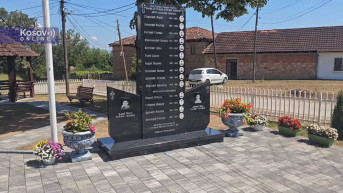
21 years ago, near Gorazdevac, two Serbian children were killed and four were wounded while they were swimming in the Bistrica River. They were shot at with automatic rifles, but the attackers were never found. UNMIK officially closed the investigation in 2010, citing insufficient evidence.
Written by: Arsenije Vuckovic
It was about 40 degrees, and the children from Gorazdevac went to the nearby Bistrica River. They were shot at from the bushes by at least two attackers using 'Kalashnikov' automatic rifles.
Pantelija Dakic (12) and Ivan Jovovic (19) were killed, and Bogdan Bukumiric, who was 14 at the time, Marko Bogicevic (12), Dragana Srbljak (13), and Djordje Ugrenovic (20) were seriously wounded.
'I will turn over every piece of land to find the children’s killers,' said UNMIK Police Commissioner Stefan Feller two days later.
Two weeks later, UNMIK Chief Harri Holkeri repeated the same sentence.
'I can assure you that not a single stone will be left unturned until those responsible are brought to justice,' he said during a visit to North Mitrovica.
Seven years later, UNMIK officially closed the investigation due to a lack of evidence.
In 2018, EULEX, handing over its responsibilities to the judicial authorities of Kosovo, also handed over 495 police case files on organized crime, 434 case files on war crimes, case files on missing persons, as well as case files that only EULEX worked on, and more than 1,400 prosecutorial case files.
Images from Bistrica
In one of those folders is the unresolved crime in Gorazdevac, and among those papers is the name of Dragana Srbljak—one of the four children who were wounded and survived.
Today, she is 34 years old and a graduate psychologist. She is someone who has been trained to help people who have gone through such traumas.
She admits that she still relives that summer day on the Bistrica River.
"On that fateful August 13, 2003, a monstrous crime occurred on the Bistrica River, where two unknown attackers shot at children while they were swimming in the river. Unfortunately, my godbrother, Pantelija Dakic, who was 12 years old at the time, and my first neighbor, Ivan Jovovic, who was 19 years old, lost their lives. The four of us were injured," Srbljak told Kosovo Online.
She arrived at the river just a few minutes before the massacre occurred.
"I ran toward the river as if someone was calling me. The moment I arrived, literally within three minutes, the shooting happened. The sound was so loud that I was stunned and frozen in place. I didn't notice that the children were scattering and running past me. My sister, who was heading home, wanted to come back to help me, but her now-husband was the one who gave me first aid and carried me to the first vehicle that came by," she recalls the moment when one of the bullets hit her leg.
She received first aid at the local clinic, and then her father, seeing that she was bleeding heavily, decided to take her to a hospital operated by the Italian KFOR contingent.
"But that day, the military was changing shifts, so they blocked our way and redirected us to an Albanian hospital. The terror continued there. Unfortunately, they put a cast on my open wound. My leg was bleeding everywhere, but they gave me a discharge paper, allowing me to go home. My mother is a medical worker, and when she saw all that, she immediately took responsibility and said she was taking us, both me and Djordje Ugrenovic, out of the hospital. She drove us to Kosovska Mitrovica," Srbljak says.
She adds that during the journey, both she and Ugrenovic lost a lot of blood, and the doctors at the North Mitrovica Clinical Center said that they were only ten minutes away from death.
"My surgery lasted two and a half hours. I stayed in the hospital for about ten days. That's where the wound was treated," Srbljak recalls.
A direct consequence of the injury is an 80 percent impairment of her ankle joint.
The other consequence is the invisible wound—the one on her soul that time does not heal. She relived August 13 once more through the wounding of Stefan Stojanovic from Gotovusa in the municipality of Strpce on Christmas Eve last year.
"What is most difficult for me, or rather, what was difficult for me during my maturation, was when I realized what had actually happened to my friends and all of us who were injured that day. The moment when I, from an adult perspective, looked at the same event, was last year on Christmas Eve when Stefan Stojanovic, who was the same age as I was then, was shot. That event shook me terribly. I saw him as me on that day. All his crying and sorrow, I went through it with him that day, and to some extent, I shed light on my trauma and the stress that happened on the Bistrica River," this young woman admits.
She doubts that those responsible for the crime in Gorazdevac will ever be held accountable.
She also says that she constantly asks herself why crimes against Serbs in Kosovo are not treated as any crime should be treated.
"It has somehow become a rule that the perpetrators of these crimes are not found. The mere fact that my parents live there and all those people who continue to endure there despite knowing that the killers walk in the same place as they do, adds to my stress and sorrow," Srbljak says.
She also wonders where the representatives of international missions in Gorazdevac were on that day—those who were responsible for their safety.
"The then-head of UNMIK stated that he would turn over every stone to find the killers, but in 2010, the investigation was halted. We received letters from EULEX stating that they had not found any evidence. At the time of the incident on the Bistrica River, international missions were present. They were responsible for our safety, for protecting human life in Kosovo and Metohija, and they knew we were not safe at that river. I wonder where they were that day, why no one protected us," Srbljak says.
Leaving to Pursue Life
Djordje Ugrenovic, the oldest victim of the crime on the Bistrica River in 2003, tells Kosovo Online that the images of horror from that August 13 remain with all the survivors to this day, and none of them have any hope that the killers will be discovered.
"It has stayed with us to this day. That feeling and that image. It simply cannot be forgotten. I was 20 years old at the time. Now, 21 years have passed, and to this day, the killers of that heinous crime have not been found. The case is closed. We no longer hope that those criminals will be found. We rely only on God," says Ugrenovic.
He says that the event "turned everything upside down in Gorazdevac."
"From that moment, everything changed in Gorazdevac. A lot of young people began to leave. Until then, we had quite a few young people, maybe even 500 youths up to the age of 30. A large number left, and now there may be only about a hundred young people left here. No more. Many left for work, got married, bought houses... Everyone went on with their lives," says Ugrenovic, who does not plan to leave Gorazdevac.
He got married there and has four children.
"I am very attached to this place, and I really wouldn't want to leave Gorazdevac," he emphasizes.
He remembers almost every detail from 21 years ago.
"On that fateful day in 2003, August 13, it happened. I don't even know how to describe it, a heinous crime that seems as if it wasn't done by a human, but by some inhuman being. They dared to shoot at defenseless children, at small children, without weapons, without anything..." Ugrenovic recalls.
He explains that the young people from Gorazdevac, which at that time was an enclave from which they rarely ventured out, would go to the Bistrica River every day to cool off from the summer heat.
On that day, there were about a hundred children at the river. Then, around 1:30 PM, gunfire was heard, bursts of shots...
"No one could have expected something like that to happen. Suddenly, shots were heard from a nearby bush. Bursts of fire. They fired three bursts at us. I fell right there. My friend Ivan (Jovovic) was right next to me, and he also fell. Unfortunately, he couldn't survive; it was a fatal hit for him. On the other side of the Bistrica... little Panto (Pantelija Dakic), Bogdan (Bukumiric)... At that moment, we didn't know what was happening. Simply put, a lot of fear entered us," Ugrenovic recalls.
Today, 21 years later, there is no doubt about who is most responsible.
"To a large extent, the international community, no one else, because they were responsible for our safety at that time. They are currently the biggest culprits regarding that crime, of course, after those who fired at the children," he emphasizes.
Since last year, a small soccer tournament called "Remembering Ivan and Panta" has been held in Gorazdevac in memory of the two young men who were killed.
Ugrenovic says that the main message of the tournament is to ensure that the victims from Bistrica are not forgotten.
"The main message is that our victims are not forgotten, innocent victims who were killed by terrorists. We will do our best to keep this going as long as we are here; we will support this tournament. At the same time, I would like to invite everyone who wants to come in the future to pay tribute to our victims, Ivan and Panta," Ugrenovic says.
System and Consequences
A similar question is raised by political analyst Nexhmedin Spahiu.
In an interview with Kosovo Online, he emphasizes that solving the crime in Gorazdevac is in Kosovo's interest.
"The responsibility for the investigation, of course, lies with the prosecution, the judiciary, and the UNMIK police at the time when the crime occurred. Nevertheless, this heinous crime should be resolved as soon as possible because it is in the interest of the citizens of Kosovo," Spahiu says.
He believes that despite UNMIK halting the investigation in 2010, it is not too late to conduct it today, and that this should be the responsibility of Kosovo's judicial authorities.
"Why this case hasn't been resolved is due to negligence or the irresponsibility of the judicial authorities. Not only back then, but even now. Because if UNMIK services didn't do their job at that time, the Kosovo judicial authorities could have done it. But it seems that the system doesn't function, as is the case with many other issues of equal or perhaps even greater importance," Spahiu emphasized.
Justice and Godot
However, Dusko Celic, an assistant professor at the Faculty of Law at the University of North Mitrovica, does not expect that the Pristina judiciary could initiate a new investigation into the murder of Serbian children in Gorazdevac in 2003.
In an interview with Kosovo Online, he says that this case, like many others, will remain unresolved.
"Under the current circumstances, I am sorry to say this as a lawyer, but I truly do not expect earthly justice when it comes to crimes against Serbs. Serbs will continue to wait for justice like someone waiting for Godot, and as we know, Godot never came. So, I fear that generations will pass without seeing earthly justice in this case and in numerous other cases involving Serbs. So, I am not optimistic about this case," Celic believes.
He highlights the lack of respect for the rule of law in all segments of Albanian institutions and the disregard of Resolution 1244 by the international community as the key problem.
"You know, one should always hold on to some grain of hope and faith. That grain of hope and faith is possible if the circumstances in Kosovo and Metohija change, and if the international community once again assumes the executive mandate in accordance with Resolution 1244. For now, this doesn't seem likely, but I think we should continue to insist on it, if only for the sake of justice. And finally, for the sake of the rule of law in Kosovo in general, because, unfortunately, the rule of law does not exist in all segments there, not only in terms of criminal responsibility but simply in all areas of life," Celic assessed.
When asked whether it is likely that the Kosovo judiciary could initiate a new investigation into the events in Gorazdevac, where two Serbian children were killed and four others wounded, this lawyer decisively stated that it is not realistic due to the perception that the judiciary in Pristina should exclusively deal with "war crimes committed by Serbs."
"There is a perception in Albanian Kosovo society that cases involving Albanians will be handled by the Specialized Chambers in The Hague, and that they in Pristina should deal with 'war crimes' committed by Serbs against Albanians, meaning that the local judiciary has a different role, a different mission—to try Serbs. I really do not expect, especially not in cases like these, where unfortunately even the EULEX prosecutor closed the investigation, concluding that there was no evidence. It is simply not realistic to expect that the Albanian prosecutor's office will now find some evidence. The situation in Kosovo's society is not such; it is ethnocentric, built on hatred against Serbs, and in such a social situation, it is not realistic to expect that the Albanian courts and prosecutors in Kosovo and Metohija will do anything in this case or in other similar cases," Celic believes.
He added that the unresolved crime in Gorazdevac was also a defeat for international justice.
"Unfortunately, there is no justice after 21 years. As we know, in 2010, the EULEX investigator, the prosecutor, closed the case with the explanation that there was no evidence. Although we know that Harri Holkeri, who was then the head of UNMIK, promised, and I quote, that they would 'turn over every stone in Kosovo and Metohija' to find the criminal. I don't know how many stones could have been turned over by now, yet the criminal has not been found, there is no justice, there is no case, and most likely there will not be," Celic stated.
He added that it is no coincidence that the crime in Gorazdevac is no longer mentioned by the international community involved in Kosovo, nor by the authorities in Pristina.
"I think that, not only regarding this massacre but with any crime against Serbs committed during 1998, especially after June 10, 1999, there will not be any serious proceedings in Kosovo and Metohija," Celic says.


0 comments