
Is the announcement of protecting the new symbols of North Mitrovica an introduction to “tying the hands” of future authorities?
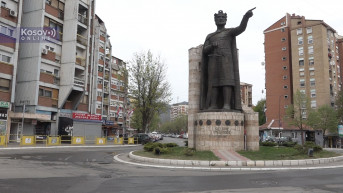
"The symbols of a municipality are adopted and amended by the municipal assembly with a two-thirds majority decision," stipulates the Kosovo Law on Local Self-Government. With this in mind, the announcement that the coat of arms of North Mitrovica, adopted last summer, will be protected from changes by a special decree, sounds unusual. According to experts interviewed by Kosovo Online, this is only the beginning, as they believe the central authorities intend to tie the hands of future governments in the four Serb-majority municipalities in the north, which will elect new administrations in October.
Written by: Dusica Radeka Djordjevic
With the election of North Mitrovica’s first Albanian mayor, Erden Atiq, in the 2023 elections boycotted by Serbs, came the initiative to change the municipality’s coat of arms. A public contest was launched, and a winning design was selected. It was announced that the author of the coat of arms is an Albanian artist from North Mitrovica. The majority-Albanian municipal assembly confirmed it last summer.
The new coat of arms features the Ibar Bridge and the monument on Kukavica Hill, replacing the previous depiction of Saint Demetrius of Thessaloniki.
The contest stipulated that the design must reflect the "historical, cultural, natural, and other characteristics of the Municipality of North Mitrovica."
Whether and when, after the local elections on October 12 – after which it is believed that representatives of the Serb community will return to power in this municipality – the coat of arms would be changed again, no one can say at this point. Still, the current authorities are announcing a special decree to protect it.
According to Nexhat Ugljanin, President of the Municipal Assembly of North Mitrovica, the current city symbol was adopted unanimously and, in his view, cannot be changed "just like that after the next government and assembly are elected."
The decree, which is still only in the announcement phase, says Ugljanin, will protect the city’s coat of arms as well as the symbols of all communities.
"With the decree, we will certainly work on protecting both the city symbol and the institutional symbol, as symbols must be displayed on the building, in the hall of North Mitrovica municipality, and in the Assembly. We want all communities to be included in the public debate and to offer suggestions on how to mark their national holidays," Ugljanin told Kosovo Online.
He added that the public would be informed once work on the decree begins. The legal department will work on preparing it, and he emphasized that all communities should be included in the public debate, given the multiethnic nature of the municipality.
"Everything will be transparent. The majority Serb community in the north, as well as other communities such as Turkish, Bosniak, and others, must be included in the process of expressing public opinion. This decree will serve to protect the right to use the symbols of all communities, as guaranteed by law and the Constitution. The decree will not encourage any criminal offense or desecration of any symbol," Ugljanin said.
However, Luka Jovanovic, assistant professor at the Department of History at the Faculty of Philosophy, believes that the current coat of arms of North Mitrovica does not reflect the wishes of the majority Serb population in the municipality and stresses that no one should impose the symbols of North Mitrovica.
He points out that in the run-up to the local elections, the Albanian-led authorities in North Mitrovica are trying in every way to strengthen and protect decisions that were controversial and opposed by the Serbian community, in order to prevent the new authorities from annulling decisions not supported by the local Serbs.
Jovanovic recalls that the local authorities announced in July 2024 that a new coat of arms had been adopted for North Mitrovica, describing it as nationally neutral and in full compliance with legal norms required by the central authorities in Pristina. He says the local authorities justified themselves to the public by stating that one Serbian proposal had been submitted in the contest and that one Serb was a member of the selection committee, thereby claiming the decision had legitimacy.
"Reactions to such a coat of arms were mixed, especially from the majority Serb community in North Mitrovica, which until then had its own municipal coat of arms that was symbolically very different from the one adopted. The announcement that the new coat of arms will be legally protected from future changes is problematic because the law gives local assemblies the right to determine and change their own symbols at intervals they deem necessary. That is the case not only in Kosovo and Metohija or the Republic of Serbia but around the world," Jovanovic told Kosovo Online.
The coat of arms of Kosovska Mitrovica, recognized by the authorities of the Republic of Serbia and replaced by local authorities last year, Jovanovic explains, features Saint Demetrius, representing the foundation of Mitrovica as a municipality, as it was named after Saint Demetrius of Thessaloniki and was formerly called Dmitrovica.
"That is the core symbol that represented Mitrovica and by which it should have been recognized through its coat of arms. The new coat of arms adopted by the current authorities features two elements of Mitrovica – the Ibar Bridge and the Kukavica Hill monument – suggesting that these are the city’s main symbols: the bridge as a symbol of either connection or division between the north and south, and the Kukavica monument commemorating those who fell in the anti-fascist struggle during World War II," the historian explains.
However, the Ibar Bridge, he stresses, represents different things to different people – a symbol of connection for some, a symbol of division for others, and a symbol of resistance for the Serbian community. The Kukavica Hill monument, meanwhile, sends a message of anti-fascism and resistance to foreign occupation by the people of Mitrovica.
"The coat of arms conveys a strong message of resistance, struggle, and perseverance of the local population, but the problem is that the current local authorities, represented by the mayor and the assembly president, are not enacting policies aimed at easing tensions or fostering coexistence. On the contrary, they are actively working to weaken the Serbian community in Mitrovica and erase their monuments. They are trying to nullify or distort the Serbian cultural heritage and historical memory," he warns.
After the elections, the new local authorities will have to address this issue from a professional standpoint, he believes.
"Assembly members should listen to the voice of their constituents and reflect their wishes in future coats of arms. If, at some point, the members of a future assembly decide that a different symbol should appear on the coat of arms – not the Ibar Bridge or the Kukavica monument – they absolutely have the authority to adopt a new one, based on a majority decision and in line with the relevant regulations," Jovanovic emphasizes, but also expresses concern that any future decision on the coat of arms will come under fire from the central authorities.
Still, he believes that the new coat of arms should include the true symbols of Kosovska Mitrovica, such as Saint Demetrius of Thessaloniki, the monument to Prince Lazar, and others.
Political analyst Predrag Rajic shares the view that the announcements by the current authorities in North Mitrovica are not just about local symbols, but about higher-level political goals. He believes that caretaker Prime Minister Albin Kurti will aim to centralize policy as much as possible.
"It’s possible they’ll invent a law declaring the north a crisis zone requiring special regulations that don’t apply to Pristina, Prizren, or Pec. Then you’ll have a situation where the central government has veto power over everything the local authorities decide. I think that’s where this is heading," Rajic warns.
He believes that Kurti’s government will undoubtedly try to render the elections in northern Kosovo meaningless and will have the support of other Albanian political actors in doing so.
"Formally, opposition parties to Kurti govern two of the four northern municipalities, but we must be aware that there’s a broad consensus among Albanian parties, and they will seek to undermine the upcoming elections, particularly in Serbian areas. They know that Serbs will participate this time and are certain to win, so they want to use acts like this to tie the hands of democratically elected Serbian authorities, preventing them from symbolically showing that Serbs also live there and adopting symbols meaningful to the local population. Instead, they want to impose symbols upon them," Rajic told Kosovo Online.
All of this is essential, he notes, because if someone doesn’t even have the power to change the coat of arms of their own municipality, one must ask – what kind of authority do they really have, and what can they actually do?
"They will certainly continue to exert pressure on anyone who supports the Serb List. Since their plan with Rasic to represent the Serbs failed, they will now try to undermine that government and turn it into a hollow shell, devoid of substance," Rajic concludes.

comments