
Jovanovic: The current coat of arms of North Mitrovica does not reflect the wishes of the majority Serbian population
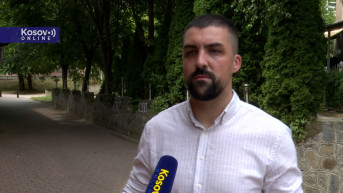
Luka Jovanovic, an assistant at the Department of History of the Faculty of Philosophy, says that ahead of the local elections, the authorities in North Mitrovica, composed of Albanians who came to power without any support from the majority population of the municipality, are trying in every way to strengthen and protect decisions that are controversial and against the Serbian community. This is done in order to prevent the new, Serbian-led government from having the ability to overturn decisions not supported by the Serbian community.
In this context, he also views the announcement of the adoption of a regulation in the Assembly of the Municipality of North Mitrovica, which will protect the coat of arms adopted last year at the initiative of the Albanian mayor Erden Atiq.
Jovanovic recalls that in July 2024, local authorities announced the adoption of a new coat of arms for North Mitrovica, claiming it was nationally neutral and created in accordance with all legal norms required by the central authorities in Pristina.
The local authorities in North Mitrovica justified this decision to the public by stating that one Serbian proposal was submitted in the design competition and that a Serb was a member of the selection committee, thus giving legitimacy to the decision.
"Reactions to that coat of arms were mixed, especially from the Serbian majority community in North Mitrovica, which until then had its own city coat of arms that significantly differed symbolically from the one adopted. The announcement that this new coat of arms will be protected by law from being replaced is problematic, because, by law, it is within the jurisdiction of local assemblies to determine and change their symbols as they see necessary. This is the case not only in Kosovo and Metohija, not only in the Republic of Serbia, but all over the world," Jovanovic told Kosovo Online.
The coat of arms of Kosovska Mitrovica, recognized by the institutions of the Republic of Serbia and replaced by local authorities last year, Jovanovic explains, represents Saint Demetrius, i.e., "the foundation of Mitrovica as a municipality," since the town was named after Saint Demetrius of Thessaloniki and was historically known as Dmitrovica.
"That is the essential symbol representing Mitrovica and the one by which the city was supposed to be recognized through its coat of arms. The coat of arms adopted by the new authorities features two main symbols of Mitrovica – the Ibar bridge and the monument on Kukavica hill, sending the message that these are the city's two main symbols: the bridge as a symbol of either unity or division between the northern and southern parts, and the monument on Kukavica, dedicated to those who fell in the anti-fascist struggle during World War II," the historian explains.
However, the Ibar bridge, as he emphasizes, is seen by some as a symbol of unity, by others as a symbol of division, and for the Serbian community, it is a symbol of resistance, while the monument on Kukavica hill sends a message of anti-fascism and the struggle of Mitrovica’s residents against foreign occupiers.
"The coat of arms conveys a noble message of resistance, struggle, and survival of its residents, but the problem is that the local authorities, represented by the current mayor and the current assembly president, are not implementing policies aimed at calming tensions or fostering coexistence. On the contrary, they are trying to weaken the Serbian community in Mitrovica and erase their monuments. They are attempting to nullify or distort the entire Serbian cultural heritage and memory," our interlocutor points out.
He believes that the current coat of arms of North Mitrovica does not accurately reflect the wishes of the majority Serbian population.
"No one should impose the symbols of Mitrovica; they must be backed by the majority of the population. I believe that after the elections, the new local government will have to address this issue from an expert standpoint. Assembly members should listen to the voices of their citizens and include on the coat of arms what the people want. If at some point the assembly members of a future assembly feel that a different symbol, rather than the Ibar bridge or the monument on Kukavica, should be on the coat of arms, they absolutely have the authority to adopt a new one, based on a majority decision and proper regulations," Jovanovic emphasizes.
He also says that the monument to Prince Lazar, located in the center of the municipality, is also a symbol of North Mitrovica and is a more significant symbol than the monument on Kukavica. If the majority population and the Assembly decide that the coat of arms should feature the monument to Prince Lazar, this should not be controversial for the central authorities.
However, he adds, it is expected that the central authorities will try to dispute such a decision because the Law on Local Self-Government and the regulations of the Ministry of Local Government require that no coat of arms conveys an ethnic or religious message, but rather be based on something that unites communities.
"Every future decision on the coat of arms will, of course, be challenged by the central authorities, but it is important that the old, true symbols of Kosovska Mitrovica, such as Saint Demetrius of Thessaloniki, the monument to Prince Lazar, and a number of other symbols, be included on that coat of arms. Heraldry, the science of coats of arms, provides guidance on how symbols should be harmoniously incorporated into a single emblem. I hope that in the future, the Serbian community will have the will to carry out such an initiative," Jovanovic concludes.


0 comments