
Baerbock on her way to the UN General Assembly: Germany’s desire for a seat on the Security Council in her suitcase
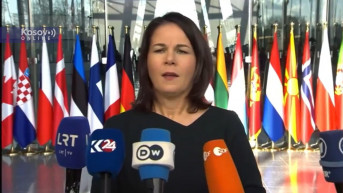
After three and a half years in the German government as Foreign Minister, Annalena Baerbock, a politician from the Greens—who will move into the opposition after the February elections—could continue her career on the East River as the President of the United Nations General Assembly. Berlin has officially announced her candidacy for this position, and sources from Kosovo Online believe her path to an office in New York is clear.
Written by: Dusica Radeka Djordjevic
The election for the President of the 80th session of the United Nations General Assembly will take place on June 2, and according to the rotating principle, the position this year belongs to the group of Western European countries.
Experts on the UN system point out that there are usually no major battles for the position of General Assembly President, as it is limited to a one-year term and is largely ceremonial. However, they do not dispute that it is a matter of prestige and can serve as a good springboard for future engagements.
According to UN rules, the President of the General Assembly declares the opening and closing of each plenary session, presides over debates, grants the right to speak, poses questions, and announces decisions. They can also propose the suspension of a session or a discussion on a particular agenda item.
Baerbock’s almost certain new role comes at a time when Berlin is actively advocating for the reform of the UN Security Council, with Germany keen to become a permanent member. It was at the UN General Assembly podium in 2023 that outgoing German Chancellor Olaf Scholz declared, "Ultimately, it is up to the General Assembly to decide on the reform of the Security Council."
Moreover, the Pact for the Future, adopted by UN member states last year, calls for Security Council reform.
Former Yugoslav ambassador to the UN, Vladislav Jovanovic, told Kosovo Online that Annalena Baerbock, as President of the General Assembly, will have an opportunity to promote Germany positively within the United Nations, given the country’s ambition to secure a permanent Security Council seat.
"She can leverage her previous experience as the foreign minister of a major country to raise Germany’s profile—not just as a powerful and influential nation in Europe and beyond, but as a country that, in every respect, deserves a stronger representative role within the UN system. This is a battle for permanent membership in the Security Council, which others have not yet allowed but remains Germany’s ambition," Jovanovic stated.
At this moment, he added, Germany is more focused on becoming a more frequent non-permanent member of the Security Council, as increased presence would reinforce its status as a significant and influential player.
As for the position Baerbock is preparing for, the former UN ambassador described it as largely ceremonial and representative, with no real ability to shape policy or engage in significant lobbying. The role primarily involves overseeing the work of the General Assembly in accordance with established principles and practices.
"Foreign ministers are usually the ones who hold this position, and none of Baerbock’s predecessors have made a significant mark or taken a major step forward. Most have comfortably transitioned into banks, insurance companies, or NGOs after their term. But it is, of course, a prestigious role that brings personal and national recognition," Jovanovic noted, expressing no doubt that the German candidate will secure the necessary votes for her election, as this position has never been the subject of intense competition.
Baerbock currently has no competitors from other Western European countries for the position, and interestingly, before her, Germany’s candidate for the presidency of the UN General Assembly was Helga Schmid, who completed her term as Secretary General of the OSCE in September 2024.
Despite Germany’s ambition to secure a seat on the UN Security Council, former Yugoslav ambassador to Berlin, Zoran Jeremic, does not believe that anyone is willing to reform the United Nations in such a way.
“That is not in anyone’s interest, although Germany attempted it last September with Namibia when they worked on the UN Pact for the Future. That was an effort to open the question of UN reform and, in turn, address this issue as well. However, I do not believe the international conditions are ripe for it, especially among the powers that currently hold veto rights in the Security Council. With Baerbock in the picture, it has even less of a chance,” Jeremic stated.
He emphasized that Baerbock faces significant animosity in international circles, suggesting that Berlin likely would not have put forward her candidacy without first conducting thorough consultations to ensure she has the necessary majority in the vote.
“Baerbock has a very poor reputation in many countries, especially among those whose votes will be crucial, such as China and India. I assume Germany has already secured the necessary backing—if they haven’t, this will be a failed move. Baerbock herself, her name, her track record, and what she has done for both Germany and the world, offer no real guarantees,” Jeremic told Kosovo Online.
According to Jeremic, nothing good can be expected from Baerbock in the role of UN General Assembly President.
"What she will be doing will work against calming international relations. This should also be considered in the context of Kosovo, if she addresses it at all. Serbia places great importance on the UN’s stance on Kosovo and Metohija due to the presence of UNMIK and NATO missions as key factors. That is why it would be crucial for someone rational and reasonable, a diplomat willing to engage in dialogue, to hold this position. Baerbock does not fit that description in any respect," he stated.
Jeremic assumes that Baerbock will not face a competitor within the Western European group of countries, as they have likely already reached an agreement.
"It's the same group sitting in London, preparing for the continuation of the war in Ukraine. They are pushing her forward because they want someone in the United Nations who will interpret their views. They see Baerbock as the best candidate for this, given that she has proven herself as Europe’s biggest war hawk," Jeremic remarked.
According to Petar Curcic, a researcher at the Institute for European Studies in Belgrade, the position Germany has nominated Baerbock for will primarily be significant for her personal career and CV. However, he finds it interesting to see how she will handle global hotspots.
"In German media, Baerbock’s candidacy is seen as a personal career move. Some criticize her for stepping away from domestic politics, while others view it as a smart career decision for her diplomatic ambitions," Curcic told Kosovo Online. He added that the role of UNGA President carries symbolic significance, as it allows the officeholder to propose topics for certain resolutions.
Regarding whether Baerbock's tenure could bring resolutions affecting the Balkans, Curcic emphasized that Germany undoubtedly maintains an interest in the region. He recalled that during the previous UNGA session, there was already a topic related to the Balkans, even though Germany was not presiding but was one of the co-sponsors of the adopted resolution.
He also believes that Baerbock’s election will not face opposition, as it is now Western Europe’s turn to hold the position, and the group has likely reached a compromise.
Baerbock’s tenure at the UN is expected to emphasize green policies, energy transition, and multilateral cooperation to accelerate decarbonization and the phase-out of fossil fuels.
"It will be particularly interesting to see her stance on the Middle East, not only regarding Gaza, Israel, and Palestine but also the Houthis in Yemen and broader security issues. This will be a litmus test because Germany has one policy while Arab countries have another. Additionally, relations between the U.S. and the EU have cooled rhetorically, and the debate over fossil fuel usage remains ongoing. This will be a personal test for Baerbock—to see whether she can balance the interests of various international groups and find common ground among opposing factions," Curcic explained.
The current UNGA President is Filmon Yang, former Prime Minister of Cameroon. If elected, Baerbock will assume her one-year mandate in September. Notably, in 2012, Vuk Jeremic, also a former foreign minister, was elected to the same position.

0 comments