
Can new evidence in the case against Thaçi and others influence the verdict against former KLA leaders, or will the court reject it?
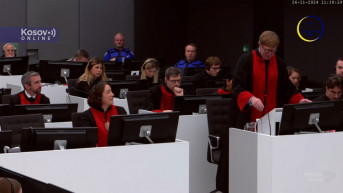
The Prosecution and the Defense have presented their arguments and witnesses in the case against former KLA leaders before the Kosovo Specialist Chambers in The Hague. A verdict is expected in the coming weeks, but in the meantime a new legal dispute is underway over whether the court will admit additional evidence submitted by the Specialist Prosecutor’s Office or uphold the Defense’s request to reject it. While attorney Bajraktari believes the court should not consider new evidence after the close of proceedings, attorney and former military prosecutor Dragan Pasic states that, from the Prosecution’s perspective, key additional evidence includes recordings indicating that Hashim Thaçi, Kadri Veseli, and Rexhep Selimi gave instructions to visitors regarding witness testimony.
Written by: Veljko Nestorovic
The proceedings against Hashim Thaçi, Kadri Veseli, Rexhep Selimi, and Jakup Krasniqi—who are being tried in The Hague for war crimes and crimes against humanity—were concluded on 18 February, after which a 90-day period began for the Kosovo Specialist Chambers to render a judgment in the case.
As explained to Kosovo Online by attorney and former military prosecutor Dragan Pasic, the Specialist Prosecutor’s Office has proposed the admission of additional evidence, which would incorporate into the case file materials obtained after the formal closure of the evidentiary proceedings.
According to him, the Prosecution claims that these are newly discovered pieces of evidence, including notes and diaries seized during searches, which were not available prior to the close of the evidentiary phase.
“Among the key additional evidence cited by the Prosecution are recordings indicating that Hashim Thaçi, Kadri Veseli, and Rexhep Selimi gave instructions to visitors regarding witness testimony—how to testify, not to testify, or to withdraw,” Pasic emphasizes, adding that the Defense cannot rely on Rule 103 of the Rules of Procedure and Evidence, which governs the presentation of evidence, because, based on publicly available information, the Prosecution obtained knowledge and information with evidentiary value only after the close of the evidentiary proceedings and the parties’ closing arguments.
He adds that the Prosecution considers these to constitute exceptional circumstances, despite the fact that the proceedings are procedurally closed.
“The Prosecution argues that certain evidence, such as detention recordings or data from seized phones, did not exist or were not physically available in earlier stages of the trial. As an additional argument, they claim that the exceptional nature also stems from suspicions that the accused attempted to influence the course of the proceedings, including alleged interference with and intimidation of witnesses through visitors while in detention,” Pasic explains.
He adds that it is now for the court to assess whether these pieces of evidence are so significant that their exclusion could affect the correctness of the judgment.
“The Defense disputes the existence of exceptional circumstances, and attorneys Gregory Kehoe and Luka Misetic argue that the Prosecution deliberately waited until the end of the proceedings to submit new evidence. They also maintain that any shortcomings in the investigation cannot be treated as exceptional circumstances,” Pasic notes.
He concludes that the Trial Panel will, after deciding on the admissibility of this additional evidence—which, if accepted, would become part of the final case file prior to the rendering of the judgment—inform both parties accordingly.
In a filing dated 13 March, the Defense requested that the Trial Panel order the Prosecution to cease submitting additional evidence.
“The Defense of Hashim Thaçi hereby requests that the Trial Panel, pursuant to Rule 136 of the Rules of Procedure and Evidence, order the Specialist Prosecutor’s Office not to submit new evidence to the Panel, except in exceptional circumstances and only where justified reasons exist,” the filing states.
Spokesperson for the Specialist Prosecutor’s Office Christopher Bennett declined to specify what evidence was at issue, stating that he could not comment on an ongoing case.
Legal expert Amer Alija from the Humanitarian Law Center says it is not known what evidence is in question, but reminds that the evidentiary proceedings have already been concluded.
“In principle, after the close of the evidentiary proceedings, the parties can no longer submit new evidence, as that phase is closed and the Trial Panel is in the deliberation and judgment phase. The Rules do provide for exceptions, but only under special circumstances and where justified reasons exist,” Alija stated.
Attorney Ardian Bajraktari believes the court should not consider new evidence after the conclusion of proceedings.
“Submitting new evidence after the proceedings have been formally closed constitutes a scandalous move and indicates an attempt by the Prosecution to justify its claims at any cost. This is contrary to the fundamental principles of criminal law, particularly the principle of equality of arms,” Bajraktari stressed.
The presiding judge of the Trial Panel, Charles Smith, previously emphasized that at this stage it is not possible to submit new filings or evidence, except in exceptional situations.
Concern has also been expressed by the Ombudsperson, who believes that such practice may undermine the right to a fair trial.
“The manner in which evidence is admitted, including after the indictment has been filed and the main trial concluded, seriously calls into question the principle of equality of arms and the right to a fair and impartial trial,” the institution stated in its response.
Academician Arsim Bajrami expects the acquittal of the former KLA leaders.
“The expectation is that they will be acquitted, declared innocent, and will continue their political work where they left off. The Prosecution failed to prove any count of the indictment, while the Defense refuted all allegations and demonstrated that the process was a politically motivated conspiracy,” Bajrami said.
On 30 September 2022, the Specialist Prosecutor’s Office filed an amended and confirmed indictment against Hashim Thaçi, Kadri Veseli, Jakup Krasniqi, and Rexhep Selimi, containing ten counts of war crimes and crimes against humanity.
The accused pleaded not guilty to the charges on 9 and 10 November 2020. The indictment was confirmed on 26 October 2020.
Following the closing arguments on 18 February, the Trial Panel has 90 days to render a decision, with the possibility of an extension.
Specialist Prosecutor Kimberly West has requested a single sentence of 45 years’ imprisonment for each of the four accused, while the Defense has requested acquittal.


0 comments