
How would a potential return of Thaçi affect the political scene, and what has changed over the past five years?
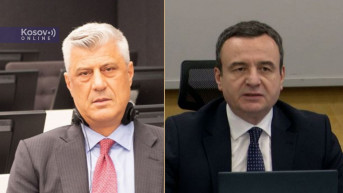
The opposition’s inability to compete with Self-Determination (Vetëvendosje) and the nearing conclusion of the trial of Hashim Thaçi, former KLA leader, in The Hague have prompted speculation in Kosovo that, in the event of an acquittal, Thaçi could alter the balance of political forces and challenge Albin Kurti. Although some believe that the former leader of the PDK, former prime minister and president of Kosovo, could strengthen his party, interlocutors of Kosovo Online doubt that his potential return from The Hague would undermine the primacy of Self-Determination. They point out that he has long been absent from the political scene and that trends and the electorate have changed.
Written by: Dusica Radeka Djordjevic
The presentation of closing arguments in the proceedings before the Special Court against former KLA leaders accused of war crimes will begin next week, with a first-instance verdict expected in the summer.
If the court in The Hague acquits Thaçi, according to Klan Kosova journalist Ardian Gaxheri, he would become a rival to Self-Determination leader Albin Kurti and might even emerge victorious from that contest.
“Opposition parties lack spirit, and I believe Hashim Thaçi would provide it,” Gaxheri believes.
Analyst Artan Muhaxhiri also believes that Thaçi’s return to the political scene would bring new energy and contribute to the rise of the PDK, but he does not believe Thaçi would take votes away from Self-Determination.
Muhaxhiri says Thaçi’s return would change the political dynamics, as he is—alongside Ibrahim Rugova—one of the most important political actors of recent decades in Kosovo.
The former KLA leader has been in detention in The Hague since November 2020, and Muhaxhiri points out that even Thaçi must acknowledge that the electorate has changed in the meantime.
“Young people now make up the electorate, and we know that young people largely support Mr. Kurti and Self-Determination. So even he will have to adapt his strategy. But I think there will be changes. He will make a difference, especially for the PDK. He will inject energy into the political scene, and that will be for the best, because in the current situation Mr. Kurti has no real opponent, which is bad both for him and for Kosovo,” Muhaxhiri told Kosovo Online.
Thaçi, he adds, knows how to deal with voters; he has been president and prime minister and knows how to deal with the international community.
“He will attract new people, and I think that will benefit the PDK. That could be bad for the LDK, because I don’t think Mr. Thaçi would take votes from Self-Determination voters; rather, he would gain votes from the undecided, perhaps from people who did not vote in the last elections,” Muhaxhiri assesses.
Historian Stefan Radojkovic also does not believe that a potential return of Thaçi to the political scene would threaten Self-Determination, as the party has a stable majority.
He also notes that trends in Albanian society in Kosovo over the past six years—during which the former KLA leader has been in The Hague—go beyond the period in which Thaçi politically dominated.
“Vetëvendosje now has a stable majority of votes. Sometimes it is close to 50 percent, sometimes below 50 percent, but it generally moves within those proportions. This shows a stable trend, and it is unlikely that a single individual could change a trend across the entire society. It is not impossible, and one should not disregard the element of chance or unforeseen circumstances. History has shown that such things can happen, but Thaçi has been absent from the political stage for a long time, and his influence is probably no longer as strong even within the party itself,” Radojkovic told Kosovo Online.
He notes that it is not only Thaçi who is on trial in The Hague, but a group of people who were part of the leadership that ran the PDK and who were significant political actors among Kosovo Albanians.
“Things have now gone so far in a certain direction in favor of Vetëvendosje that I simply do not see the possibility of any fundamental structural change in that sense,” Radojkovic emphasizes.
He cites the example of the return to Belgrade of Vojislav Šešelj, leader of the Serbian Radical Party, from The Hague, where he was tried before the Tribunal, which, he says, resulted in only a slight rise in the party’s popularity that month, after which it quickly returned to its previous level.
A potential return of Thaçi, Radojkovic believes, could be a straw of salvation the Albanian opposition is trying to grasp, as it is clear to them that for some time they have been unable to erode Albin Kurti’s popularity.
“But it is not just his popularity, but also that of the party he represents and its work on the ground, where it is clear that support for Vetëvendosje is not regionally concentrated, but that it has supporters in all municipalities in Kosovo and Metohija, especially among all Albanian communities in Kosovo and Metohija,” Radojkovic concludes.
Security studies researcher Nikola Vujinovic assesses that if Thaçi is not convicted, his return to Kosovo would strengthen the PDK and make the opposition louder and more respectable, but even with Thaçi, the PDK would not be able to reach the level of popularity currently enjoyed by Self-Determination.
According to Vujinovic, Thaçi’s potential return to Kosovo’s political scene would reconcile warring factions within the PDK and stabilize the party, where the struggle for leadership, he says, is being waged behind the scenes.
“But they cannot catch up with Self-Determination for the simple reason that Mr. Kurti has shaped the political framework in Kosovo in such a way that hatred toward Serbs is the dominant theme. Self-Determination truly excels at this, if I may put it that way. As a result, you cannot outdo it, because the next step would be killing people in the streets, and I believe Mr. Thaçi—who was quite cooperative during his presidency and while he was prime minister—would not do that,” he told Kosovo Online.
The thesis of Thaçi’s return, he adds, is more an expression of the opposition’s desire to finally find a solution for defeating Albin Kurti.
“These elections showed that, despite all criticisms and arguments, people continue to adhere to certain values that are most important to Self-Determination—above all ethnic hatred toward the Serbian community and the exclusion of that community from the political system of so-called Kosovo. It seems to me that Mr. Thaçi’s return would rely on the old glory of a KLA commander, but that in the current state of Kosovo’s political system he would have nothing else to offer except to act as a brake on the complete collapse of an opposition that is going downhill at an enormous speed,” Vujinovic believes.
According to Vujinovic, the verdict against Thaçi will be an acquittal, because, he says, that is the narrative the sponsors want.
“As with Mr. Haradinaj, Mr. Oric from Bosnia and Herzegovina, and Mr. Gotovina from Croatia. Quite simply, the story of a Serbian aggressor cannot be accepted if you are accused of crimes, because that would destroy Kosovo’s national myth—that we are victims of genocide, and a victim cannot commit crimes. If it were confirmed that a victim can commit crimes, that would then call into question the entire myth: why are you an independent state, when there is already one Albanian state in the Balkans,” he concludes.
Hashim Thaçi and three other former KLA leaders—Kadri Veseli, Rexhep Selimi, and Jakup Krasniqi—are charged before the Special Court in The Hague on the basis of individual criminal responsibility with crimes against humanity, including persecution, imprisonment, other inhumane acts, torture, murder, and enforced disappearances, as well as war crimes, including unlawful and arbitrary deprivation of liberty and imprisonment, cruel treatment, torture, and murder.
According to the indictment, these criminal acts were committed approximately between March 1998 and September 1999 at several locations throughout Kosovo, as well as in Kukës and Cahan in northern Albania.
At the moment when the Specialized Chambers in The Hague confirmed the indictment against Thaçi on 5 November 2020, he was President of Kosovo. He resigned from that position, stating that he did not wish to appear before the court in the capacity of president, and on the same day he was taken to The Hague, where he has since been held in the court’s detention unit.


0 comments