
The day after the Srebrenica Resolution: Disputes over reconciliation
Will Yesterday's Date Enter Regional History as Another Epic Moment Celebrated by Some as a Victory and Others as a Defeat?The absence of consensus on basic concepts in the Balkans has been a constant since 1389, which was most evident in recent days during the disputes over what "reconciliation" means and whether it should start in Srebrenica or Jasenovac. It turns out - it will start from New York, where, after all, everything began.
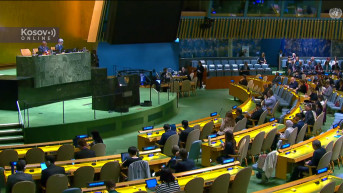
The adoption of the Srebrenica Resolution in the General Assembly is finally in the past, though it's the kind of past that affects the present and clouds the future.
Thus, in the Balkans, just a day after D-Day, there are debates instead of reconciliation, threats of new resolutions instead of looking towards the future.
Although the Chairman of the Presidency of Bosnia and Herzegovina, Denis Becirovic, described the event as "a great opportunity for catharsis in the entire region," one of Kosovo Online's interlocutors notes that "now no one is happy." This is clearly reflected in the generally accepted rhetoric, as it is debated who the Resolution - which is supposed to reconcile the Balkans - is "targeted" at.
"They did everything to humiliate us, and we soared," the President of Serbia stated yesterday in - for some, an excessive, for others, the only appropriate - epic manner.
For Vidovdan is, after all, in the eye of the beholder.
The Srebrenica Resolution is directed against Serbia and the Serbian people, and because of it, political relations in the region will be "under scrutiny," especially in Bosnia and Herzegovina, historian Bojan Arbutina assessed for Kosovo Online.
"Relations between the Republic of Srpska and Bosnia and Herzegovina are certainly not good, especially in recent years, as there are constant pressures on Republic of Srpska. We heard yesterday that the Government of Republic of Srpska convened in Srebrenica, where peaceful disintegration of Bosnia and Herzegovina was proposed. However, from my perspective, this will not be possible in the near future. Therefore, these tensions will have certain fluctuations; at times they will increase, and at other times the situation will calm down. Regarding Serbia, we are certainly not happy that Montenegro voted for the Resolution, justifying it with their European orientation, because if you are committed to something, it does not mean you have to be dependent on something or that you cannot make independent decisions," Arbutina states.
The biggest surprise of yesterday's vote, in his opinion, was that only 84 UN General Assembly members voted in favor.
"Projections were that around 100-110 members would vote in favor, which means our diplomacy did an excellent job lobbying against the Resolution," Arbutina notes.
He adds that Bosnia and Herzegovina is not satisfied with the results and that their biggest disappointment came from the abstention of the United Arab Emirates, from whom they had hoped to receive a positive vote.
Croatian historian Hrvoje Klasic believes that reconciliation cannot be achieved through resolutions and political decisions.
"What isn't happening in our region is that we still don't view crimes and criminals through the same lens; instead, we categorize them based on national, religious, or other affiliations. Essentially, we still behave as if 'our criminals' are somehow lesser criminals and we have more understanding for them, while crimes committed against us are much greater than crimes committed against others. And that is a big problem. When you have situations where people convicted in courts, whether in the region or in The Hague, appear on public television shows, then we cannot say that any resolution will change anything," our interlocutor states.
According to him, the Srebrenica Resolution cannot be the basis "for any lawsuits," as he recalls, Serbia has already been sued and acquitted of genocide in The Hague.
For him, "the great diplomatic mistake of the Serbian political and state leadership" was the uproar over the Srebrenica Resolution because its adoption, he says, will not change anything in regional relations.
"We will continue to live in parallel realities, in the sense that our politicians and some irresponsible intellectuals will continue to live in the past, will continue to have nothing to offer, and will not look to the future," Klasic believes.
Former Macedonian ambassador Risto Nikovski assessed that the adoption of the Srebrenica Resolution is an unusual move with a political background "that has nothing to do with humanity or condemning the terrible crime that happened in Bosnia and Herzegovina," emphasizing that the ultimate goal was to pressure Serbia to be more flexible regarding Kosovo.
He points out that the Croat-Bosniak Federation and Republic of Srpska do not cooperate and that Bosnia and Herzegovina de facto does not function, and that the Resolution will cause further divisions and tensions in the Balkans.
"This move is directed towards the destruction and collapse of that dysfunctional state community. Therefore, the purpose of this move is not seen, its essence is against the peace and stability of the Balkans, although for Kosovo this may seem positive in principle. However, pressure on Serbia cannot under any circumstances bring anything useful to anyone," Nikovski observes.
He emphasizes that it is unclear what the purpose of the Srebrenica Resolution is, given that there have been many genocides in the world, but the perpetrators have not been declared genocidal nations.
"Over two million Vietnamese were killed in Vietnam. Not to mention America and the killing of Native Americans. Or the Jews in World War II, over six million were killed. Over 25 million Russians were killed in World War II. Was Germany declared a genocidal nation? No. So yes, this has some narrow party interests that are currently not clear enough, but in any case, they are against the interests of our region and will bring nothing good," stated the former ambassador.
On the other hand, university professor Nexhmedin Spahiu told Kosovo Online that the Srebrenica Resolution cannot raise tensions in the region.
"The Resolution cannot raise tensions, considering that it is an evil that happened and that the Serbian people will have to come to terms with, and it is an evil committed by members of that people," Spahiu assesses.
He adds that if Serbian society accepts this, it will lead to reconciliation and much healthier relationships between neighbors in the Balkans.
"This is something that should lead to the acknowledgment that what happened cannot be ignored. And if this is accepted as an evil that was committed, it is a guarantee that it will not be repeated in the future," our interlocutor believes.
He also has no objections to the adoption of other, similar resolutions.
"There is nothing wrong with adopting such resolutions about Jasenovac and anywhere else where evil was committed. I think it should not be understood as a counter-reaction. Simply, the peoples here in the Balkans must condemn evil," Spahiu concludes.
However, historian Stefan Radojkovic believes that after the adoption of the Srebrenica Resolution, Pristina might use this Resolution to worsen relations and disrupt the Brussels dialogue.
"When it comes to Bosnia and Herzegovina, this Resolution will be used to strain relations between Belgrade and Sarajevo, and Sarajevo and Banja Luka. However, over the past ten years, we have witnessed that these relationships are sensitive and that this Resolution will further be used to keep those relations tense, so that whenever the issue of the Srebrenica crime is raised, they worsen and become more strained. They will never be ideal or exceptionally good, as is actually the case with Skopje or Podgorica. Good relations with Croatia will remain untouched; we can only expect that Pristina, especially Albin Kurti's government, might use this Resolution proposal to worsen relations and disrupt the Brussels dialogue. So, more or less, nothing new in the West," the historian believes.
He notes that the voting results show that the world is divided on the issue of Srebrenica.
"One part of the UN, less than 50 percent, supports the mainstream narrative about Srebrenica, while the other part, slightly more than 50 percent, either does not care about the issue and does not want to deal with it or is against it. It was particularly interesting to me that Israel did not participate in the voting at all. The official stance of Israel and its institutions is that the crime in Srebrenica was committed and that it is undisputed and proven, but its legal classification does not correspond to that type of crime," emphasizes Radojkovic.
Macedonian political analyst Saso Klekovski also believes that the Resolution will inevitably cause regional divisions, viewing the document as a reaction to "the increased attempts by Republic of Srpska to secede from Bosnia and Herzegovina or to not recognize the institutions of Bosnia and Herzegovina."
He adds that any principled matter, if used for daily political purposes, ends poorly.
"The Bosnians are not happy that the Resolution has been significantly softened, and the Serbs are unhappy that it exists at all. In Macedonia, divisions have been created between local communities; we have a local Serbian and a local Bosniak community, and it seems to me that more negative emotions have been stirred up than questions answered. According to theory, reconciliation must be connected with justice, related to what happened, but not for daily political goals," Klekovski told Kosovo Online.
Referring to the voting results, Klekovski notes that there were more abstentions than support, indicating a geopolitical moment.
"This is not a vote for Srebrenica at all; this is a vote by the West against the global South. We used to call these non-aligned countries. Simply due to the West's lack of principles, especially regarding Palestine and Gaza, I think many countries think differently about Srebrenica, not because they think differently about those events, but simply because of the hypocrisy that is happening, they decided to vote against or abstain," he stated.
Historian Aleksandar Gudzic also believes that the goal of adopting the Srebrenica Resolution is the dismantling of Republic of Srpska and the unitarization of Bosnia and Herzegovina, noting that Kosovo could use this decision to come forward with the same or a similar demand.
"This is a political decision, and the ultimate goal of all this is the dismantling of Republic of Srpska. For decades, there has been a view in the regional public, and parts of the international public, that Republic of Srpska is a genocidal creation, that it was founded on genocide. This Resolution, this decision of the Assembly, the adoption of this German proposal, aims at dismantling Republic of Srpska and achieving the unitarization of Bosnia and Herzegovina at some point," Gudzic told Kosovo Online.
He assessed that such a decision cannot have direct consequences on Kosovo, but it can serve as an example for Kosovo officials to come forward with the same or a similar demand.




0 comments