
Klekovski: The Srebrenica Resolution will bring additional unrest to the region
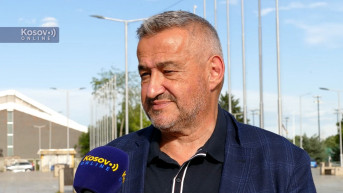
Macedonian political analyst Saso Klekovski, commenting on the adoption of the Srebrenica Resolution, stated that the geopolitical moment was such that it raised questions throughout the region, as well as questions about why some countries were "for" and others "against" the resolution and what the basis for their stance was. Klekovski believes that this will introduce additional unrest in the region and that the resolution is a reaction to the intensified attempts by Republika Srpska to secede from Bosnia and Herzegovina or to not recognize the institutions of Bosnia and Herzegovina.
Klekovski emphasizes for Kosovo Online that it is necessary to clarify that it is not about recognizing or not recognizing the genocide in Srebrenica, because the title of the Resolution is "International Day of Remembrance for the Genocide in Srebrenica."
"So, to mark what happened. Essentially, there are two points of view here, principled and geopolitical. Basically, in principle, I think all involved parties acknowledge that what happened in Srebrenica is an act that has been judged as it has been judged," Klekovski explained.
The question, he says, is why now, why here, and why not at some other time and place.
"And these things inevitably open many debates," he points out.
As he says, France pushed the process of recognizing the Armenian genocide in Turkey a few years ago, which Turkey strongly opposed.
In this sense, he says it is normal to expect opposition from some in the region, although he notes that the Resolution itself is quite watered down, moderate, and measured because it does not imply that any nation, state, or ethnic community is collectively guilty for what happened, but that individuals carried out these acts.
He believes that the Resolution is a reaction to the intensified attempts by Republika Srpska to secede from Bosnia and Herzegovina or not to recognize the institutions of Bosnia and Herzegovina.
"I'm not sure it will have a positive effect in Bosnia, no matter how much the forces in Bosnia try to make the Resolution acceptable to all parties. But, the division will be regional, and that inevitably happens. The fundamental question is why now and why in this situation," he said.
Specifically, he adds, in North Macedonia, they witnessed that North Macedonia did not support resolutions related to Palestine and Gaza, but now supports a resolution related to Bosnia.
"I must say that the problem with such things has crept into internal politics," he says.
Pointing out that Prime Minister Kovacevski said that the Resolution on Palestine had been agreed upon with Ambassador Frckovski at the United Nations, thinking it would soften the criticism from the pro-Palestinian Muslim population in the country, Klekovski says that he spared Minister Bujar Osmani from criticism.
"When the Srebrenica Resolution came, the opposite reaction followed. Osmani boasted that North Macedonia would be a co-sponsor without consulting President Pendarovski and the Government. It is clear that both acts, Gaza and Srebrenica, have been put into daily political use," he said.
He adds that every principled matter, if put into daily political use, ends badly.
"Now, no one is happy, Bosnians are not happy that the Resolution is quite watered down, Serbs are not happy that it exists at all. In Macedonia, divisions have been created between local communities, we have a local Serbian and a local Bosnian community, and it seems to me that more negative emotions have been opened than questions. What theory says is that reconciliation must be connected with justice, related to what happened, but not for daily political goals," he emphasizes.
According to the voting results, Klekovski notes, there were more abstentions than support, indicating the geopolitical moment.
"This is not a vote for Srebrenica at all, this is a vote of the West against the global South. We used to call them non-aligned countries. Simply because of the West's lack of principle, especially regarding Palestine and Gaza, I think many countries think differently about Srebrenica, not because they think differently about those events, but simply because of the hypocrisy that is happening, they decided to vote against or abstained. Essentially, for such an event, it should be declarative and not enter into daily political schemes," he concluded.



0 comments