
Is the decision of Spain to recognize Kosovo passports the result of pressure on the European five, and what is the role of London in this?
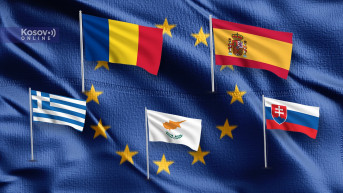
Just a few days after the British Foreign Secretary, David Cameron, announced in Pristina that Great Britain would help Kosovo gain new recognitions, the Spanish Government decided to recognize Kosovo passports, which has once again brought up the question of pressure on the five EU member states that do not recognize Kosovo, and speculation about which of them could be the "weakest link" and the first to change their stance. Interlocutors of Kosovo Online have no doubts that Britain has an interest in consolidating Kosovo's independence and, at the same time, reasserting itself as a significant geopolitical player not only in our region but also beyond, following its departure from the EU. However, they believe that the increased pressure, at least for now, will not influence any of the European five countries to recognize Kosovo.
Officially, Madrid emphasized that recognizing passports did not imply recognition of statehood. However, this decision likely opens the "Pandora's box" of speculation and various interpretations, ranging from considering the recognition of Kosovo passports as a purely administrative matter to viewing it as the first step towards diplomatic engagement between Spain and Pristina. Some even see it as an introduction to recognizing Kosovo.
Expert in Balkan relations, Alejandro Esteso Perez, admits surprise at the decision of the Spanish Government and believes that out of the five EU countries that do not recognize Kosovo – Spain, Romania, Greece, Slovakia, and Cyprus – Spain is the most challenging to influence.
However, there are different perspectives, and former Spanish Foreign Minister Jose Manuel Garcia-Margallo stated that accepting the Kosovo passport as valid did not imply recognizing the country. Still, he expressed confidence that it was a "decisive step" towards that goal. He warned that recognizing Kosovo as a state would present a "very complicated and serious" precedent for Spain concerning Catalonia and its hypothetical declaration of independence.
On the other hand, Greece has been pointed to for a while as the country that could be the first among the European five to recognize Kosovo, with different perspectives in Belgrade and Pristina. President of the Republic of Serbia, Aleksandar Vucic, spoke with Greek Prime Minister Kyriakos Mitsotakis a few days ago, thanking him for respecting Serbia's territorial integrity and sovereignty. However, Deputy Minister of Foreign Affairs and Diaspora, Kreshnik Ahmeti, claims that there is a possibility that Greece will recognize Kosovo because, as he emphasizes, the relations between Pristina and Athens have become very close.
Also, after Cameron's visit to Pristina and the messages he sent, the idea emerged that Great Britain would take over the "baton" from the EU and the US in the coming period regarding the Belgrade-Pristina dialogue, especially considering that Brussels and Washington are awaiting elections this year. The largest pressure on the European five not recognizing Kosovo will come from London.
In the past few years, 28 countries have withdrawn their recognition of Kosovo's independence, and there have been no new recognitions of Kosovo in the last three years.
For Branka Latinovic, Vice President of the Forum for International Relations, Spain's decision to recognize Kosovo passports was not a surprise. She points out that it should not be linked to the fact that this move came just a few days after Cameron announced that London would help Pristina gain new recognitions.
"One should be fair to our Spanish friends, and this should not be dramatized because it was not a national decision. The decision to abolish visas for Kosovo citizens, or to introduce visa liberalization, was not made by the Spanish Government but by the European Commission. Spain, not only a member of the Schengen area but also one of its advocates, has, in a way, a moral obligation not to question the functioning of Schengen. It has been the only Schengen member state so far that has not allowed citizens from Kosovo, with Kosovo passports, to enter Spain. Now, I think it simply wants to show those general values", Latinovic says for Kosovo Online.
She continues that Spanish officials were explicit in stating that this act should not be connected in any way to the active recognition of Kosovo and does not question Spain's stance.
"That stance is very strict. It's important to remember that Spain mentions the territory of Kosovo in all this, and there are no major surprises in that", she says.
Regarding the politics of Great Britain, Latinovic points out that after leaving the EU, London's ability to directly influence through that forum has decreased, however, it can still influence through NATO since, except for Cyprus, all other Union states that have not recognized Kosovo are members of the Alliance.
"This should be more about the line of possibilities for the influence of Great Britain, or the new British minister, who, as we see, has started very dynamically, especially concerning our region, i.e., Kosovo and Metohija, which is very sensitive and significant for us. It is something that is constantly present on the agenda of those countries, especially countries that have great ambitions to act on the European and global stage, and that should not be surprising. It's just a matter of dynamics, how it is achieved. Sometimes it's more intensive, sometimes it's a standstill, and sometimes it's an announcement that something is going to happen," Latinovic points out.
According to her, Cameron's statement should also be connected with the internal situation in Serbia.
"If you have a good internal situation and the functioning of the state at the European level, then the possibilities for someone to draw attention to you in such a way that they can influence what is sensitive to you are small. If you have a situation like today, especially what happened in Kosovo and Metohija regarding the Banjska case, which Cameron emphasized in his statement in parliament, then you have such statements", she explains.
When asked if she expected increased pressure on the European five – Spain, Greece, Slovakia, Romania, and Cyprus – to change their stance and whether these pressures would come from Great Britain, which, according to some interpretations, intended to take over the "baton" in the dialogue between Belgrade and Pristina from the EU and the US, given that this was an election year for them, Latinovic says that it is "a good assessment and a good thesis".
"Considering that after Brexit, the UK began to build its stronger image as a geopolitical player, not only in Europe but also in the Pacific and the Middle East, in that context, it could be interpreted in that way. Especially since Cameron is an experienced politician, of strong caliber. It should not be forgotten that he was also a prime minister who implemented the decision to hold a referendum on Britain's exit from the EU. He will certainly give a personal touch to the whole process, striving to engage in the current conditions, as it is an election year for both the European Parliament and the European Commission, to absorb a lot and for the UK to take on and thereby emphasize its importance, both in Europe and on the international stage", Latinovic notes.
She also commented on the fact that the "weakest link" among the European five that do not recognize Kosovo could be Greece.
"Greece is mentioned in this context because it has taken some steps that other members of the five have not done. It has opened a trade office in Pristina. It is independent of the embassy in Belgrade, and all other diplomatic offices that these other members have are tied to embassies, not independent but detached departments. They monitor the situation on the ground and cover practical steps regarding their citizens. A larger number of them also have contingents within KFOR. Whether Greece will take that one step would be even more significant, I think at this moment there are no indications for that. But it should not be ruled out, depending on what happens in the Western Balkans and in Europe after the elections", Latinovic concludes.
Senior research associate, and historian Dr. Aleksandra Kolakovic, says that it should be kept in mind that the dialogue between Belgrade and Pristina has entered a complex phase, and various political actors are on different sides, with those most involved in this process present in the region.
"This is also demonstrated by Cameron's visit, which is very interesting, it was one of his first visits as head of diplomacy. On the other hand, we had visa liberalization, which is extremely significant from the perspective of the Eurointegration of the region, and it somewhat prompted the decision of the Spanish government to recognize Kosovo passports. Of course, we received clarification that it is not about recognizing Kosovo but allowing citizens of the so-called Kosovo to travel to all EU countries, including Spain. In that context, for a long time, we have been observing that certain circumstances dictate that different actors react differently to certain events. In this case, this liberalization and new states that would recognize the expansion are, in fact, channels for some diplomatic pressures, initiatives, efforts for the actors to better position themselves before new negotiations, or their continuation", Kolakovic says for Kosovo Online.
She points out that in the 21st century, unlike in the 20th century, when we had clear relations between countries regarding whether a state was recognized or not, these relations are somewhat different now.
"In some segments, when it proves significant, different states, or even those not recognized, participate, although we recognize them as elements of statehood. On the other hand, in this specific case, when we look at Spain, it sought to provide a communication space while maintaining its old positions," our interlocutor emphasizes.
Regarding the five EU countries that do not recognize Kosovo – Spain, Greece, Slovakia, Romania, and Cyprus – Kolakovic emphasizes that this is crucial for Serbia's position in the negotiations.
"We also know that pressures on them are constant and increasing. In which direction this will further develop is hard to say, it depends on individual countries. We are aware that individual countries, especially now after these crises and wars, are extremely protective of their national interests. When it comes to Spain, I think their positions regarding the non-recognition of Kosovo are quite firm. However, in some future diplomatic initiative and possible other diplomatic circumstances, we will see how this situation will further develop," she says.
She points out that within the context of European unity, strong pressure is exerted on these five EU members, and she adds that this is not something of a recent date but has existed since Kosovo declared independence.
"In these complex, complicated conditions, the pressure is higher. In other words, certain concessions are possible. But certainly, Cameron's statement should be viewed in the light of consolidating the British position in these relations and in the Balkans, and that firm stance that dates back a long time, which is essentially a stance for finalizing the process of Kosovo's independence", Kolakovic emphasizes.
Political scientist Dimitrije Milic from the New Third Way believes that Spain's decision to recognize Kosovo passports should not be associated with Cameron's announcement that Pristina can expect London's help in gaining new recognitions of independence. According to Milic, of the five EU countries that do not recognize Kosovo, Spain and Cyprus are the least likely to change that decision.
"The decision to recognize Kosovo passports is more of a question of internal changes in Spain, where the left is currently in power, and they have a softer stance on both Kosovo and the autonomy of different regions in Spain. This is mainly because the current government of Pedro Sanchez depends on a large number of parties that come from these regions, and they want much greater autonomy and some even full separatism. So, this is a unique position for Spain in the sense that no Spanish prime minister has ever been weaker in relation to the influence of these parties that want greater autonomy. If a right-wing government had been formed in Spain, the decision on Kosovo passports would not have been possible, and probably the opposition to recognizing these documents would have lasted a very long time, even though other EU countries aligned with this decision", Milic notes for Kosovo Online.
He believes that when it comes to states that could recognize Kosovo's independence, they should not be sought among the five EU members who have not done so – Spain, Greece, Slovakia, Cyprus, and Romania.
"We should probably look at states where Britain still has some influence, which are located in the regions of the third world. I assume that states that have recognized and then de-recognized Kosovo will now be under pressure. The question is how authentic and essential this will be for Britain, how much Cameron's message was merely principled and may not lead to concrete steps and diplomatic efforts. Perhaps this should be viewed in the context that Britain today has slightly fewer diplomatic capacities than 10 or 15 years ago, both in terms of resources allocated for it and in terms of general attention compared to all other issues affecting British foreign policy. Including, ultimately, the war in Ukraine, where Britain stood out as one of the most active in supporting Kyiv", our interlocutor points out.
He continues that pressure will continue on the five EU member states that do not recognize Kosovo, but it is difficult to say which of them is the "weakest link".
"It might be easier to say which states are the strongest, which will hardly change their stance, and that is Spain, the largest, politically most powerful, with the most problems regarding regional autonomies that have much greater ambitions than autonomy. Cyprus is unlikely to change its stance due to its problems in the north. Other states that, for example, have skepticism regarding the Hungarian minority, such as Slovakia and Romania, may be somewhat more lenient, as well as Greece. But fundamentally, these are very rigid positions that did not change even when much greater pressure was exerted in 2008 and 2009. It would be more appropriate to look at these states that have much less political power and are located around the world. After all, their recognitions and de-recognitions do not contribute significantly to the outcome, except quantitatively, in terms of the number of states that do not recognize or recognize Kosovo", Milic concludes.
Mazllum Baraliu, a Professor of Constitutional Law at the University of Pristina, assessed that in recent years, the process of new recognitions of Kosovo had been halted, and he attributed that to both external and internal situations within Kosovo and also, as he said, the actions of the Ministry of Foreign Affairs of Serbia.
According to Baraliu, much of the progress regarding new recognitions of Kosovo depends on international sentiment, however, he emphasizes that "important centers of power," both in Europe and beyond, seemed inclined to recognize the independence of Kosovo by as many countries as possible.
"However, in recent years, due to the situation, both external and internal in Kosovo, this has somehow stopped. This government has not managed to secure any recognition, except for the one from Israel, which was actually the merit of the former US President Donald Trump, and an agreement resulting from the situation in Washington. In recent days, some countries in the Arab world have started lifting visas for certain categories and the UAE for the entire population of Kosovo; there is some progress, but it is not what Kosovo institutions and some countries would desire. So far, more than 117 countries have recognized Kosovo. Dacic stated that around 10 countries had withdrawn recognition. No one really knows what happened, but there is a diplomatic struggle between Belgrade and Pristina in that direction," Baraliu stated for Kosovo Online.
Among the five European Union countries that have not yet recognized Kosovo, it seemed that Greece would be the first to do so, Baraliu says, however, he adds that there are no concrete steps in that direction for now.
"Greece was ready, as some very important sources said a year or two ago. However, it stopped because the current government of Kosovo did not participate in the gas pipeline that would pass through Greece. Because of that, it seems Greece has not declared its stance or taken steps. However, it is evident that Greece, in addition to offices opened in Athens and Pristina, has very good economic relations with Kosovo and is trying to play a constructive role, in my opinion. They consider themselves a leading country in the Balkans, especially because they are members of the European Union and NATO. They can influence the improvement of relations and the stabilization of the situation in the Balkans. Therefore, Greece plays a constructive role. However, it has not taken a concrete step toward recognizing Kosovo yet," Baraliu points out.
On the other hand, Baraliu claims that Spain has taken a very important step by recognizing Kosovo passports.
"It is a very important step because passports are a symbol of statehood and states, as only states issue passports. Spain, the last of the five EU countries that do not recognize Kosovo, has recognized Kosovo passports; the others did it earlier. So, this is one step closer to recognition or, in quotation marks, tolerating that Kosovo takes certain measures toward integration. Representatives of Spain have said that they would not obstruct these integration steps of Kosovo into the European Union. However, they were quite adamant regarding recognition; they said they would never do it. Even a few weeks ago, representatives of Spanish sports did not recognize representatives of Kosovo sports. However, concerning passports, this is a very good step for Kosovo and stability, both in Kosovo and the Balkans. I think this is also a good sign that the EU will probably have a change in policy toward the Balkans and Kosovo. After the events in Ukraine and the lessons regarding the policy that the EU pursued toward Russia and other countries, especially toward the Balkans, that should change. And that means that, sooner or later, if they want stability and progress in the Balkans and Europe, they will have to recognize all Western Balkan countries", Baraliu concluded.




0 comments