
Economic cooperation between Kosovo and the US: Political marketing or a race with Belgrade?
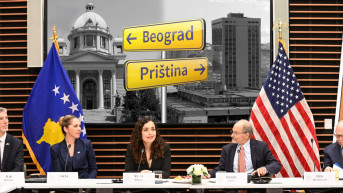
Kosovo's President Vjosa Osmani stated that Kosovo is interested in strategic economic cooperation with the United States, particularly in the sectors of energy, IT, and defense. While there is consensus that such cooperation could strengthen ties with Washington and influence the dialogue with Serbia, analysts argue that it is primarily a case of political marketing with little substance. The new Donald Trump administration has made it clear that US interests are primarily economic, and in that race, analysts tell Kosovo Online, Pristina can hardly compete with Belgrade.
Written by: Petar Rosic
During her tour in the US in mid-July, Osmani said at the Hudson Institute that economic cooperation with Kosovo “could be a force multiplier” for American global leadership.
“We must help the US increase its role in the global economy. And I think that can be done with the help of pro-American countries. And as you know, Kosovo is the most pro-American nation in the world,” said Osmani.
She then presented plans to build a munitions factory, which she believes would interest the US.
“We believe Kosovo has excellent capacity for arms production, with support from the US and American companies that could be interested in this direction. This is important at a time when we need to ramp up production—both for internal needs and due to demand from Europe, the United States, and NATO, which Kosovo aspires to join,” said Osmani.
She also stated that Kosovo is ready to assist the US in the global fight against China’s dominance in the rare minerals sector. She proposed opening a mineral processing plant in Kosovo, highlighting the country’s strategic role in “strengthening America’s economic and industrial power.”
Petar Donic, associate of the New Third Way, says Osmani tried during her US tour to pave the way for economic cooperation with the Trump administration, but he remains skeptical about Kosovo's actual economic potential to meet Washington’s expectations.
“Albanians, whether from Kosovo or Albania, have always known how to lobby the Americans and built their political position early on, unlike the Serbian side,” Donic told Kosovo Online.
However, he notes, much of that political capital was invested in relations with the Democratic Party.
“Now, with Trump’s return and the big changes he’s bringing—threatening even more changes regarding various funds and organizations—they need to reassess what currently aligns with Republican interests. Trump has imposed a very simple agenda—trade and deals,” Donic explains.
He believes Osmani's statements can be seen as an attempt to use a business narrative to attract Republicans and Trump to view Kosovo more favorably.
“Trump is a businessman and has shown business interest through politics, but when it comes to Kosovo, I’m skeptical. How realistic is this? Regarding arms production—not very. And I’m not aware of any significant rare mineral extraction beginning in Kosovo. These are massive investments that take decades, and a processing plant would only make sense if the extraction were nearby,” he adds.
Marko Miskeljin from the Center for Social Stability believes Osmani’s statements were primarily aimed at building political capital she could use domestically.
“Vjosa Osmani wants to use her US visit to build political capital, mainly aiming to boost her political career by presenting supposedly strong ties with the new administration as evidence of her own political weight,” Miskeljin told Kosovo Online.
He considers it more of a pre-election promise, especially given the political situation in Kosovo.
“The provisional institutions are struggling to form. For such agreements, broader political consensus is required, along with political stability. So, at this moment, this should primarily be seen as political messaging that resonates well with voters,” he explains.
Commenting on Pristina’s efforts to approach Washington economically, he says it's hard to assess whether there’s real substance.
“We shouldn’t expect too much. Beyond political stability, there are hardly any economic capacities that would interest the US—except possibly for facilities to house illegal migrants, which has been speculated about in recent months,” he says.
Kosovo could attract some potential investors with certain mineral resources, he adds, but that can't be compared to Serbia’s economic offer.
“When we talk about US interest in Serbia and economic cooperation, there’s a much broader spectrum—energy, mineral wealth, serious production capacity, and potential for larger economic exchange with the US. Resources like highly educated personnel are highly valuable to American companies, so the potential is significant,” Miskeljin notes.
Asked how Pristina's economic positioning could affect dialogue with Belgrade, he points to the Washington Agreement.
“If we recall the Washington Agreement, we have our answer. It was primarily economic, and the focus was on economics. But since it was signed, we’ve seen constant tension from Pristina and escalating situations on the ground. Even the US guarantor changed, and the Biden administration didn’t insist on the agreement,” he explains.
He concludes that if Pristina were genuinely willing to focus on peaceful coexistence through economic cooperation, it could be a positive signal—but he doesn’t believe that’s the case.
“That should be everyone’s primary goal, but right now, based on what we see on the ground, it seems like just another political message,” says Miskeljin.
This view is shared by economics professor from Pristina, Shkumbin Misini, who believes Osmani is trying to score political points through ties with the US instead of focusing on internal issues, including the months-long institutional deadlock in Pristina.
“When they have internal problems, they go and pose for pictures or make proposals like President Osmani’s. Whether this really strengthens international relations, particularly between Washington and Pristina, or creates any geostrategic investment—that’s the question. The intent might be there, but before that happens, it would be better for Vjosa Osmani to deal with domestic issues, because Kosovo hasn’t had a government for seven months and still hasn’t resolved the election of a parliament speaker,” Misini told Kosovo Online.
He believes such moves do not absolve Osmani of political responsibility.
“I think it would be better if Vjosa Osmani focused on internal problems—these proposals do not diminish her responsibility,” Misini adds.
Stefan Vladisavljev, program coordinator at the BFPE Foundation for a Responsible Society, says Donald Trump is increasingly shaping US foreign policy around Washington's economic interests, and regional countries are racing to offer something that might interest America.
“We see reactions from officials around the world, including in our region, who are racing to draw attention and offer something appealing to the United States to establish this new era of relations in the best way,” Vladisavljev told Kosovo Online.
He sees Osmani’s statements during her US visit in that context.
“I would view the Kosovo president’s statements as a reaction to signals from Washington. If Kosovo—or anyone else—can offer something that serves US interests, like developing economic relations that benefit American companies and citizens, that could open the door to dialogue and cooperation going forward,” he notes.
Asked whether potential economic cooperation with the US would strengthen Pristina’s position in the dialogue with Belgrade, Vladisavljev says that depends on Serbia’s approach.
“It would influence it only to the extent that the Serbian side allows. Comparing Kosovo and Serbia’s economies, Serbia has far more to offer. Although both economies are small in the global order, there’s a clear sphere of US interest that allows Serbia to establish a new relationship with Washington, which can serve as a basis for dialogue in other areas as well,” he explains.
He adds that US interest in Serbia’s critical raw materials is no secret, nor is the fact that some of Donald Trump’s close associates often visit Belgrade to potentially establish business ties.
“It seems future cooperation with the US will be defined through that kind of communication—put simply, if you want to cooperate with Americans through 2028, you better have something to offer that grabs their attention,” Vladisavljev concludes.



comments