
Expectations of the international community from Kurti – progress in the dialogue “wrapped” in congratulations
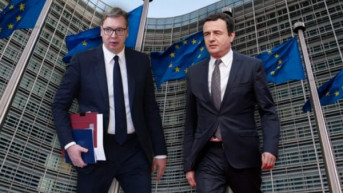
International officials expect renewed momentum and progress in the dialogue between Belgrade and Pristina from Kosovo Prime Minister Albin Kurti, which they clearly conveyed to him through congratulations sent after the formation of the government. Interlocutors of Kosovo Online assess that such messages can be “read” as the European Union expecting dialogue to be the priority topic of the institutions in Pristina and that Brussels will continue to insist in the coming period on the implementation of undertaken obligations. However, it remains questionable whether – and when – real progress in the normalization process will actually occur.
By: Milena Maksimovic
From the loud disagreement of European Union officials with the policies pursued by Albin Kurti during his previous mandate, to congratulations and support for the dialogue process, the distance is short, but the wait for concrete steps in the process conducted in Brussels has been long.
Just a few hours after the election of the new government, the EU High Representative for Foreign Affairs and Security Policy, Kaja Kallas, sent congratulations to Kurti, stating that it was “encouraging news” and represented “new momentum” for progress in the dialogue between Belgrade and Pristina, adding that she was ready to soon host a high-level meeting.
German Chancellor Friedrich Merz also congratulated Kurti, stating that Germany will remain a strong and reliable partner to Pristina in the process of Euro-Atlantic integration, as well as in the continuation of the dialogue with Serbia under the mediation of the European Union. Austrian Foreign Minister Beate Meinl Reisinger assessed that after the formation of the government, Kosovo can move forward in implementing European reforms, make use of funds from the Growth Plan, and achieve progress in the Belgrade-Pristina dialogue.
However, the question remains what the new-old prime minister is ready to fulfill, bearing in mind that the last high-level meeting in Brussels was held on June 26, 2024.
Messages from international officials sent to Kurti after the formation of the government show that for the European Union the dialogue between Belgrade and Pristina and the normalization of relations are strategically important, political scientist Ognjen Gogic assessed. He emphasizes that the EU does not abandon the process even when it appears that there is no progress.
“For the European Union, the dialogue between Belgrade and Pristina and normalization are strategically significant because the current European Commission is pursuing a policy of strategically bringing this region closer to the European Union, that is, the Western Balkans. The issue of relations between Belgrade and Pristina stands out in particular, because it is the most sensitive point of the Western Balkans. That is a relationship that exists and that can threaten regional stability if it does not move in the direction of normalization. For that reason, the EU does not give up on the dialogue, even when it seems as though it is not moving in the desired direction”, Gogic told Kosovo Online.
Gogic stresses that Kaja Kallas’s message was also clear.
“That means she will send an invitation to the leaders from Belgrade and Pristina, because it is believed that conditions now exist to resume dialogue at the highest level after Kosovo finally formed a government following almost a year of institutional vacuum”, he said.
An invitation can be expected soon, Gogic points out, and it remains to be seen whether a direct meeting of the leaders or separate meetings will be organized. However, what is certain is that the European Union will continue to insist on the implementation of undertaken obligations because, as Gogic notes, this is crucial for both Serbia and Kosovo on their path toward the EU.
“The European path of both Serbia and Kosovo, among other things, depends on whether they improve their mutual relations and whether they move along the path of normalization. The European Union does not punish, it does not exert pressure; it pursues a policy of conditionality. That policy essentially means that the EU makes certain benefits available to the parties if they meet the conditions it sets for them. If they do not meet them, if they are not constructive in the dialogue, the EU withholds its support”, he said.
As he explains, this was best seen in the case of Kosovo, which faced EU punitive measures in the form of suspended financial funds.
“The EU sees itself as a mediator, as someone who should help the parties improve their relations, and not as someone who should punish them, because this process is voluntary. The European Union cannot force anyone to implement undertaken obligations; it tries to motivate the parties through benefits it makes available, or by withholding them if there is no progress”, the political scientist said.
In addition to the European Union, Gogic notes that the position of Donald Trump’s administration should also be monitored.
“Last year, the US Congress adopted the National Defense Authorization Act, which contains a special segment called the Western Balkans Prosperity and Democracy Act. Among other things, it addresses relations between Belgrade and Pristina and the normalization process. Interestingly, that law calls on the parties to implement the agreements from Brussels and Ohrid, which will soon mark three years. It is notable that the US administration is not returning to the Washington Agreement, even though it mediated its signing almost six years ago, but is instead insisting on the implementation of the Brussels and Ohrid agreements. The Americans are more inclined toward so-called bulldozer diplomacy, where they expect constructiveness in implementing obligations, with the possibility of applying tougher measures”, Gogic stated.
Professor of Political Science in Pristina Basri Muja, despite the messages sent by international officials to Kosovo Prime Minister Albin Kurti after the formation of the government, does not expect substantive talks between representatives of Kosovo and Serbia this year.
For Muja, the congratulations sent to Kurti after the formation of the government were more than a mere symbolic gesture, but he nevertheless does not believe that pressure will follow to bring about a meeting at the highest level.
As he explained, the High Representative of the European Union for Foreign Affairs and Security Policy, Kaja Kallas, wanted to signal to Kurti to be ready for a summit meeting.
“Congratulations after a victory are more than symbolic. It is certain that Ms. Kallas wanted to tell Mr. Kurti that she expects a high-level meeting to take place soon and that Mr. Kurti should be prepared for it. In this case, I am referring to meetings with the President of Serbia. I do not believe there will be pressure regarding such a meeting and, in all likelihood, there will be parliamentary and presidential elections in Serbia this year. I think that during an election campaign, pressure does not produce significant results, and I do not believe that there will be substantive talks between representatives of Kosovo and Serbia this year”, Muja assessed for Kosovo Online.
Muja points out that Kosovo now has a legitimate government and that, if a presidential election takes place, this would contribute to political stability in the coming period.
“It seems to me that the problem lies with Serbia, because it is facing major internal challenges – political ones, given that for more than a year and a half there have been mass protests by students and citizens. The legitimacy of President Vucic has been seriously undermined and I expect elections to be held this year. In election years it is difficult to exert pressure on political structures because they are not cooperative due to fear of voter reaction. Therefore, I do not expect significant pressure, precisely because of the political situation in Serbia”, Muja concluded.
The Director of the Center for Foreign Policy, Aleksandra Joksimovic, believes that the messages sent to Kosovo Prime Minister Albin Kurti after the formation of the government are very clear – the newly formed institutions in Pristina are expected to make the Belgrade-Pristina dialogue a priority.
Joksimovic points out that the political crisis, that is, the absence of functional institutions in Pristina, made it impossible to conduct dialogue for an extended period.
“As you know, the key goal of the European Union is regional security, within which the intensive dialogue between Belgrade and Pristina is included and constantly insisted upon. At this moment, given that there was no interlocutor in Pristina, that dialogue could not proceed in the way the European Union expects,” Joksimovic told Kosovo Online.
She emphasizes that the message of the High Representative of the European Union for Foreign Affairs and Security Policy, Kaja Kallas, that she is ready to soon host a high-level meeting, is also very clear.
“The message is very clear – it is expected that the priority topic of the newly formed institutions in Pristina will be the dialogue between Belgrade and Pristina. Of course, this will now increase pressure to see some tangible results in that dialogue, which will equally represent pressure on Belgrade. However, in the context of the EU’s desire to ensure stability in its own backyard, I believe that it will insist quite strongly on this issue in the period ahead,” Joksimovic concluded.
The last technical level meeting between representatives of Belgrade and Pristina within the dialogue was held on January 22, 2026, in Brussels.

0 comments