
Expectations from Sorensen: Is there a solution to the deadlock in the Belgrade–Pristina dialogue?
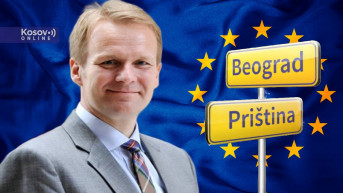
Peter Sorensen has inherited Miroslav Lajcak’s office in Brussels, the phone numbers of the main negotiators, and a "hot potato" – a normalization process stuck in a dead end. Interlocutors of Kosovo Online warn that it is unlikely Sorensen will be able to find a way out of this stalemate without significant support from the EU and the US.
Written by Arsenije Vuckovic
The Danish diplomat and newly appointed EU Envoy for the Belgrade–Pristina dialogue officially starts his mandate on February 1, which will last the next 13 months.
According to the EU Council, Sorensen’s focus will be on continuing the dialogue process, particularly the implementation of the Agreement on the Path to Normalization and its Implementation Annex, adopted in February and March 2023.
While NATO welcomes close cooperation with the new European envoy, Kosovo's Deputy Prime Minister and chief negotiator Besnik Bislimi expects a “balanced approach” from Sorensen, considering it a key prerequisite for success.
In initial reactions, analysts have suggested that Sorensen will bring a new spirit to the negotiations but caution that "miracles should not be expected", despite his Danish background – Denmark being one of the countries that recognized Kosovo.
Dragisa Mijacic, Coordinator of the National Convention on the EU’s Working Group for Chapter 35, believes that Sorensen will focus on technical mediation, while EU foreign policy chief Kaja Kallas will lead the political negotiations.
(Im)possible mission
However, Milica Andric Rakic, Program Manager at the NGO Social Initiative, is skeptical that Sorensen or the EU can change the dialogue’s dynamics.
"It is hard to expect that he can change the dynamic of the dialogue. It is even hard to expect that the EU can push through certain changes in the dialogue. I assume we will see new processes and a return to agreements reached under the Trump administration rather than any progress in implementing what was agreed upon under the EU’s auspices or in signing new agreements," Andric Rakic says for Kosovo Online.
She explains that Sorensen is taking over the dialogue at an extremely difficult time when the process is "essentially in ruins."
"It has become clear that the EU lacks the political power to compel the parties to engage in constructive dialogue. Nothing is changing on a global scale that would alter this atmosphere, making this an incredibly challenging task for him," the analyst emphasizes.
Assessing Sorensen’s potential as a diplomat is difficult, but she does not expect him to achieve anything beyond what his predecessor, Miroslav Lajcak, accomplished.
She also notes that a significant obstacle is that the new European administration is currently focused on Russia and its relations with the United States.
"I don’t expect him to achieve more than what Lajcak did, and unfortunately, in the end, that wasn’t much. Again, this doesn’t depend on the individual mediator but rather on the power of the European Commission, which has so far shown little interest in the Kosovo issue. The main focus has been on Russia, and now it will likely be on relations with America as well. The European Commission and the European Parliament will have far more pressing and serious issues to deal with, and I believe the dialogue will truly be pushed into the background," Andric Rakic concludes.
A "chance to score"
Political analyst Shkelzen Maliqi is also doubtful, stating that it is difficult to predict Sorensen’s moves. However, he does not rule out the possibility that the new EU envoy might “score a goal” by exerting additional pressure on Belgrade and Pristina to conclude the normalization process.
"Many believe that the dialogue has essentially failed and that everything should start over. I don't think that is the case, and I don’t believe the EU will back down because there is a fundamental agreement, even though it hasn’t been signed, both sides have agreed to it, making it a valid international document," Maliqi told Kosovo Online.
He is convinced that the EU will insist on implementing the Ohrid Agreement.
"That is why both sides will be pressured to begin implementing the Ohrid Agreement, which also outlines the method of implementation. Now, I can’t predict how that process will unfold or whether new difficulties will arise. The situation in Serbia is tense, and here, in Kosovo, we are uncertain about the election outcome – whether Kurti will remain in power and continue playing his game that has lasted for three or four years. But I believe there is a chance for progress precisely because the situation has changed and because there is an awareness that this opportunity should be used to overcome a blockade that has lasted two or even ten years," Maliqi emphasized.
His optimism is also based on the fact that, although the dialogue issue remains unchanged, the key European actors are new.
"There is now a completely new European team. It is not just that Lajcak is gone, every other official is new as well. But the situation remains the same. Everything was agreed upon nearly two years ago, and now it should be finalized. First, Serbian elections delayed the resolution of the agreement. Now, it is the Kosovo elections. We will see the outcome very soon," Maliqi stated.
When asked what strategy to expect from the new EU special envoy and how it might differ from Miroslav Lajcak’s approach, Maliqi said that Sorensen’s planned approach remains to be seen.
"That is something we still need to see – what kind of dynamic he envisions. But I believe he won’t miss the chance to score a goal when the opportunity arises. Everything is mostly prepared. Will American assistance be necessary? Probably, but what kind of assistance remains a significant uncertainty," the analyst clarified.
He does not believe that Lajcak should be blamed for the stagnation of the dialogue but rather the reluctance of both Belgrade and Pristina.
With "a new person and new energy in the EU," this could change, Maliqi is convinced.
"Lajcak managed to achieve what has been accomplished so far. That is not a failure. The failure came from Belgrade and Pristina due to their hesitations and differing positions on what they wanted. They refused to implement the agreement due to internal issues. This is an opportunity for a new person with fresh energy to move things forward. Otherwise, the geostrategic situation is so complex and risky that I don’t see an alternative to at least stabilizing this region to some extent," Maliqi concluded.
Washington's role
Historian Stefan Radojkovic told Kosovo Online that Sorensen’s influence on the dialogue will only go as far as Brussels’ ability to pressure Belgrade and Pristina into being more constructive. However, he emphasized that the process ultimately depends on Washington’s willingness to participate in resolving the issue.
"He will be powerful and influential only to the extent that the EU and Brussels can push Serbia and Pristina to conduct the dialogue in a more constructive manner. However, the biggest part of this will primarily depend on Washington and the developments in Pristina and Serbia," Radojkovic said.
He is not only referring to the upcoming February elections but also to all the previous unilateral moves by Pristina aimed at the Serbian community.
"All of this will affect the scope of the dialogue. Likewise, Serbia has every right to be extremely dissatisfied with Pristina’s behavior and, therefore, to potentially suspend its participation in the dialogue for a certain period until the situation improves, at least regarding the position of Serbs and other Serbian citizens in Kosovo and Metohija," Radojkovic said.
Even without the current issues on the ground, he notes that Sorensen himself will have little direct influence on the dialogue process.
"He may try to use his personal expertise and charisma to encourage goodwill between Belgrade and Pristina, but his strength will only be as great as Brussels' influence. Given the current balance of power in Europe and the world, especially in the Balkans, Washington appears to be the decisive factor. If he gains Washington’s support, he will carry some weight. If he does not, or if Washington simply has no interest in Brussels’ dialogue – which can be inferred from Donald Trump’s foreign policy, at least his rhetoric – then the Balkans will not even be at the bottom of Washington’s foreign policy priorities. Consequently, Sorensen’s influence will be proportional to that of Brussels and the EU, which is not expected to be significant," Radojkovic emphasizes.
When asked how Sorensen’s engagement might differ from Miroslav Lajcak’s mandate, Radojkovic points out that the Danish diplomat is well-acquainted not only with the Balkans but also with Kosovo, which will enable him to "speak a language that local actors understand."
"What might set him apart from Lajcak is that he spent some time in Kosovo and Metohija during an extremely tense and negative period, marked by violence against Serbs, Roma, Ashkali... This was the time of the March Pogrom. He knows what cards Pristina holds. He is well-versed in the Balkans, having served in Belgrade, Zagreb, and Sarajevo, so he understands the entire region. In that sense, he might be able to communicate in a way that is more comprehensible to local actors," Radojkovic explains.
However, he reiterates that it is difficult to expect that, as an individual, Sorensen will be able to implement any of the previously agreed-upon measures.
"As an individual, he will not be able to do much, even though his mandate is to work on implementing what was agreed upon in Ohrid and in the Agreement on the Path to Normalization, which is all part of the Brussels dialogue. I believe everything will depend on Washington, developments on the ground, and the actions of local actors – Belgrade and Pristina," Radojkovic concludes.

0 comments