
False narratives about the pogrom persist even after two decades: Who fuels the rhetoric that set Kosovo ablaze?
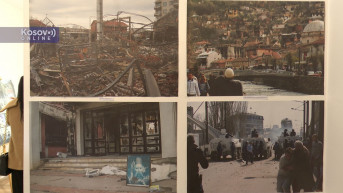
“Repeat a lie twice and it becomes the truth”—but what happens when false information is repeated for more than two decades? A false report accusing Serbs of drowning Albanian boys in Cabra triggered a wave of violence on March 17, 2004. Representatives of the journalistic community told Kosovo Online that Albanian-language media, by spreading disinformation, played a key role in the pogrom that followed. They also stress that unprofessional reporting continues even 22 years later, sustaining inaccurate narratives that hinder reconciliation.
Written by: Milena Maksimovic
No one has ever been held accountable for the false report broadcast at the time by the public broadcaster Radio Television of Kosovo, nor for its subsequent dissemination.
It appears that there will be no accountability for further inaccuracies related to that either. However, one community will remember that in the wave of violence, eight Serbs were killed, at least 170 injured, and more than 4,000 displaced, while nearly 900 Serbian homes were destroyed and 35 religious sites burned, including 18 cultural monuments.
This March 17 as well, Albanian-language media again blamed Serbs for the drowning of the boys in Cabra, without reference to reports by international missions and organizations such as United Nations Interim Administration Mission in Kosovo, Organization for
Security and Co-operation in Europe, and Human Rights Watch, all of which confirmed that the false report broadcast in Albanian media triggered the violence in which 23 people were killed, the Association of Journalists of Serbia warned.
Political figures were no more restrained. The mayor of South Mitrovica, Faton Peci, while laying a wreath at the children’s graves, stated that they had been stopped mid-play “by an organized group of Serbs.”
A group of non-governmental organizations issued a joint appeal to institutions in Kosovo, the media, and the international community to respect established facts and adhere to professional standards regarding the March 2004 violence, warning about harmful rhetoric by political leaders and certain media outlets.
The Initial Trigger
Interviewees stress that the false report was the spark for the ensuing violence, but that even 22 years later, media continue to treat the event unprofessionally.
Zivojin Rakocevic, President of the Association of Journalists of Serbia (UNS), stated that March 17, 2004, was a moment when it became important “to finish off the Serbs—their culture, spirituality, statehood, and all their distinctiveness,” with Albanian-language media acting as the trigger and “initial detonator.”
He attributes responsibility for the catastrophe to a non-democratic and totalitarian environment, recalling that the spark was the false report about Albanian boys drowning in the Ibar River, for which Serbs were blamed.
“At that moment, that spark caused an explosion in a society that could not accept others and differences. That media totalitarianism, directed at Serbs, amounted to targeting across cities, villages, churches, and micro-communities that had survived from 1999 to 2004,” Rakocevic said.
He added that the media “conducted a witch hunt,” citing OSCE records noting that while Serbian churches were burning, RTK correspondents reported that “the situation in the city is calm.”
“When a system decides to carry out a final reckoning with a group, truth becomes irrelevant. There are no internal mechanisms left to prevent the spread of hatred,” he emphasized.
A Crime Without Punishment
Rakocevic highlighted the absence of accountability, both for perpetrators and for those who spread the false report.
“The perpetrators should have been punished, but that has been minimal and negligible. At the same time, media identified as the trigger—primarily RTK and the liberal daily ‘Koha Ditore’—represent a paradox: the issue was not calls to violence, but the fact that the majority believed them,” he said.
He also pointed to a controversial article published at the time in “Koha Ditore,” warning that Serbs “colonizing Kosovo” were legitimate targets, authored by a person whose identity was never clarified.
Responsibility of the International Community
Vladimir Radomirovic, editor-in-chief of the portal Pistaljka, emphasized that responsibility for the 2004 violence also lies with international actors tasked with ensuring security under UN Security Council Resolution 1244, particularly KFOR and UN missions.
“KFOR was supposed to guarantee full security, especially for Serbs and other vulnerable communities. It failed to do so, and the United Nations mission did not pursue accountability for those failures,” Radomirovic stated.
He warned that false narratives continue to appear in Albanian-language media even today, including repeated claims that Serbs chased Albanian children into the Ibar River.
“These narratives persist thanks to so-called liberal media that were heavily supported by Western countries, while no one has ever been held accountable for inciting violence,” he added.
According to him, instead of improving the security of Serbs, the consequences of the violence were used to intensify pressure, contributing to the later unilateral declaration of Kosovo’s independence.
Still Unknown: Who Organized the Violence?
Ivana Vanovac, President of the Association of Journalists of Kosovo and Metohija (DNKiM), noted that even today it remains unclear who organized the violence of March 17–18, although it is known who significantly contributed to mobilizing the public—namely, the media that published the false report.
She stressed that investigations conducted by international bodies showed that the Serbian community had no connection to the drowning of the boys in Cabra.
“If we continuously revive the narrative of collective guilt, we risk seeing the same escalation every year on March 17,” Vanovac warned.
She concluded that editorial policies and those behind them bear responsibility for how the events are still reported today, adding that genuine reconciliation will only begin when media on all sides change their approach to such sensitive issues.



0 comments