
Rakocevic: False narratives of media in Pristina about March 17 are part of the psychology of a final reckoning with Serbs
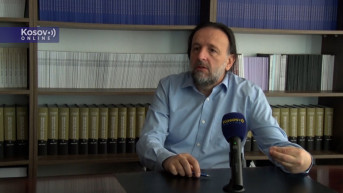
President of the Association of Journalists of Serbia Zivojin Rakocevic believes that March 17, 2004 was one of the dates when it was important to complete a final reckoning with Serbs – with their culture, spirituality, state, and all their particularities – and that certain Albanian media at the time were merely a trigger which, even today, 22 years later, is waiting to carry out the dark desires of a system that has brought almost no good to its citizens.
Despite the existence of confirmed facts and international documentation about March 17, 2004, more than two decades later inaccurate claims about the causes that triggered the wave of violence against non-majority communities in Kosovo continue to spread in the Albanian public. Rakocevic believes that the catastrophe that followed was caused by an undemocratic and totalitarian environment, reminding that the trigger was false news about the drowning of Albanian boys in the Ibar River, which was blamed on Serbs.
“At that moment, that fuse caused an explosion in a society that could not accept others and those who are different. And that media totalitarianism, which at that moment was directed against Serbs, was a classic targeting of places in cities, villages, churches, and those micro-communities and ghettos that had survived from 1999 to 2004. So you had media that on that day filmed and broadcast footage of some bones and claimed that Serbs had killed Albanians in 1999 and kept those bones. After that, there was not a single moment in which that Serbian community could survive, it was not given even the minimum possibility to survive,” Rakocevic told Kosovo Online.
He recalls that the media at the time were “leading a witch hunt.”
“There is a record by the OSCE: a correspondent of the public broadcaster RTK reports from Djakovica and says ‘the situation in the city is calm’, while a Serbian church is burning. That is absolute indifference. There is no other side there. The other side is condemned to disappearance,” Rakocevic emphasized.
He states that March 17 was one of the dates when it was important to complete a final reckoning with Serbs.
“When a community, a group, a system, a society decides to carry out a final reckoning with someone, then truth is absolutely not important. There are no internal mechanisms left that would prevent you, in relation to others and those who are different and to the truth, from spreading hatred and renewing the possibility of conflict. Because the issue here is not that you spread false news out of inertia or because it suits public opinion, the issue is that an entire system is striving to continue the psychology of a final reckoning,” Rakocevic said.
The consequences of such a narrative are catastrophic, he points out, because there has been no progress among those who spread the false news or among the perpetrators, nor have there been punishments.
“The perpetrators should have been punished and the hand of justice should have reached them, and that is absolutely minimal and negligible. On the other hand, the media identified as the trigger – primarily the public broadcaster Radio Television of Kosovo and the most liberal newspaper among Kosovo Albanians ‘Koha Ditore’ – represent a paradox in which the problem was not the marching calls and incitements to attack by media advocating war goals, but that the majority believed them. It was necessary for the public broadcaster to send such false news about the killing of children into the public, as well as for ‘Koha Ditore’, as a liberal newspaper, which published the text ‘Beware, Serbs are colonizing Kosovo’,” he said.
He adds that the text was signed by a man named Petar Rogel, whose identity was never established, and who claimed that Serbs from the Belgrade regime settling in Kosovo were legitimate targets.
“At that moment, it was felt that return could happen, and that is why one of the goals was achieved – preventing the return of Serbs to cities in Kosovo and Metohija after March 17. 236,000 expelled people were forgotten, and after that, everything was a farce, nothing could happen,” Rakocevic said.
He notes that when a community decides to “eradicate” someone in such a way, truth is no longer important and only justification for a final reckoning is sought “with others, those who are different, and those you have labeled as age-old enemies.”
“How is that possible? What did the international community do? Has the past 27 years been just a time in which we are waiting to confront one another? How is it possible that in history and in this region we have had much more tragic and bloody conflicts, but imagine a Europe in which, 27 years after a war, even among the fiercest and bloodiest enemies, a community in a certain territory suffers in the way Serbs suffer today and live in this system – that is completely unimaginable. Which means that behind everything lies insecurity and a need to manifest that insecurity through conflict. The majority, even of liberal, public, and other figures, do not have the strength to say: ‘Wait, leave that church in Pristina’, ‘What is the problem with having a temple’, ‘What is the problem with someone thinking differently’,” Rakocevic emphasized.
He notes that the narratives and ideas of March 17 have been embedded in the psychology and methodology of a final reckoning, and that the key question is how to survive them.
“We can survive them if we develop pluralism, normality, and examples within our communities that we must never think in a totalitarian and exclusionary way, nor in the psychology of a final reckoning, when it comes to others and those who are different. Unfortunately, we are the target of such thinking, and the media are the trigger waiting to carry out the dark desires of a system that has not found its purpose and has brought almost no good to its citizens,” Rakocevic concluded.
0 comments