
Has the Constitutional Court untied or further tangled Kosovo’s political gordian knot?
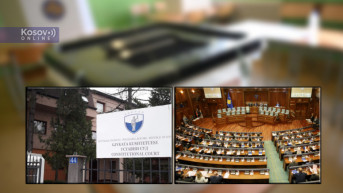
The term “Gordian knot” aptly describes the months-long institutional crisis in Kosovo. Analysts argue that instead of resolving the issue, the Constitutional Court’s decision has further complicated the situation. All signs now point to early elections, according to interlocutors of Kosovo Online.
Written by: Djordje Barovic
On 26 June, the Constitutional Court of Kosovo ruled that MPs must conclude the constitution of the Assembly within 30 days.
This was in response to a question posed in May by the Alliance for the Future of Kosovo regarding the constitutionality of the Self-Determination Movement’s decision to hold a secret vote for electing the new Speaker of Parliament.
No one seems to have a clear answer on how to implement this decision, with political party representatives offering their own interpretations.
Self-Determination MP Mimoza Kusari-Lila announced that she would request a new interpretation from the Constitutional Court regarding the opposition’s non-participation in the vote.
“We do not share the same interpretation of the Constitutional Court’s decision – it is clear that it has not clarified the situation but rather made it more complex,” Kusari-Lila said.
Still, analysts mostly point the finger at Self-Determination as the main culprit.
Kosovo Democratic Institute associate Eugen Cakolli accused acting Speaker Avni Dehari of violating both MPs’ constitutional rights and the Court’s ruling by continuously adjourning the constitutive session.
“This is not only a violation of the Constitutional Court’s decision, but also of MPs’ constitutional right to vote,” Cakolli wrote on Facebook.
Some remain pessimistic about the Assembly being constituted within the 30-day deadline.
Political analyst Halil Matoshi places the blame squarely on Albin Kurti.
“I don’t expect the Assembly to be constituted within the Constitutional Court’s deadline because Kurti refuses to respond to the will of the people, and the formerly demonized opposition cannot stop him,” Matoshi said.
Uncertainties and the Lack of Consensus
Political scientist Ognjen Gogic believes the Constitutional Court's decision has not resolved but only deepened the institutional crisis, with the core issue being that Kurti lacks a majority while the opposition lacks the will to form a government.
“The ruling has done little to solve the crisis, as parties have taken entirely different interpretations of what the Court actually decided. Most likely, the impasse will continue, and we’ll see more failed sessions because there is no consensus on how to move forward,” Gogic told Kosovo Online.
According to him, a major question mark is what happens after the 30-day deadline imposed by the Court.
“Neither the Constitution nor the Court’s ruling clarifies what should happen if the Assembly is not constituted within that period. It may fall to the Court to clarify whether President Osmani could then dissolve the Assembly. That’s a legal grey area,” Gogic explained.
He also warned that beyond the failure to form the Assembly, there is no agreement on a governing majority.
“So far, neither the government nor the opposition has declared they’ve secured a new majority. If they had, everything would be resolved,” he said.
Gogic considers procedural issues, such as whether the Speaker should be elected by secret or open ballot, or the nomination of Albulena Haxhiu, as peripheral distractions.
“These are artificial issues meant to mask the fact that no one is willing—or able—to form a government,” Gogic emphasized.
He views the nominee’s identity as a political smokescreen: the opposition knows Kurti won’t back down, but also wouldn’t support any other Self-Determination candidate.
He outlined two possible scenarios to resolve the crisis:
- The opposition forms a government – “According to the Constitution, the winning party proposes the candidate, but that doesn’t mean the candidate has to be from that party. The opposition could tell Kurti they’ve agreed to form a government and propose their own candidate. Nothing stops him from doing that. The Constitutional Court emphasized the need for dialogue and consensus-building,” Gogic said.
- The opposition tactically votes for Haxhiu to constitute the Assembly – “This would open the legal path for them to form a government. Kurti has no majority to elect the Speaker or a government, and the opposition doesn’t want to take responsibility either, resulting in a stalemate,” Gogic concluded.
(Un)clear Deadlines
What happens after the 30-day deadline remains the “million-dollar question,” and even those who should know the answer, don’t.
Former President of the Constitutional Court Enver Hasani said the ruling is unclear both for politicians and the public and that the real issue lies not just in the reasoning but in the operative part, which fails to specify the next steps.
“For clarity and coherence, the ruling should have explicitly stated what the Constitution requires in this case under Article 90,” Hasani stated.
Former Vice-President of the Constitutional Court Kadri Kryeziu told Kosovo Online the decision is binding for all MPs, and failure to comply gives President Osmani the option of calling snap elections.
“There is a deadline, and if it’s not met, the President has the power to dissolve the Assembly and call extraordinary elections,” Kryeziu said.
He explained that the Court’s ruling effectively functions as a legal order.
“Each MP is obligated to form the parliamentary institutions, specifically by electing the Speaker and Deputy Speakers,” he added.
Kryeziu is confident that the new Assembly will be constituted within the 30-day deadline.
“I believe the Assembly will be formed within 10 days. If MPs ignore the Constitutional Court’s binding decision, then the President can call snap elections,” he clarified.
He also pointed out that two Deputy Speakers must be chosen from minority communities—one from the Serb community and one from other non-majority groups.
“If that is not achieved, the President can intervene,” Kryeziu noted.
Compromise and Consequences
Petar Ivic, an associate of the Pupin Initiative, also believes Kosovo is heading toward early elections.
“The political crisis is long-standing, deep, and highly polarizing. None of the actors is ready to make a real compromise. Self-Determination is trying to push through their nominee for Speaker to offset their electoral decline. The opposition knows this and won’t let them succeed, hoping for new elections and further weakening of Self-Determination,” Ivic told Kosovo Online.
Commenting on the Court’s decision and the 30-day deadline, Ivic doesn’t foresee a resolution.
“In the next 30 days, we can expect more futile attempts to form the Assembly and likely the announcement of snap parliamentary elections. Even if the Assembly is formed, that doesn’t guarantee a government will be elected. Given the polarization, that’s unlikely, so elections seem inevitable,” Ivic said.
Asked about Kurti’s failed meeting with opposition parties, Ivic noted that Self-Determination isn’t ready for a real compromise.
“Kurti offers ‘compromises’ that are not real. For instance, he proposes secret ballots, which are less transparent. The opposition is aware of this. Until Self-Determination offers a genuine compromise, the status quo will only drag on,” he argued.
He sees a change in Self-Determination’s candidate as the most logical, but least likely, way out of the crisis.
“In normal circumstances, the logical step would be for Self-Determination to propose a new candidate. But that’s unlikely,” he said.
He also noted a legal ambiguity: President Osmani may not be able to dissolve a parliament that hasn’t yet been constituted.
However, he added, there is a constitutional provision allowing Osmani, upon Kurti’s formal proposal, to dissolve the Assembly and call elections.
Calling new elections seems the most likely outcome, Ivic believes, but the ruling party will try to align them with upcoming local elections.
“In political science, it’s well established that when parliamentary and local elections are held close together—or overlap—it tends to benefit the dominant party, in this case Self-Determination,” Ivic concluded.



0 comments