
How will Dora Bakoyannis's report affect Kosovo's further path towards joining the Council of Europe?
Awaiting the report of Dora Bakoyannis, the rapporteur for Kosovo in the Parliamentary Assembly of the Council of Europe, following her visit to Kosovo last week, Kosovo Online's interlocutors suggest that if the report presents a realistic picture of the situation on the ground, it will not serve as an argument for Kosovo's membership in this European institution, primarily because there is a lack of respect for human rights in Kosovo. They also point out that Kosovo's membership in the Council of Europe would be a violation of the CoE Statute and everything the CoE stands for.
As a reminder, Kosovo submitted its application for membership in the Council of Europe on May 12, 2022. Last week, former Greek Foreign Minister Dora Bakoyannis, in her capacity as the rapporteur for Kosovo in the Parliamentary Assembly of the Council of Europe, visited Kosovo. It is expected that she will prepare a report for the Committee on Political Affairs of the PACE, which will discuss and vote on it in the coming period. According to what the PACE Press Service said to Kosovo Online, her report will take into account the report prepared by two eminent legal experts assessing the compliance of Kosovo's legal system with the Council of Europe's standards.
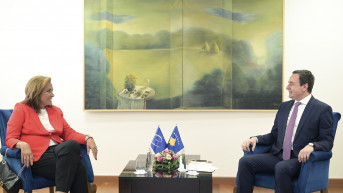
During her visit to Kosovo, Bakoyannis met with the Prime Minister and President of Kosovo, the delegation of the Serb List, and the abbot of Visoki Decani Monastery, Sava Janjic, among others. She did not make public statements, but according to the Government of Kosovo statement, Bakoyannis "expressed satisfaction with the change and progress that Kosovo has made since her last visit 14 years ago".
While the representatives of the Serb List pointed out during their meeting with Bakoyannis that the Serbs in these areas were in the worst position since 1999, the President and Prime Minister of Kosovo assured her that Kosovo was committed to fulfilling all Council of Europe standards, including democracy, human rights, and the rule of law.
The next phase in the process of considering Kosovo's membership request in the CoE also involves the Committees on Legal Affairs and Human Rights and the Committee on Equality and Non-Discrimination preparing separate opinions, with the rapporteurs of these committees visiting Kosovo by the end of the year.
Slobodan Zecevic, a scientific advisor at the Institute for European Studies, says for Kosovo Online that if the report by rapporteur Dora Bakoyannis is favorable, it could "push" Kosovo toward CoE membership, but it can only be favorable if it presents a false picture of the situation on the ground.
"If a false image is presented, one where national minor
ities live entirely normal, where the Serbian Orthodox Church is not under pressure, where there is no attempt to appropriate the property of the SOC in historical and physical terms, as some of the Church's land has been usurped, then it can be considered positive", Zecevic added.
As he adds the reality on the ground is entirely different from what can be seen in the resolutions of the European Parliament or in some reports by Western intermediaries and rapporteurs.
"It's a completely different reality. If they create a report based on some fictional reality, they will say that everything is fine, Kurti is a champion of democracy, the SOC is not endangered, nor are the Serbs; everything is fine. If they make an objective report, they will see that there are many problems, primarily related to the Community of Serb-majority Municipalities", Zecevic notes.
During the meeting with Bakoyannis, Kosovo's President Vjosa Osmani pointed out that since the Council of Europe was celebrating its 75th anniversary next year, it would be "symbolic" for the CoE to open its doors to Kosovo. However, Biljana Pantic Pilja, the head of the Serbian delegation to the CoE, said that at this moment, it was difficult to predict whether Kosovo would become a full member of this organization. While there were pressures from some countries, there was also a lack of unity among the CoE member states.
"It is difficult to predict whether this will happen. In my opinion, it would be a violation of the Statute of the PACE, and everything that the PACE actually stands for because we have never had a situation where an entity is admitted as a member state. That's the first point. Second, it is also difficult to foresee how the voting will go. A decision requires a two-thirds majority vote. I sincerely hope that the procedure will proceed as it should, but so far, we have seen that the PACE, under pressure from some countries, does not respect the procedure and the Statute. As a Serbian delegation, we have raised this issue every time it comes up for discussion", Pantic Pilja said.
She adds that regarding the respect for human rights, which the PACE advocates for, there is none of that in Kosovo, especially when it comes to the Serbs.
"As for the respect for human rights in so-called Kosovo, I consider it nonsense because it is clear to everyone, which the Serbian delegation regularly emphasizes, that there is no respect for human rights toward the non-Albanian population, especially towards the Serbs. Just remember the attacks on children who were carrying the Serbian Christmas tree and how many people were expelled during the Kurti regime. So, if the report is realistic about how things are really happening, I am confident it will show that there is no respect for human rights in so-called Kosovo, especially towards the non-Albanian population. We'll see what the Committee on Equality and Non-Discrimination, which is responsible for monitoring compliance with certain regulations in so-called Kosovo, has to say", Pilja says.
She emphasizes, however, that Pristina continuously exerts pressure.
"We constantly encounter this in the PACE. They exert pressure on certain countries, emphasizing that Kosovo is a democratic country, respects all rights and regulations, and should become a full member. But this is where we put the brakes on and say, 'No, first, you are not a country, but an entity'. We emphasize the need to respect the UN Resolution, stating that human rights are not respected. As the Serbian delegation, we will continue to fight against their admission because we consider it a gross violation of the Council of Europe's Statute, which is one thing. Secondly, it has been shown within the CoE that there is no unity on this issue, and this method particularly disrupts that unity within the CoE when there are challenging times, such as conflicts concerning Russia and Ukraine, Palestine and Israel. Some countries have especially shown that they have double standards and do not respect the norms of international law concerning the admission of so-called Kosovo", Pilja said.
Our interlocutor stated that Bakoyannis would present a brief report in December at the Political Committee of the PACE, which would be subject to discussion.
"In terms of the debate, I'm sure there will be a thorough discussion of this report in the relevant Committee, amendments will be introduced, and I'm confident that the Serbian delegation will have amendments to submit. But let's not prejudge; we don't know what Bakoyannis' report will look like", Pilja said.
She adds that when the report is adopted, it goes to the plenary, where a two-thirds majority is required for approval.
"Two-thirds of the PACE members need to support the report, and then the statutory opinion is sent to the Committee of Ministers, which decides on the admission of a country to full membership in the PACE, which would not be the case here, as so-called Kosovo is not a country, but an entity, as we regularly emphasize," Pantic Pilja said.
As for the timing of the voting process in the PACE on Kosovo's membership request, after the "fieldwork" was completed, the PACE Press Service did not provide a specific answer.
"The full Assembly will hold a plenary debate in the near future and will vote on its opinion on the membership request, which will then be forwarded to the Committee of Ministers of the Council of Europe. The date for this debate has not been determined", the PACE Press Service stated.
Kosovo's request for admission to the Council of Europe, submitted in 2022, remained "frozen" for an entire year until the Committee of Ministers of the Council of Europe decided on April 24 of this year to forward it for further consideration to the Parliamentary Assembly of the Council of Europe. During the Committee's decision-making process, the countries that voted against initiating the procedure for deciding on Pristina's request were Hungary, Azerbaijan, Georgia, Romania, Cyprus, Spain, and Serbia. Kosovo received support from 33 countries, including the regional countries of Montenegro, Slovenia, North Macedonia, Croatia, and Albania.


0 comments