
Increasing complaints from Serbs on the work of Kosovo Police: Law enforcement or repression?
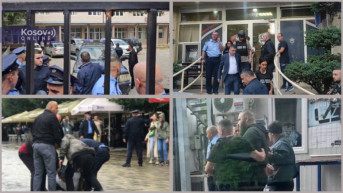
Numerous non-governmental organizations, not just in the north of Kosovo, have been alerting to numerous irregularities in the work of the Kosovo Police, especially in Serbian communities, over recent months. The number of citizen complaints has also increased, with the Kosovo Police Inspectorate (PIK) receiving 21 percent more last year compared to 2023. Speakers at Kosovo Online warn that this is a dangerous trend in which the meanings of "law enforcement" and "repression" can easily be confused.
Written by: Arsenije Vuckovic
"One of the most common complaints is precisely the use of force and improper communication between police officers and citizens. Then, there are complaints about the abuse of official duties, complaints related to bribery, and other cases of a different nature including accidents involving police officers, how cases are handled, delays in case management," stated PIK chief Kustrim Hodaj.
He noted that PIK received 1,900 complaints from citizens about the conduct of police officers in 2024, which is 21 percent more than in 2023.
Many NGOs consistently point out that the police, especially in the north of Kosovo, exceed their powers, often using brutal force.
"Our children were on the ground, in the street; they were harassed, literally trampled on them. The cries of my son and other children were silenced with knees," recounted Ljubomir Milic, the father of one of the four young men who were arrested in North Mitrovica last September for disturbing public order and peace by singing.
However, this is just one example of the brutal use of force that repeated even after the explosion at the Ibar-Lepenac water canal.
And it was not only members of the Serbian community who were targeted.
A group of NGOs from the north of Kosovo reported that during a raid by Kosovo Police in North Mitrovica on November 30, there was a serious violation of human rights, including physical violence, excessive use of force, and verbal and psychological abuse against the vice-president of the Roma Initiative party Gzim Jahirovic, his wife Sultana, and their extended family, but similar testimonies also come from the citizens of Zvecan and Zubin Potok.
"Gzim Jahirovic stated to the media that during the raid he was subjected to brutal beatings and humiliation, while his wife suffered sexual harassment by the police officers. Their children witnessed these horrible events, which constitutes an additional violation of the right to family security," the statement said.
NGOs from the north have repeatedly appealed to the competent institutions, but also to representatives of the international community because of abuses and harassment of citizens of Serbian nationality.
In the study "Ethnicization of Kosovo Police: Undermining the Foundations of Ahtisaari's Civil and Multiethnic Institution," five NGOs at the end of last year indicated that an increasing number of Kosovo Police officers publicly display or carry legally prohibited symbols, such as those of Albania or "Greater Albania," the former KLA, symbols "panisera" on which are a skull and Albanian flag...
Ethnonationalization
One of the authors of this study, NGO program manager Social Initiative Milica Andric Rakic, in a conversation for Kosovo Online, says that citizens in the north of Kosovo have many reasons for dissatisfaction with the police's work and that the only way is changing the political messages that incite ethnonationalism and undemocratic approach to the Serbian community.
"Since Self-Determination took power in Kosovo, governance has been characterized by nationalism and populism. This damages the multiethnic character of institutions and interethnic relations. And it started from the top and it needs to start being corrected from there. It is crucial to change those political messages coming from the top, which encourage ethnonationalism and a treatment towards the Serbian community that is simply not democratic," emphasizes Andric Rakic.
She highlights that there have been numerous examples of clear mistakes in the police's conduct in minority communities, as well as incidents.
The latest incident includes the accidental discharge of a gun by a police officer in Zvecan, where the response was that "more training is needed."
"There were also shootings in Bistrica, twice. A first-instance verdict has recently been issued for one of them. Therefore, there are many reasons why there is apprehension in the Serbian community about the way the police behave, primarily based on these examples of police unprofessionalism and then the lack of timely reactions from the institutions to this unprofessionalism, which creates the impression that there is a certain readiness to forgive the police officers for their unprofessionalism," emphasizes Andric Rakic.
She explains that there have been a lot of problems with establishing a normal relationship between the Serbian community and the Kosovo Police.
"It actually started with the Kosovo Police's inability to establish a normal relationship within the police itself. If we had had a balanced relationship and a relationship of trust between the Regional Police Directorate North and the Police Directorate in Pristina since September 2021 when the crisis began, we would not have come to the situation where Serbs massively in the north leave the Kosovo Police," stresses this activist.
She adds that whether one believes or not that members of the police from the Serbian community left the KP due to political pressures, the facts show that at the crucial moment the Kosovo Police as an institution was not capable of defending its multiethnicity because from the beginning there was no trust between Serbian and Albanian police officers.
"Of course, if you cannot establish a normal relationship of trust with colleagues, then this later transfers to the community itself and of course there are problems with selectivity when it comes to some police practices in minority communities, especially when you get to the stage where the police is no longer practically multiethnic or has a very small number of minority community members who are mostly not in the field. Either they are in the station or maybe in traffic controls, but basically, there are very few in the city. In this sense, there are many problems with the way the police perform their duties among minority communities," emphasizes Andric Rakic.
Instrumentalization
Assistant Professor at the Faculty of Political Sciences in Belgrade, Stefan Surlic, says in a conversation for Kosovo Online that the security issue is key for northern Kosovo, and that the actions of the Kosovo Police seem as if they are an instrument for discriminating against the Serbian community.
"It seems that today in northern Kosovo, the police are an instrument for discriminating against the Serbian community and something must be urgently changed about this. We cannot talk about any kind of integration or survival of the Serbs if their safety and security in everyday life are not primarily guaranteed," stated Surlic for Kosovo Online.
He believes that the security issue is key for northern Kosovo, which is why the topic of the return of Serbs to the Kosovo Police should be part of the dialogue between Belgrade and Pristina, but also to be implemented immediately after the February elections.
"The security issue is a key issue in northern Kosovo and it needs to be addressed at the beginning of the year. Both parliamentary and local elections are just an opportunity to start a process, primarily the return of Serbs to the police, and this is something that must be among the first points in the dialogue between Belgrade and Pristina. It is obvious that this police is completely identified, Albanian. Citizens in northern Kosovo do not feel safe and therefore report various kinds of harassment, have complaints about treatment, we have had cases of beatings by the police, completely unjustified arrests, and everything else," believes Surlic.
He also explains that the Government of Kosovo has presented to the public that the Serbian community in northern Kosovo is frightened by Belgrade and some Serbian formations and that the arrival of the Kosovo Police will instill confidence.
"What happened from that story of the Kosovo government to what we now see on the ground? There is a huge difference between what Pristina represents as the role of the police in the north and what the citizens feel on the ground. They do not see the police as a friendly formation, they see the police as a repressive apparatus that builds special bases, which appears there only in special formations with long barrels. And that is not an atmosphere in which we can talk about any kind of building trust or a kind of voluntary integration of the Serbian community into Kosovo society," concludes Surlic.
He believes that the language barrier is also a problem.
"Serbs are used to having, for a hundred years, their own police who speak their language and who are theirs. And now suddenly you have a police force that altogether does not understand the language spoken in that community," observes Spahiu.
Perception of Guilt
Marija Marsenic, a sociologist at the Institute for European Studies, believes that the numerous complaints from the Serbian community about the work of the Kosovo Police show that this institution is not serving them, and there are numerous reasons for this, including the fact that Serbs are perceived as "guilty of everything."
"The Kosovo Police cannot be said to serve the Serbian community in Kosovo and Metohija, nor do they perceive it as an institution that is in their interest, but rather as an extended arm of the so-called Kosovo regime," highlights Marsenic for Kosovo Online.
She sees one of the main obstacles as the inability to communicate, followed by the attitude that "Serbs are always to blame."
"Older police officers of the Kosovo Police who know the Serbian language often refuse to speak it, and younger members of the Kosovo Police do not want to speak Serbian, so in the first place, there is this language barrier in communication. Also, there is this indoctrination of the members of the Kosovo Police that Serbs should not be trusted and that Serbs are always guilty. It would be redundant to list how many times Serbs have been subjected to harassment at checkpoints, excessive searches, verbal and physical violence, arrests, beatings. Unfortunately, this police brutality is still present," says Marsenic.
She believes that the distrust of the Serbian community in the Kosovo Police grew even more when their representatives left this institution.
"It's simply impossible to trust an institution that perceives all Serbs as terrorists," emphasizes Marsenic.
She adds that there are a number of factors, including repressive measures, that cause this situation and distrust.
"The composition of the police in Serbian communities often does not match the ethnic structure of the local population, which is one of the main conditions of all signed agreements. This leads to a feeling among the Serbs that the police simply do not act in their interest. Also, the use of repressive methods by the Kosovo Police is another reason for this distrust, for eroded trust, because every time they leave their homes, Serbs risk being arrested, being beaten, being subjected to insults and verbal violence," emphasizes Marsenic.
She also points out the lack of legal protection.
"Serbs often feel that they do not have access to justice through Kosovo institutions because the courts and police favor the Albanian majority. In many cases, complaints against members of the Kosovo Police have gone unpunished or even unconsidered, so Serbs feel that these legal mechanisms operate inefficiently and selectively," believes Marsenic.
This can only change if Serbs realize that this police is "theirs."
"For the Kosovo Police to become more effective in serving the citizens of the Serbian community, it must develop the ability to act without political and ethnic pressures and must be trained to work in multiethnic environments, with a special emphasis on human rights and understanding cultural differences. Thus, Serbs in northern Kosovo and Metohija often feel that the police are not 'theirs.' This is because they do not have representatives in the Kosovo Police, so increasing the number of Serbs could potentially contribute to greater community trust in this institution," concludes Marsenic.
Encouraging Ethnization
Milos Pavkovic, an associate at the Center for European Policies, emphasizes for Kosovo Online that the key problem of the illegal actions of the Kosovo Police in the north is the ethnization and nationalism of the police encouraged by the highest officials in Pristina with their statements and the lack of punishment for those responsible.
"This leads to a very unstable situation. The enforcement of law and order is basic, and these police officers are violating some codes of conduct and the Law on the Kosovo Police Service. That is one thing. Another is whether the government in Pristina encourages such behavior of Kosovo police officers because their inactivity means the Police Inspectorate does not sanction them at all. At the same time, from Pristina, from the highest political officials, we get similar messages, promoting Greater Albania and changing borders. This actually represents, in a way, a tailwind for these officers to behave and simply absorb this nationalist behavior. Primarily, I am thinking of the role of the Prime Minister of Kosovo, but also other high officials. Here, the problem is the violation of the law and actually the lack of desire to sanction these police officers. But, their existence in northern Kosovo is also problematic and questionable," believes Pavkovic.
Pavkovic identifies four factors contributing to the Serbian community's distrust in the Kosovo Police: ethnic composition, language barriers, the ethnization of the force, and the use of special police units.
"The root of the distrust is that it is ethnically Albanian police, although Kosovo's laws stipulate that the police composition must represent the ethnic makeup of that part of the territory. Given that Serbs left the Kosovo Police and all other institutions in November 2022, there are now no Serbian police officers, which is a key cause of distrust," says Pavkovic.
He sees the language barrier as another factor of distrust, despite Serbian being one of the official languages in Kosovo.
"This then creates a problem in communication, as citizens simply do not have a way to communicate with that police. This creates a kind of animosity between the citizens and the special police," he specifies.
He also sees causes in the ethnization of the Kosovo Police.
"That is, their behavior, the display of 'Greater Albania' and other nationalist symbols that they often wear on their uniforms or gesture with. This then deepens the divide between them and the Serbian community."
Pavkovic sees frequent incidents involving special police and citizens as a fourth factor.
"The Serbian community cannot know when stopped by the police whether they will be arrested, beaten, taken to the police station, or perhaps shot at," says the analyst, adding that the heavy presence of special police units is problematic not only from a legal perspective but also in terms of social stability.
"In predominantly Serbian areas, there are ethnically Albanian special police units, which is in itself a problem and a recipe for instability. A particular problem is that members of this police force often, as we have had the opportunity to see documented in publications by civil society organizations, exhibit nationalist behavior. Whether it is their vocabulary or their gestures, wearing symbols of other countries or other symbols that are actually not allowed by the laws of so-called Kosovo," warns Pavkovic.



0 comments