
Djuric: At UN Security Council session, we disrupted plan to sweep Serbian victims under the rug
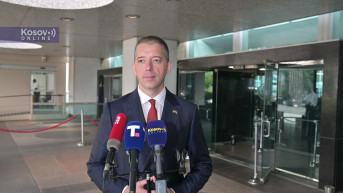
Serbian Foreign Minister Marko Djuric said that, at the UN Security Council session, Serbia had disrupted Pristina’s plan to sweep Serbian victims under the rug and conceal the truth that the KLA had committed widespread, systematic and extremely brutal war crimes in Kosovo.
“We prevented an attempt to conceal the fact that, in Kosovo and Metohija, Tirana and some other places, those convicted of war crimes are being celebrated despite a final judgment, without any reaction from the international community,” Djuric told RTS.
He also said that the session had highlighted the fact that Albin Kurti’s government was obstructing Serbs from voting in the upcoming elections for the Serbian Parliament by refusing to allow polling stations to open in Kosovo.
“Kurti’s government is preventing this because they know whom the people overwhelmingly support. In addition, we heard politically obsessive remarks here about Aleksandar Vucic and members of his family, which should serve as yet another clear signal to citizens as to who perhaps represents the greatest obstacle to Albin Kurti’s political ambitions,” Djuric said.
He stressed that it had been deeply disturbing to hear the Pristina representative belittle Serbian victims, noting that, unlike Glauk Konjufca, he himself had also mentioned Albanian victims with regret and had said that Serbia did not seek Serbian justice or Albanian justice, but objective justice—justice for everyone.
“In stark contrast, we heard Kurti’s representative say that Serbian victims were a fabrication. Such disrespect speaks very poorly of the political culture of Kurti’s government, although it comes as no surprise,” the Serbian Foreign Minister said.
He pointed out that, in a way, it was useful that the international community had been able to see clearly that, at a time when the UN was reporting more than 100 ethnically motivated attacks, Pristina’s representative had responded by attacking the United Nations itself.
“Before the Security Council, they attacked UNMIK and the UN Secretary-General. As unusual as that was, it was also useful for the international public to hear what kind of interlocutor we are dealing with,” Djuric stressed.
He reiterated Serbia’s commitment to the Serbian people in Kosovo and said that support for the population and record levels of investment would continue.
“Although some complain that we have increased investment, we will increase it even further. Neither Kurti nor those in our own country who would like to promote such an agenda as a political program will prevent us from doing so,” Djuric said.
He noted that a considerable number of countries at the session had supported Serbia’s position on certain issues, expressing gratitude to Serbia’s traditional friends who supported its territorial integrity.
“Serbia’s territorial integrity cannot be less important than Denmark’s territorial integrity, and Denmark is also a member of the Security Council,” Djuric stressed.
He added that some participants had attempted to focus on Banjska while overlooking the fact that three Serbs had also lost their lives in the incident and that the truth about their deaths remained unknown.
“An Albanian police officer was also killed, which is regrettable, but I do not believe or expect that, under these circumstances, there can be a fair process, because there was not even an attempt to establish responsibility for the wounding of two Serbian boys on Orthodox Christmas Eve in 2023, when an active member of the security forces fired a gun at a child. No one mentions that. I spoke about it because we do not want to remain silent, bow our heads and accept blame and responsibility for the fact that Kosovo and Metohija is today an area of apartheid and terror. The responsibility lies with Albin Kurti’s government, which has refused for 13 years to establish the Community of Serb Municipalities,” Djuric said.
He also insisted at the session on the establishment of the CSM.
“I said that a child born when the Brussels Agreement was signed in 2013 would now be a teenager, while the CSM has still not been established. We demand its establishment,” Djuric reiterated.
He also observed that, during the session, Pristina had spoken much more about the past, while only a few participants had addressed the present and very few had spoken about the future.
“We envision a future in which our people live well in Kosovo and Metohija, with their rights respected and in peace. Unfortunately, however, the drums of conflict, hatred and the past continue to beat from Kurti’s government, even in the most important body of the United Nations,” Djuric stressed.
Asked about the prospects for resuming the dialogue, he replied that Serbia had not only never shied away from talks, but had actively sought dialogue and progress in relations. Unfortunately, he added, there had not been enough parties willing to invest in that process.
“It is always easier to pursue a policy of confrontation and conflict. Albin Kurti’s government has shown that there is nothing it will stop at. But we, too, have shown that there is nothing we will not do to protect Serbs in Kosovo and Metohija. For us, peace and stability are sacred, but so is the survival of Serbs in Kosovo and Metohija. At this session, we succeeded in striking the right balance in presenting that position,” Djuric concluded.

comments