
Kosovo on the campaign for voters, dialogue on the backburner
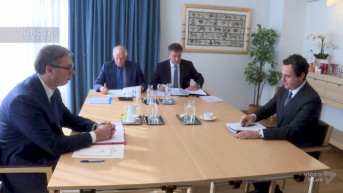
Until elections are held in Kosovo and a new government is formed, it is hard to expect any progress in the negotiation process between Belgrade and Pristina, mediated by the European Union. The dialogue hasn't been functioning for months, and the fact that everything in Kosovo will be subordinated to the fight for voters until February 9 could further undermine the process, which, practically, has only the facade left.
Written by: Dusica Radeka Djordjevic
Even if Brussels schedules negotiation rounds in the coming months, as Kosovo Online's interlocutors assess, it will likely be just a formality and more likely at the level of chief negotiators than at a high level.
The European Union's special representative for the dialogue, Miroslav Lajcak, stated ten days ago that the opening of the bridge on the Ibar River would be discussed at the next meeting in Brussels, without hinting when it would be, but the officials in Pristina believe this issue is not for the dialogue. It is very likely that until the polls close, the Kosovo side will remain closed to further talks with Belgrade on any topic.
Marko Milenkovic from the NGO "New Social Initiative" told Kosovo Online that the dialogue between Belgrade and Pristina has been degraded and dismantled on the ground by unilateral actions and moves, which is why he doesn't expect any progress in this process until the elections in Kosovo.
Everything that was agreed upon in the previous period, he says, has been nullified or set aside, and there has been no concrete engagement, primarily from Pristina, regarding the dialogue and the implementation of agreements.
"In the coming period, I expect further escalation of narratives and rhetoric from Pristina, primarily in a nationalist spirit. I also expect new actions that will further undermine what was agreed upon in the dialogue. This will continue to some extent, as it seems that the mood of the electorate in Kosovo is such. What we have seen in the recent period from some opposition parties is not encouraging in this sense. It seems that all political options are entering into a mode of nationalist rhetoric, and that will actually dictate the campaign, which is not good for the Serbian community, does not benefit Serbs in Kosovo, and will lead to further tensions and escalations, making Serbs feel uneasy here in Kosovo,” Milenkovic notes.
He expects the dialogue to be partially frozen because, at this moment, he does not see the will or strength from the EU to restart the dialogue.
"The dialogue will need to change its format or working methodology because the previous approach has simply not yielded results. We must also take into account the US elections because the focus of the American administration is on those elections, as we see that the race for the US presidency is uncertain. I see an opportunity for the dialogue to start again after those elections, but we need a stronger and more concrete approach from the international community, which we have not had in recent months, or even years. The international community must guarantee the implementation of what has been agreed upon. This has been lacking in the previous period. We have not had sufficient strength from the European Union to push these processes forward and to guarantee their implementation. I do not expect the European Union to have that strength in the coming months or even the next year, but I do expect that perhaps the US, with greater engagement and a concrete approach, could support the dialogue and accelerate progress in this process,” Milenkovic says.
Until the elections on February 9, Eugen Cakolli from Kosovo's Democratic Institute sees the dialogue in a lethargic phase.
"Even if meetings between the two sides occur, they will only be formal. I do not expect concrete results because neither side is willing to use dialogue as a platform for resolving issues," Cakolli says for Kosovo Online.
He points out that past experience has shown that when a government enters the final phase of its mandate, there is practically no reason for the parties to sit and talk. Therefore, he does not expect any new agreement or step forward in the dialogue, at least until the middle of next year, since the formation of a government in Kosovo, as he mentions, usually takes weeks, if not months, after the elections.
"Even though the mandate of the current EU mediator in the dialogue, Miroslav Lajcak, has been extended until the beginning of next year, I do not expect any concrete results. Even if meetings occur, I expect them to be between the chief negotiators or technical teams, not between Prime Minister Kurti and President Vucic together, because I don't see anything concrete that the parties could agree on. However, the visit of the CIA Director could change the dynamics, as it has once again demonstrated American commitment to the region and peace and stability in these areas," Cakolli says.
When asked whether the dialogue will actually be frozen until the elections in Kosovo and the US are concluded and until a new EU mediator in the dialogue is appointed, Cakolli says that regarding the new mediator, he expects Borut Pahor to take on that role, as it seems there could be such an agreement.
"The extension of Lajcak's mandate until next year, in my opinion, is a sign that the EU wants a new perspective and a new spirit in the dialogue after the formation of the government in Kosovo and after the formation of a new administration in the US. I believe they are waiting for the right moment for new energy – a new mediator, a possible new president in the US, a new government, regardless of whether it will be led by Kurti or not, although everything indicates that he will be the next prime minister," Cakolli emphasizes.
Stefan Vladisavljev, program coordinator of the BFPE Foundation for a Responsible Society, says that given the lack of results from the dialogue in the previous period, the election campaign doesn't have much to influence.
"Nothing significant has been agreed upon or implemented in the past year. Also, until now, the dialogue has managed to function at some technical level, primarily through emissaries, whether we are talking about the heads of the Office in Serbia or the heads of the negotiating team in Pristina," Vladisavljev tells Kosovo Online.
He points out that the dialogue, after some momentum at the end of 2022 and the beginning of 2023, did not bring concrete results in the implementation of what was agreed upon in Brussels and Ohrid, and that the lack of progress was also caused by changes at the administrative level due to elections in Brussels, as well as the upcoming elections in Washington.
"But we must not forget that just before Trump's departure, one of the last efforts came from Washington as an attempt to produce concrete policies on the international stage. Now there are three months left until the American elections, and it remains to be seen whether the administration will attempt to push through some elements of agreement implementation during that period, or if we will be in a sort of limbo until the elections in Kosovo are completed and potentially a new administration takes office in the US," Vladisavljev says.
Political analyst Shkelzen Maliqi assesses that the dialogue between Belgrade and Pristina has essentially failed, as it has been obstructed and boycotted by both Aleksandar Vucic and Albin Kurti.
"I don't think there is any point in continuing this kind of dialogue," Maliqi told Kosovo Online.
He recalls that Vucic and Kurti met last September and that only a month ago, their meeting in Brussels was scheduled, "which Kurti sabotaged and nothing came of it."
"That shouldn't happen. The citizens of Kosovo are suffering because of this," Maliqi says.
However, he points out that the agreement between Kosovo and Serbia is more or less finalized, and Serbia will not be asked to formally recognize Kosovo, but it should recognize it factually. Now, he says, it remains to be seen whether Serbian President Aleksandar Vucic will be forced to accept the final agreement. On the other hand, Maliqi points out that in the past year, Albin Kurti has been more of an obstacle in the dialogue because he didn't take the first step regarding the Community of Serb Municipalities, i.e., to send the draft statute of the CSM to the Constitutional Court.


0 comments