
London's role in the dialogue: Why didn't Kurti address a letter with accusations against Lajcak and Borrell only to the British?
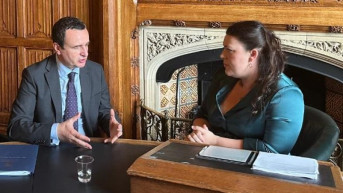
After the last round of dialogue in Brussels, which failed due to Albin Kurti's refusal to accept the compromise proposal of the EU, the Kosovo Prime Minister accused the European mediator Miroslav Lajcak of "coordinating" with Serbia and sent letters complaining about his bias to the addresses of EU members. as well as in the capitals of all Quint countries - except Great Britain. Why Kurti did not address London only on that occasion is considered logical by some, because Great Britain is no longer a member of the EU, while according to another interpretation, this very fact tells which way the "wind blows" and raises the question of the real British role in the Kosovo crisis.
What, really, is the role of official London in the policy of escalation from which the Kosovo authorities do not deviate, regardless of the fact that it brings them into an increasing confrontation with the USA and the EU, from where even harsher measures are announced for Kosovo?
Unlike the US and European officials who reacted harshly by criticizing the move of the Kosovo Prime Minister, when it comes to official London, only the British Embassy in Pristina announced that this country also joins and supports the invitation that the EU sent to Kosovo after the failure of the last round. and Serbia to "engage without further delay in the implementation of the assumed obligations".
On the other hand, the US Envoy for the Western Balkans, Gabriel Escobar, clearly said that Kurti was wrong with the letter to Blinken in which he accused Lajcak and Borrell of collaborating with Russia against Kosovo, and when asked about his message to the Kosovo Prime Minister, Escobar briefly said: " please don't waste your time”.
Also, although Western countries have practically isolated Kurti and suspended bilateral visits due to his refusal to calm tensions in the north in recent months, the British authorities have not lowered that ramp either. The Prime Minister of Kosovo was in London in June, he met with the Minister of Foreign Affairs of the United Kingdom James Cleverly.
Political scientist Professor Dr. Marija Djoric tells Kosovo Online that Kurti did not complain about the European mediators to Great Britain, because London leads the way in pro-Albanian politics in the Balkans.
"England certainly pursued an openly pro-Albanian policy when it comes to the territory of the Balkans, that's why Kurti doesn't complain to them. Kurti himself knows best why and to whom he sent the letters and what he wanted to achieve with it," Djoric says.
The fact that Kurti attacked Lajcak and Borrell after the failure of the last round of dialogue, Djoric interprets that he is trying to protect himself and his position.
"The fact is that negotiations with him can no longer have even an elementary basis because he refuses to fulfill the condition of all international agreements, which is the Community of Serb-majority Municipalities. Without the formation of the CSM, these negotiations are meaningless and absurd," Djoric says.
She believes that it is clear that the Quint countries are only "allegedly" exerting certain pressure on Pristina.
"It is obvious that it is unsuccessful. However, I am sure that if the international community, including the Quint countries, wanted to put real pressure on the so-called Kosovo, it would bear fruit. But, I am not sure how serious they are in their intentions," Djoric concluded.
Analyst of the Center for Social Stability Nemanja Zavisic says that Kurti's letter to the countries of the Quint, in which he complains about Borrell and Lajcak, which he deliberately omitted to send to Great Britain, confirms the thesis that Kurti does not act independently and that he has the support of at least one strong center of political power in the west.
"In this example, we see that there is probably a high level of coordination between Pristina and London and that Kurti certainly enjoys a certain level of protection within the Western bloc. British interests in these areas in the past few centuries were generally opposed to Serbian interests, and official London often led politics directly against our state and national interests. Unfortunately, this has also been the case in the last few decades, from the wars in Croatia and Bosnia and Herzegovina, through NATO aggression, to supporting the secession of our southern province, the British have always been on the side of Serbian enemies," Zavisic says.
He points out that this is certainly a big challenge for Serbia since it is an extremely influential country.
"However, the Serbian state leadership is for now successfully opposing them and protecting Serbian interests. Thanks to the wise diplomatic moves of President Vucic, nobody can accuse Serbia today of being a disruptive factor, on the contrary, the fact is that we are the factor of peace and stability in the Balkans, as well as the fastest-growing economy in this region. Also, Serbia has friends in all corners of the world, as demonstrated by the session of the UN General Assembly, where President Vucic delivered a historic speech, while representatives of the Kosovo Albanians fought in the corridors to take pictures with someone. There was no place for them in the UN hall where the states had their representatives, and despite the wishes of some, there never will be," Zavisic says.
Dragan Sutanovac, the former Minister of Defense of Serbia and the founder of the Council for Strategic Policies pointed out for Kosovo Online that a lobby supported Kurti in European political circles, including Britain. He stated that in Europe Kurti was supported by certain parliamentarians, and in Britain by the chairperson of the Foreign Policy Committee of the British Parliament, Alicia Kearns, who, Sutanovac pointed out, was practically his promoter.
"The media are working on it, they even managed to convince a part of the public in Serbia that he is right and that the USA, the EU, and all the others are wrong. However, it is important to say that the administrations in the West are very precise and clear, that it is clear to everyone that Kurti is not a man of deals and that he cannot be counted on. Escobar once said that the Brussels Agreement would be implemented with or without Kurti and now it is up to them to see how it will go without Kurti or with Kurti," Sutanovac states.
On the other hand, an analyst from Pristina, Shkelzen Maliqi, says that he does not believe that the background of the fact that Kurti did not complain about Lajcak and Borrell and London is that the Kosovo Prime Minister has the support of Britain for his policy, and even that it is behind some his moves.
"As far as I can see the reactions of the British Envoy and they are not so far from the Americans, there is a strategic line, the NATO line, to ensure stability in the region. There are Brussels Agreements that are very well thought out, they have been worked on for a long time, they have this agreement on the missing persons that have been waiting for years just to be signed and to start the implementation. A big job has been done, but for ten years everything has been stalling because there is no a certain big agreement," Maliqi says.
He points out that the agreements were accepted by both parties and that "now they are playing a little more to please the domestic audience".
"I'm also thinking of Vucic, not only Kurti, but Kurti is more stubborn in his demands and attitudes," Maliqi says.


0 comments