
"Loopholes" in Kosovo’s Law during the process of constituting the Assembly: Is a legal overhaul needed?
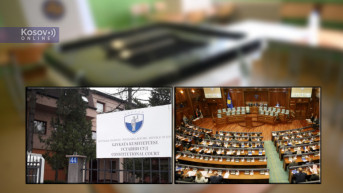
Although seemingly perfect on paper and modeled after well-regulated EU countries, Kosovo’s law has revealed many shortcomings during the process of constituting its Assembly. Political parties, which have failed to form the parliament even after 54 attempts, insist on respect for the law, while analysts say the Constitution and laws have been repeatedly violated by all parties involved. According to experts interviewed by Kosovo Online, a legal overhaul is necessary and appropriate when no solution is in sight for the ongoing political and constitutional crisis.
Written by: Milena Miladinovic
A key argument used by Self-Determination is the 2014 Constitutional Court decision granting the winning party the absolute right to nominate a candidate for Speaker of the Assembly without a specific deadline. Self-Determination is invoking this to push for acting Justice Minister Albulena Haxhiu to assume the top position in the Kosovo parliament.
Unable to secure the necessary 61 votes in the Assembly for her election, the session’s presiding officer from Self-Determination, Avni Dehari, proposed a secret vote and the formation of a commission to monitor it—a proposal rejected by other political parties. Legal experts in Kosovo have deemed this move unconstitutional.
Kosovo President Vjosa Osmani and the Constitutional Court have intervened in the crisis. Responding to a request by AAK, LDK, and PDK, the Court gave a 30-day deadline for MPs to reach an agreement and form the parliament—but without clear guidelines or sanctions for failure to comply, which is exactly what happened.
Another judicial decision followed, suspending all activities related to the formation of the ninth legislative term of the Kosovo Assembly until August 8, after which the Constitutional Court is expected to issue a final ruling on the situation.
Throughout the entire process, Self-Determination and opposition parties have accused each other of violating the law and constitution—while claiming they themselves are defending them.
However, the current crisis has exposed "loopholes" in Kosovo’s legal framework that MPs exploit to avoid responsibility. According to legal analysts interviewed by Kosovo Online, the Constitution and laws are subject to change—and should be amended when necessary.
Legal Gaps
Legal expert from the Kosovo Institute for Democracy, Vulnet Bugaçku, believes both the Constitution and the Assembly’s Rules of Procedure should be amended to simplify the formation process.
He emphasizes that MPs must focus on the Rules of Procedure, particularly the sections dealing with how the Speaker of the Assembly is elected. He also stresses the need for agreement on how the inaugural session is chaired, noting that Avni Dehari, under the influence of Self-Determination, has been pushing his party’s agenda.
"Recent interpretations by the Constitutional Court and the current political and constitutional crisis clearly show legal gaps that must be addressed once the parliament is constituted. I want to highlight the need to amend the Rules of Procedure regarding voting procedures—especially whether it is permissible to proceed with the election of the Speaker. MPs should agree on changing the rules for the inaugural session. You can see that having an elderly MP chair the session has caused problems, as he promotes his party's agenda,” Bugaçku told Kosovo Online.
He added that the winning party should have a deadline to propose a Speaker. If it fails to secure 61 votes, the opportunity should be given to other parties.
"That’s why I believe both the Rules of Procedure and the Constitution should be amended to make the parliament's formation more practical. The first issue is the proposal of a Speaker candidate. A deadline should be introduced, after which another parliamentary group may nominate a candidate who can secure the required votes. This creates room to improve the Constitution or the Rules of Procedure,” Bugaçku said.
He expects the Constitutional Court to assess the constitutionality of the procedures led by Avni Dehari since June 26, based on a request by PDK and LDK.
"I expect the Court will determine that the session procedures since June 26 were unconstitutional, as Dehari imposed a commission formation not on the agenda, preventing MPs from expressing support or opposition to the Speaker candidate,” he explained.
Bugaçku notes that there is uncertainty about what exactly the Court will decide after August 8. One possibility is that the Court will annul the current process due to legal irregularities and return it to the beginning.
"The Court might define the timeframe and rights of the largest parliamentary group to nominate the Speaker. It might even analogously interpret procedures as in government formation—allowing other parties to propose a Speaker if the largest group fails. There’s much debate, and the Court could rule either way after August 8,” Bugaçku concluded.
Legislative Reform Aligned with Reality
Aleksandar Rapajic, Program Director of the NGO Center for Advocacy of Democratic Culture in North Mitrovica, told Kosovo Online that Self-Determination is trying to exploit legal loopholes, but acknowledged that some situations remain unregulated, which is why mechanisms for legal change exist.
"We’ve seen that not all real-life situations are covered by law. That’s not uncommon—no lawmaker can predict every scenario. That’s why laws can be amended, and the Constitutional Court can be consulted,” said Rapajic.
He emphasized that legislation is a living system that must adapt to new realities.
"We’ve seen Self-Determination trying to circumvent the law by exploiting gaps. That happens everywhere—it’s happened in Serbia, and it happens elsewhere. Legislation must evolve constantly. Kosovo’s electoral law was recently amended, but many situations still weren’t addressed,” he added.
He also pointed out that Kosovo’s legal framework was largely copied from European models without considering Balkan realities.
“In this situation, the majority delayed the constitution of the Assembly, holding sessions every two days, exploiting a legal loophole stating that until a Speaker is elected, nothing else can proceed. The Constitutional Court interrupted this practice, ruling that the Assembly is not constituted until the Speaker and Deputy Speaker are elected—verifying mandates is not enough. This ruling filled one legal gap, but many others remain. The Constitution and laws were drafted hastily, copying European models without considering Balkan political dynamics,” Rapajic noted.
Incomplete Parliamentary Elections
Professor of Law at the University of Belgrade and Constitutional Court judge Vladan Petrov stated that the current institutional crisis has exposed major flaws in Kosovo’s Constitution and laws. He cited a key provision in the Assembly’s Rules of Procedure requiring not just verification of mandates but the election of the Speaker and Deputy Speaker to constitute the Assembly.
“The Rules require not only verifying MP mandates but also electing the Assembly's leadership. Given the current election results, we’re faced with a deadlock—where the leading party lacks a majority, and the opposition is unwilling to cooperate. That has created a seemingly unsolvable situation,” said Petrov.
He stressed that the only legal solution would be new elections.
“The most recent parliamentary elections in Kosovo remain incomplete because the Assembly has not been constituted. The only possible solution is for the President to call new elections. This clearly shows that the so-called state of Kosovo lacks constitutional capacity and that all major political actors have violated constitutional obligations,” Petrov concluded.

0 comments