
Loud silence from Brussels - who benefits from the marathon dialogue?
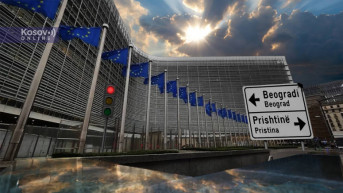
There are no deadlines, nor delays in the dialogue between Belgrade and Pristina, EU Spokesperson Peter Stano was explicit in September 2020, nine years after the negotiations began with the mediation of the European Union. Four years later, it seems that it has turned into a marathon process with no clear signs of an end. When asked who benefits from this dialogue lasting so long, analysts provide different answers, but they agree on one thing – they blame the “loud silence” of the international community while citizens are paying the highest price.
Written by: Petar Rosic
The last round of dialogue in Brussels took place on October 24. Although there was a triple meeting of the chief negotiators from Belgrade and Pristina, Petar Petkovic and Besnik Bislimi, with the EU Special Envoy Miroslav Lajcak after a long time, the result was absent.
This was confirmed by Lajcak himself, who stated that although no progress had been made, he remains optimistic “regarding some progress on other key issues.”
The Special Representative of the UN Secretary-General in Kosovo and head of the UNMIK Mission, Caroline Ziadeh, emphasized at the Security Council meeting on October 30 that the dialogue between Belgrade and Pristina remains crucial for addressing all issues, including the establishment of the Community of Serb Municipalities.
On the same day, while presenting the 2024 Enlargement Package, EU High Representative Josep Borrell warned that the pace of enlargement and progress in the dialogue mediated by the EU toward normalizing relations “must go hand in hand.”
However, Marko Milenkovic from the NGO "New Social Initiative" assesses that the international community is trying to maintain some appearance that dialogue exists, although it essentially yields no results.
"But it seems that, at this point, the EU is relatively satisfied with this level of dialogue, as it keeps peace within its own borders. I think the EU needs to exert greater influence to revive and reinvigorate the dialogue, primarily through applying pressure or offering incentives to the participants," he says for Kosovo Online.
He explains that the EU is content because there are no major escalations on the ground.
"That is the red line they are holding at this moment. Whether the dialogue will be constructive, or whether the Serbian or other communities will be threatened, doesn’t seem to matter to them right now," Milenkovic emphasizes.
He adds that Albin Kurti benefits from this situation the most.
"Kosovo loses internationally in terms of advancing its standing, particularly regarding recognition and membership in international organizations, while Serbia is losing mechanisms it has on Kosovo, which is evident. Serbia’s institutional and even extra-institutional activities and mechanisms on the ground are gradually diminishing," Milenkovic explains.
He underlines that the Serbian community is suffering the most as a result of all this.
"The Serbian community is extremely vulnerable, primarily due to the lack of results in the dialogue and solutions at a local level, as well as the lack of political will to resolve certain issues. Some issues are even being exploited in the dialogue, with unilateral steps taken that complicate and worsen life for people on the ground," Milenkovic concludes.
Srdjan Barac from the Center for Social Stability believes that the stalemate in the dialogue benefits Albin Kurti, but not the Serbs in Kosovo.
"Looking back from 2013 to today, we’ve used this time to strengthen economically and improve our geopolitical position. But on the other hand, this situation benefits Albin Kurti, as it does not suit the Serbs living in Kosovo and Metohija. They face daily economic pressures, and even endure physical violence, legal harassment, and psychological abuse. This delay in the process does not favor them," Barac says for Kosovo Online.
He emphasizes that the people in Kosovo bear the greatest burden due to this situation, prompting Serbia to take significant steps, such as declaring Kosovo a special area for social protection.
On the other hand, he says that the international community is silent about this.
"We can say it is almost deafeningly silent. It remains silent, as if unable, particularly Brussels, to influence Albin Kurti, which is hard for us to believe. That is why I believe the United Nations or the Security Council is the right stage. We need to return there because it was precisely in the UN Security Council in 1999 that this chain reaction began, where international actors stopped measuring their strength in the diplomatic international arena of the United Nations and began to measure it on the ground with military boots and weapons," Barac says.
He explains that the Security Council has the power, ability, and tools to make a concrete difference on the ground.
"First and foremost, to halt Albin Kurti’s actions, which entail actual and factual control over northern Kosovo and Metohija and the expulsion of Serbs from Kosovo and Metohija," he says.
He adds that dialogue with Kurti has proven impossible and that Serbia should conduct talks with representatives of the State Department and Brussels.
University professor from Pristina Mazllum Baraliu assesses that both Kosovo and Serbia are losing due to the stalemate in the negotiations, and that the greatest responsibility lies with the European Union, which, as he says for Kosovo Online, pursues a failed foreign policy toward the Balkans, especially regarding the dialogue between Belgrade and Pristina.
He believes that the current EU policy is short-sighted and ineffective, both globally and in the Balkans, particularly regarding the Kosovo-Serbia dialogue, because, as he says, it is neither decisive nor impartial.
“This is why there is no success, and there won’t be any, at least until after the elections in Kosovo. We will see what the new approach of Ms. Kaja Kallas and others will bring. I think there is hope, and then we might see changes and progress in the dialogue,” Baraliu said.
He believes that both Serbia and Kosovo are using the stalled dialogue to "buy time." Serbia because it expects, with the Kremlin publicly promising that the war in Ukraine will end in a victory for the Russian Federation, that the geostrategic landscape in the Balkans, Europe, and for Russia and its allies will change, and Kosovo because of the elections.
He emphasizes that the international community neither encourages nor assists the dialogue and that the United Nations is acting completely powerless. On the other hand, he says, the region continues with conflict-driven policies.
"And the people don’t want that. In this democratic age, the 21st century, when paths to cooperation are opening and developing everywhere, democratic components here are lagging. Why? No one in their right mind supports this. It seems we haven’t followed or understood what’s happening around us to be included in those currents, so that citizens could benefit from the circulation of goods, ideas, capital, science, and culture… We are holding each other back, and they aren’t helping us integrate into Europe and the world,” he concludes.

0 comments