
Marta Kos’s first visit to Serbia: Encouragement for EU membership, Kosovo Dialogue not a priority
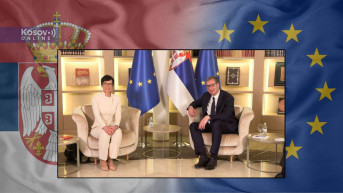
Strong support for Serbia’s path toward EU membership was the key message conveyed by European Commissioner for Enlargement Marta Kos during her first visit to Belgrade. Due to the institutional crisis in Kosovo, the issue of continuing the dialogue was not on the Brussels agenda this time, analysts told Kosovo Online.
Written by: Djordje Barovic
“We had an open exchange. We spoke about all the good things, all the problems. We talked about Serbia’s strategic path and what needs to be done in the future. We also discussed the geopolitical landscape,” said President Aleksandar Vucic after his meeting with Marta Kos.
During her two-day visit to Serbia, Kos met with the new Prime Minister Đuro Macut, the new Minister for European Integration Nemanja Starovic, as well as with representatives of the opposition.
Accelerating the Enlargement Process
Slobodan Zecevic, Director of the Institute for European Studies in Belgrade, told Kosovo Online that Marta Kos’s visit should be seen in the context of the EU’s intention to speed up the enlargement process as a means of addressing security threats.
“I think the EU is now aware, especially in light of the war in Ukraine, that there are security threats — namely, they see Russia as such — and they want to secure themselves by admitting new members, thus creating a larger and stronger alliance,” Zecevic said.
He recalled that Kos stated that Montenegro and Albania could be among the first countries to join the EU by the end of the current European Commission’s mandate in 2030.
“She does not mention Serbia in that context, although realistically we were in the same package with Montenegro. Their geostrategic interests now lie in expanding membership to ensure control over the entire European continent, particularly in anticipation of a possible resurgence of Russian influence in Europe,” Zecevic explained.
When asked about the absence of the Belgrade–Pristina dialogue from the meeting agenda, Zecevic noted that Kos had mentioned in interviews the EU’s desire for Kosovo to receive candidate status, but that they are waiting for a new government to be formed.
“They are waiting for the new government to meet certain conditions related to the dialogue. However, she did not specify what those conditions are. Whether she is referring to the Community of Serb-majority Municipalities (CSM), which would be crucial for a safer and more normal life for our people — we’ll have to see. In any case, she mentioned it in the context of Kosovo’s post-election developments,” Zecevic said.
He expressed confidence that the dialogue issue will be addressed by the new EU High Representative for Foreign Affairs and Security Policy, Kaja Kallas.
“They hope that a new parliamentary speaker and government will be elected in Kosovo by May, after which Kaja Kallas might be able to address the dialogue more concretely,” he said.
Zecevic believes that Kos’s visit should be interpreted more through the lens of Serbia’s internal situation.
“They want to see internal issues resolved so that Serbia can later engage in addressing outstanding matters. Cluster 3 in the negotiation process is still not open, even though it is ready. The government gave certain guarantees in December related to the adoption of media laws, voter list reforms, and the appointment of new REM members. These commitments still stand, and I think that’s the main reason she came to Serbia. There was criticism that the EU ignored the students’ demands — now they want to show they didn’t ignore them, and that the best response to those demands is for Serbia to implement what was agreed in December,” Zecevic emphasized.
Encouragement and Priorities
On the other hand, Aleksandra Joksimovic, Director of the Center for Foreign Policy and former Serbian Ambassador to the UK, believes that Kos’s two-day visit aimed to familiarize herself with the new administration in Belgrade and send a clear message of encouragement — that EU enlargement remains a priority of the current European Commission.
“EU enlargement is certainly a priority for the current European Commission. They made this clear from the start of their mandate. Given the geopolitical situation, this is essential for the overall security of Europe. They will insist on fulfilling their promise that at least one country will join the EU by the end of their term, that is, by 2030,” Joksimovic told Kosovo Online.
She noted that there are currently several “frontrunner” countries.
“Montenegro leads the way, with Albania trying to catch up. Unfortunately, Serbia has fallen off that list due to a few issues burdening the accession talks. One is the country’s stance toward Russia and its alignment with the EU’s common foreign and security policy. The other is the dialogue with Pristina,” she said.
She added that Kos’s statements regarding Serbia’s potential membership should be seen as encouragement.
“But we’ll have to wait and see if there will be concrete progress, because for several years now, there hasn’t been a single significant step forward in the process. Opening Cluster 3 would be symbolically important. It wouldn’t be a dramatic breakthrough, but it would break the deadlock that has existed on Serbia’s EU path for quite some time,” Joksimovic explained.
When asked why the Belgrade–Pristina dialogue wasn’t discussed, Joksimovic said that this topic will likely be handled by Kaja Kallas.
“Sørensen, the new EU envoy, is under her authority. Also, until the election cycle in Pristina ends and a new government is formed, we can’t expect significant progress on this issue. That’s why it isn’t currently a focus for the EU in terms of further steps — they are waiting for primary conditions to be met before dialogue can resume,” she said.
A Positive Signal
Petar Donic, an analyst from Novi Treci Put ("New Third Way"), said that Marta Kos’s visit sends a positive signal and a clear message that Serbia plays a central role in the Western Balkans.
“This visit is definitely a positive signal. The EU cannot function or integrate the region without Serbia. Serbia is the most important player in the
Western Balkans — it has the largest economy, the highest military expenditure, the most significant influence, and a central position. Every European Commission, including this newly elected one, has an interest in Serbia. Especially now, given the current geopolitical reshuffling, Serbia and the Western Balkans play a key role,” Donic said.
According to him, Kos’s remarks this time were more significant than in previous visits, and Serbia now faces the challenge of meeting various steps toward full EU membership, particularly Clusters 3 and 4.
Donic believes Cluster 3 is the most difficult because it deals with inclusive growth and human rights — areas where Serbia faces opposition, mainly from the Baltic countries, not only over rule-of-law issues but also due to Serbia’s unique policy toward Russia.
“Serbia has maintained its policy, hasn’t imposed sanctions, yet has openly supported Ukraine — maintaining a sort of neutral stance. The Baltic states, shaped by their Soviet past, are cautious of Russian influence. Since the annexation of Crimea and the ongoing Ukraine crisis, they are even more cautious. We’ll see what this means in practice because EU integration requires alignment with all members and finding common ground. That’s why the process is so slow,” Donic said.
He warned about the optics of Serbia’s continued “flirtation” with Russia — for example, if President Vucic attends a military parade in Moscow.
“If Serbia openly or semi-openly continues to flirt with Russian interests — say, if President Vucic attends a military parade in Moscow where, among all European leaders, only Orbán and Fico are present — both important Serbian partners, but not major EU decision-makers — it raises questions. EU integration means aligning with all members, and this kind of signaling complicates the process,” he noted.
He pointed out that Montenegro is currently the most advanced in EU integration, followed by Albania, which has “accelerated significantly.”
“Serbia is the next country with the most chapters opened, but its progress is very slow,” Donic concluded.
When asked why the Belgrade–Pristina dialogue was not on the agenda this time, Donic said it reflects the focus on other geopolitical topics.
“Amid announcements of Serbia attending a military parade in Moscow and the quiet alignment of some state and church officials with Russia, certain EU officials are understandably uneasy. That’s why other topics — more urgent on the geopolitical scale — likely dominated the agenda. This visit sends a strong message: Europe wants Serbia’s integration and is possibly ready to move faster, but they need a committed partner. A new government means a new beginning, and a new Commission also means a new start — so let’s hope this brings renewed momentum. Perhaps the dialogue wasn’t mentioned explicitly to avoid ambiguity and to send a clear, undivided message,” Donic concluded.

0 comments