
Moscow marks the 80th Anniversary of Victory in World War II: Red Square becomes a stage for new geopolitics
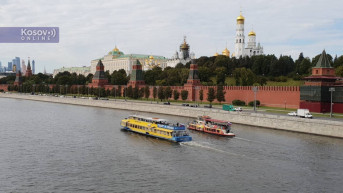
A ceremonial event commemorating Victory Day in World War II will be held on May 9 in Moscow, featuring the traditional military parade on Red Square. This year’s gathering, attended by Russia’s highest leadership, representatives of allied nations, and the public, marks not only a historic milestone—the 80th anniversary of the defeat of fascism—but also a key moment in today’s rapidly evolving global order. Red Square is becoming a stage for articulating a modern vision of a multipolar world. The focus will not only be on honoring the past, but also on demonstrating Russia’s geopolitical aspirations in a new global power structure.
Written by: Zeljko Sajn, Special Correspondent of Kosovo Online from Moscow
As a new international order takes shape, the question remains: where will Serbia position itself? Serbia maintains a policy of military neutrality, aspires to join the European Union, but resists conditionalities it deems unjust, while preserving friendly ties with Russia. Although there is no official confirmation yet regarding President Aleksandar Vucic’s attendance at the ceremony in Moscow, it is clear that both Russia and Washington are closely observing Belgrade’s stance. Serbia continues to balance between European integration and traditional friendship with Moscow, and symbolic gestures—such as attending or skipping the Red Square parade—carry layered implications.
Russia, invoking the principles of the UN Charter and their interconnectedness, has demonstrated friendly relations toward Serbia, particularly in sessions of the UN Security Council, where it has used its veto to block resolutions harmful to Yugoslavia and Serbia. After the Cold War and the fall of the Berlin Wall, permanent Security Council members such as the U.S., France, and the UK often bypassed the UN and, together with NATO, pursued the dismantling of socialist states and the Soviet Union.
Russian Foreign Minister Sergey Lavrov referenced the geopolitical synthesis of the Yalta Conference, emphasizing that historical anniversaries are not only about the past, but also about reaffirming current principles of the international order. Speaking on the topics of territorial integrity and the right to self-determination—in Russia’s case, Crimea, and in Serbia’s case, Kosovo and Metohija—Lavrov stated:
“When the principle of self-determination runs counter to Western geopolitical interests—such as in the case of the free will of the people of Crimea, Donetsk and Luhansk People’s Republics, as well as the Zaporizhzhia and Kherson regions, who chose unity with Russia—the West not only ignores it but condemns it with outrage and imposes sanctions. However, when it suits the West, self-determination is treated as an absolute right. One need only recall the seizure of Kosovo from Serbia, and that without any referendum.”
Lavrov also expressed concern over the deteriorating situation in Kosovo. He criticized the delivery of weapons to Kosovo forces and NATO’s support in building the so-called Kosovo army, calling it a grave violation of UN Security Council Resolution 1244. The global community, he said, is witnessing a repeat of the Minsk Agreements tragedy, in which the special status of the Donbas republics was to be recognized—but which Kyiv, with Western backing, openly sabotaged. The European Union, he noted, now neither wants nor is able to pressure its Kosovo protégés into fulfilling the 2013 Brussels Agreement, particularly regarding the establishment of the Community of Serb-Majority Municipalities (CSM) with special cultural and language rights. Despite having guaranteed the agreement, the EU appears to be abandoning it, much like other Western-backed deals. As Lavrov remarked:
“The quality of the sponsor determines the outcome.”
In this context, Russian grandmaster and Federation Council member Sergey Karjakin asserted that “Crimea was not occupied—it was returned.” He defends this claim with personal conviction:
“I was born in Simferopol, and the 2014 decision of the Crimean people is, for me, a historical act of justice. The West calls it occupation, but that’s pure propaganda. Ask the people who live there—their will is clear.”
Karjakin further pointed out the West’s double standards on self-determination:
“When it comes to Western interests, anything goes—state fragmentation, artificial entities, baseless recognition. But when other nations assert their will outside those interests, it’s immediately branded a violation of international law.”
It is evident, the article argues, that the world longs for balance and peace—and that the era of hypocritical politics must be overcome. The 80th anniversary of the victory over fascism offers an opportunity to project a new geopolitical architecture—one based on equilibrium, multilateralism, and the principles of the UN Charter. May 9 is being redefined as a symbolic turning point from unipolar dominance to a balanced international community built on sovereign equality and resource-based cooperation.
Just as May 9, 1945 marked the triumph over fascism, this May 9, for Russia and its allies, stands as a symbol of resistance to global unipolar dominance—and a chance for a new beginning based on sovereignty, balance, and the right of every nation to choose its own path freely.
According to diplomatic sources and conversations in Moscow, President Putin is expected to issue a strong call for building such a new world order—an appeal that will be further reinforced by his upcoming bilateral meeting with Chinese President Xi Jinping, who arrives in Moscow tomorrow.
0 comments