
New format, same story: Does Europe have solutions for dialogue - or is it waiting for America?
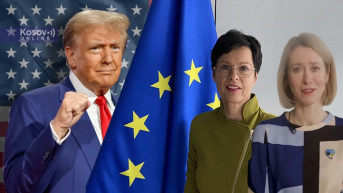
Hearings for candidates for European Commission commissioners have begun in the European Parliament, sparking expectations in Belgrade and Pristina that the international community will finally find a way to move the dialogue out of the deadlock. New models, tools, and formats have been announced, but analysts told Kosovo Online that these are old stories that do not fundamentally offer a solution, which lies in implementing existing agreements. They assess that Europe is still uncertain about the direction the dialogue should take, as it waits for moves from the new American administration.
Written by: Petar Rosic
Responding to a question about the dialogue between Belgrade and Pristina, the candidate for Commissioner for Enlargement, Marta Kos, stated during her hearing in the European Parliament that "if things are not working, we must find new ways."
In this context, she quoted Albert Einstein, saying that "insanity is doing the same thing every day and expecting different results."
She added that the dialogue is formally in the hands of the EU High Representative for Foreign Affairs and Security Policy and Vice-President of the Commission, or Kaja Kallas, if she is elected to this position.
However, during her hearing, Kallas did not focus much on the dialogue, stating that the Western Balkans is a very important region and that the EU approaches it through two tracks: enlargement and the process of normalizing relations between Serbia and Kosovo.
Dutch MEP Thijs Reuten agreed with Marta Kos after the hearing, stating that new mechanisms are needed to move the parties forward and reformat the dialogue.
"If you expect something different and more, then you need to look at the process and perhaps redesign it and try to find other ways or instruments to achieve the desired results," Reuten noted.
While the government of Albin Kurti has insisted on a new format for dialogue for years, Afrim Hoti, a professor of law and international relations at the University of Pristina, believes that the issue is not the format but the lack of political will from both sides to implement the agreed points.
"When we take into account that there is an agreement in effect, mediated by the European Union, as well as an action plan that outlines how a specific agreement should be implemented, we can say that the agreement is in place, and all we need to do is address another aspect I want to discuss: the method of implementation. However, we currently have a lack of willingness to implement it from both sides," the professor from Pristina told Kosovo Online.
He believes the stalemate in implementing the agreement occurred because both sides were waiting for the results of the U.S. elections.
Now that a new administration is in place in the United States, Hoti sees a real chance for the dialogue to resume.
"All we need is some kind of pressure, primarily from the EU, but also a dynamic process that must come from the new U.S. administration, which will create and exert pressure on both sides to implement the agreement. If such pressure exists, then from my perspective, no new format is needed because there is no need for a new format when we have an agreement in place," Hoti concluded.
Dragisa Mijacic, Coordinator of the National Convention on the EU Working Group for Chapter 35, shares a similar opinion. He told Kosovo Online that the Brussels Agreement remains the foundation for all future discussions on the path to normalizing relations between Belgrade and Pristina.
Commenting on Marta Kos's statement during the hearing in the European Parliament about the need for new approaches to the dialogue between Belgrade and Pristina, Mijacic said that her remarks deserve attention but are merely a subjective opinion that has no impact and does not change the essence of the negotiation process.
First of all, he reminded that Kos has not yet been elected as Commissioner for Enlargement and that her appointment must go through various bodies.
"She made some statements during the hearing, but that does not necessarily mean she will be elected as Commissioner, although there is a good chance. Another important thing is that the Commissioner for Enlargement does not deal with issues related to the dialogue. So, her opinion on the dialogue is a subjective opinion that certainly deserves attention, but the Commissioner for Enlargement has no authority regarding the dialogue. Therefore, her statement in that direction is surprising," he said.
He is adamant that the Brussels Agreement and its Ohrid Annex remain the foundation for all future discussions.
"Everyone knows, including Marta Kos, that the dialogue is not progressing in the desired direction. A different negotiation model is indeed needed, but the basis is the agreement on the path to normalization, accepted last year in Brussels, along with its Ohrid Annex. These will be the foundation for all future discussions on the European platform for dialogue between Belgrade and Pristina," stated Mijacic.
Speaking about Pristina's stance, which has for years insisted on changing the dialogue format, supported by some MEPs, Mijacic emphasized that the format is not important, but fulfilling obligations is.
"Pristina has obligations within the framework of the agreement on the path to normalization, so regardless of the format, it cannot avoid its obligations. What Pristina is trying to do is introduce other topics to avoid forming the Association of Serb-majority Municipalities (ASM), which is Pristina's obligation not only under the latest agreement but also under the one from 2013. Therefore, Pristina's demands to change the format will not change the essence, that is, they will not change the international community's demands to form the ASM," he said.
Program Manager of the NGO Social Initiative, Milica Andric Rakic, stated that the new compositions of the European Parliament and the European Commission have not only failed to provide concrete solutions for the dialogue between Belgrade and Pristina but are also unsure in which direction to proceed.
"Given that these are new compositions of both the European Parliament and the European Commission, it would truly be irresponsible of them not to acknowledge that the dialogue has had issues. However, so far, all statements are almost abstract and boil down to saying that the dialogue has not been good. A new solution is needed, but no one identifies what the framework of that new solution would be, and I think this is largely because they themselves are unsure," she told Kosovo Online.
She stated that it is still unknown what the stance of the new American administration will be, and there are three main scenarios in this regard.
"In the first scenario, America continues to cooperate with the EU as it has so far. The European Union plays the main role, while America, so to speak, lends a certain kind of power to the European Union. This is, in my opinion, the least likely scenario," said Andric Rakic.
The second option is for America to completely ignore the dialogue process.
"In that case, it sees that there is not much room to advance the dialogue and chooses not to tie itself to things that, so to speak, smell of failure," she added.
The third scenario, as she explained, is for America to take over the dialogue.
"To actively sabotage the European Union's role in the dialogue, as was the case in 2018 and 2020, and to completely take over the dialogue. I think Europe still does not know what the stance of the U.S. Congress will be, and therefore they are also unsure of what needs to be improved in the dialogue. That is why we have these rather abstract and general statements about what it will look like," said Andric Rakic.
She also recalled Kaja Kallas's testimony in parliament, which, as she noted, also did not provide any indication that there might be changes.
"There were speculations that she herself might decide, like Mogherini or Ashton before her, to be in charge of the dialogue. However, given how little she spoke about the dialogue—practically just one sentence—I assume that this is no longer an option, and she will certainly appoint a new mediator who will lead the dialogue on her behalf. That is the only policy we can predict for now, and it essentially does not represent any change. So, it is more or less a continuation of what we have had so far," assessed the Program Manager of the NGO Social Initiative.
Progress in the dialogue, as she said, can be expected after the Kosovo parliamentary elections.
"Until then, I think much will be frozen. I even believe that the number or scope of unilateral actions from Pristina will decrease because, more or less, everyone is now waiting to see how the new American administration will address global issues. It is especially important who will be in charge of the Balkans within it. That is why I think all actors, particularly Pristina in this context, will calm down a bit until the elections," concluded Andric Rakic.


0 comments