
North Mitrovica under pressure from central authorities: “Unified city” or new divisions?
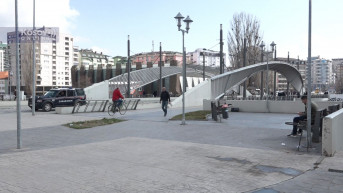
The Mayor of North Mitrovica, Milan Radojevic, recently warned of increasingly frequent interference by central authorities in the competencies of the municipality, assessing that such actions fit into the idea of a “unified city” that would merge the municipalities on the southern and northern sides of the Ibar River. Analysts speaking to Kosovo Online believe that such a development would turn Serbs into a minority and that similar trends could be reflected in other Serb-majority municipalities. They emphasize that this would deepen political and ethnic divisions, undermine dialogue, and call into question the establishment of the Community of Serb-majority Municipalities (CSM).
Written by: Jovana Jovanovic
Since assuming his new position in December, the Mayor of South Mitrovica, Faton Peci, has frequently erected memorials, visited Albanian families, opened institutions with representatives of central authorities, organized marches, and announced the opening of a museum. It could be said that this aligns with his function; however, interlocutors of Kosovo Online point out that Peci is increasingly carrying out activities in the north as well, crossing the Ibar and exceeding his competencies.
These activities by the Mayor of South Mitrovica in the north prompted a reaction from Radojevic, who warned that citizens want to live in North Mitrovica, not in a “unified city.”
He pointed out that in recent years Kosovo Prime Minister Albin Kurti has sought to abolish the separate municipality of North Mitrovica and merge it with the southern part, and that the international community must clearly state that such a plan by Kurti—whose party Peci belongs to—cannot be implemented.
“Since we assumed office on December 5, both the Government of Kosovo and the newly elected Mayor of South Mitrovica have adopted an aggressive approach. On multiple occasions, they have come to North Mitrovica and announced programs that are not within their jurisdiction, directly interfering in the competencies of North Mitrovica,” Radojevic underlined.
The latest case was recorded on Wednesday, shortly before 7 a.m., when the demolition of garages located near the detention center in North Mitrovica began. The garages are owned by Serbs and were demolished without the approval or knowledge of the municipal inspection authorities.
The Office for Kosovo and Metohija also reacted, stating that such a move demonstrates the absence of the rule of law in Kosovo and that attempts by authorities in Pristina to take over and reduce the competencies of local self-government in North Mitrovica are unacceptable.
Disregard for competencies leads to chaos
Dusan Radakovic from the NGO Center for Advocacy of Democratic Culture (ACDC) assessed for Kosovo Online that a series of actions on the ground, including recent developments in North Mitrovica, indicate a trend toward centralization of decision-making and neglect of local self-government competencies, along with an increasingly pronounced redefinition of the concept of a unified city of Mitrovica.
“Every day, through various activities we observe, we can conclude that the actions are aimed primarily at promoting the city of Mitrovica as a whole. It is no longer South Mitrovica or North Mitrovica—only the city of Mitrovica is being discussed. We have actions such as the opening of a tax administration office, the ‘Love Mitrovica’ sign in North Mitrovica, issues with garages, distrust toward inspection authorities, police refusing to assist inspections in North Mitrovica, decisions made at the central level, inspections roaming the north—all in areas that fall under the jurisdiction and responsibility of local self-government,” he said.
Radakovic believes that in a unified city, Serbs would become a minority and have only one or two representatives in the local assembly.
“Every day we see examples that are very negative and poorly interpreted in relation to a city where the majority consists of the Serbian community and other communities, where Serbs make up more than 85–86 percent, and Albanians less than 10 percent—yet it is being presented as a unified city. If the city were unified, Serbs would have perhaps one or two representatives in the local parliament,” he stressed.
He explains that North Mitrovica is only a starting point and that similar violations of competencies could occur in other Serb-majority municipalities.
“The abolition of jurisdiction, that is, the abolition of the Municipality of North Mitrovica, would lead to catastrophe and collapse, displacement, and a complete violation of the Ahtisaari Plan, the Constitution of Kosovo, and all competencies granted to municipalities in Kosovo. Disregard for one municipality today will mean disregard for Leposavic, Zvecan, Gracanica, and others tomorrow. Through North Mitrovica, an example is being created to make it easier to abolish or ‘Albanize’ other structures in a similar way,” he stated.
While the Mayor of North Mitrovica is calling on the international community to react and exert pressure on Pristina, Radakovic warns of the inactivity of international representatives.
“I have worked for the international community and know that when a problem is initiated, it is resolved within a maximum of 24 hours. Today, we have a situation where NGOs, political parties, municipalities, and institutions themselves are all seeking help and reaction. The international community is, colloquially speaking, wandering in the fog—it is absent. Conflicts in Ukraine, and now in Iran, are significantly affecting the international community’s silence on such serious matters,” Radakovic emphasized.
A warning to the European Union
Nikola Perisic from the Center for Social Research also pointed to the passivity of international actors, who issue statements and condemnations but fail to take concrete action.
“My hope is that everything that has happened in the recent period will serve as a warning that the entire international community must address this issue more seriously and insist, above all, on what has already been agreed in previous agreements. This primarily refers to the Brussels Agreement, which envisaged the establishment of the Community of Serb-majority Municipalities,” he said.
He added that international actors possess the greatest capacity to react and influence socio-political developments in Kosovo.
“We have seen over the years how significant it is when such organizations take a proactive role. However, given everything happening globally, it seems that the European Union, which is in a way responsible for the Belgrade–Pristina dialogue, currently lacks the capacity and space to deal with developments in Kosovo. Nevertheless, this should serve as a warning that if there is no serious effort to resolve the issue, escalation of violence could occur in the near future, and any form of conflict on the European continent would not be beneficial for major global or European states,” Perisic concluded.
Perisic explained that the consequences of disregarding the competencies of North Mitrovica could be far-reaching, particularly in terms of continued tensions between Serbian and Albanian populations.
He noted that the incident in which representatives of the company “Trepca jug,” assisted by police, demolished 23 garages in North Mitrovica reflects the policy of Prime Minister Albin Kurti since taking office.
“His ultimate goal can increasingly be seen in his attempt to negate the existence of Serbian municipalities—that is, municipalities where Serbs are the majority—and to integrate them in various ways into so-called Kosovo institutions. It is clear that he aims to abandon the Brussels Agreement, which provided for the Community of Serb-majority Municipalities, a form of autonomy for municipalities in northern Kosovo where Serbs constitute the majority population,” he stated.
Perisic also believes that such isolated incidents could become more frequent in the coming months in order to generate further instability that benefits Kurti politically.
“Keep in mind that the institutions themselves are in a kind of crisis—we have seen several electoral processes repeated, and there are significant divisions among Albanian political parties in Kosovo, making it unlikely that a new president can be elected. All of this does not favor Kurti at the moment. Therefore, certain isolated incidents suit him, as they divert attention from legal and political problems and may help restore his rating, which has declined in the recent period. This indicates that he must react negatively and more harshly toward the Serbian community in order to gain the support of the Albanian population,” Perisic concluded.



0 comments