
Osmani’s four-year presidency – What will her legacy be?
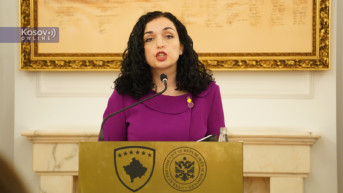
Today, Kosovo’s President Vjosa Osmani enters the final, fifth year of her term. From her perspective, she has spent the past four years serving the people of Kosovo. However, analysts see her presidency as largely shaped by the policies of Albin Kurti’s Self-Determination Movement and government. She largely stayed on the sidelines regarding controversial government decisions, yet she did not shy away from using harsh words when addressing officials from Belgrade or European representatives whose statements she disapproved of. Nevertheless, she remained a more acceptable dialogue partner for foreign actors compared to Kurti, despite lacking actual political power.
Written bay: Dusica Radeka Djordjevic
Osmani was elected President of Kosovo in the Assembly four years ago. Upon taking office, she stepped down as leader of the "Guxo" list she founded, which has since become a political party led by Faton Peci and Donika Gërvalla.
Her election as president followed parliamentary elections in which Osmani, for the first time, was not a candidate of the Democratic League of Kosovo (LDK), which she left in 2020. Instead, she ran on the Self-Determination Movement’s list in agreement with Albin Kurti, securing 300,788 votes.
She has not disclosed her plans after her term ends in 2026 or whether she is considering another five years in office.
"At the beginning of next year, we will discuss this issue. Throughout my political career, I have worked solely in the interest of Kosovo and all its citizens. None of my political decisions were based on personal calculations about my position but only on where Kosovo and its citizens should be," Osmani recently stated.
However, analysts argue that her presidency has been characterized by political calculations. Former diplomat Avni Arifi claims she has brought no real value to Kosovo and will do anything for her career. Political analyst Halil Matoshi believes she lacked both power and courage to oppose government mistakes, while political scientist Ilir Hajdini accuses her of remaining silent on the ruling coalition's errors for four years, only to start voicing certain criticisms two months before elections.
The Brussels administration was stunned when Osmani called a statement by former EU spokesperson Peter Stano on the issue of opening the main bridge in Mitrovica "racist" last year. The EU responded by reminding her that it is in Kosovo’s best interest to listen to its friends and allies, warning that otherwise, Kosovo risks being left isolated.
She also indirectly criticized former EU envoy for dialogue Miroslav Lajcák, stating that discussions on the draft statute for the Community of Serb Municipalities (CSM) should be held with the U.S. and that she trusts America more than "some bureaucrats from countries that do not recognize Kosovo."
Osmani has repeatedly stated that Kosovo proudly considers itself "the most pro-American country in the world." However, she did not attend the inauguration of newly elected U.S. President Donald Trump, instead sending a delegation from her office to the event.
Recently, she expressed a negative stance on the European draft of the CSM statute, arguing that it would not pass constitutional review. A few months ago, she suggested that Kosovo could unilaterally implement the Brussels Agreement and the 2023 Ohrid Annex (which includes the establishment of the CSM) if international partners provided guarantees that Kosovo would, in return, gain recognition and membership in international organizations.
Political analyst Blerim Burjani told Kosovo Online that Vjosa Osmani has had no particularly notable achievements as Kosovo’s president over the past four years, aside from maintaining relations with the U.S. and the EU. He noted that at times, she appeared to act as a mediator in Albin Kurti’s relations with Washington and Brussels, while in domestic politics, she was largely invisible.
Burjani also pointed out that she was not active in foreign policy regarding Kosovo’s international recognition and did not contribute significantly in that area.
"People in Kosovo are not satisfied with her performance over the past four years. She did not play a fundamental role, nor did she fulfill the presidential duties as required by the Constitution. She did not maintain good relations with the country's legal system, effectively obstructing the work of the prosecution by failing to nominate a chief prosecutor, leaving the institution to function under an acting head," Burjani noted.
He added that while Osmani respected political parties, she lacks the capacity for political leadership or governance.
"She remained silent and merely signed off on laws passed by the Kosovo Assembly, giving the impression that she struggled with fulfilling her constitutional duties. She has effectively played the role of Kurti’s notary, which has been heavily criticized," the analyst concluded.
According to him, Albin Kurti’s increasingly negative influence on relations with the international community and his reputation as a diplomatic problem have led to his diminishing role on the global stage, where he has been largely replaced by Vjosa Osmani.
Stefan Surlic, an assistant professor at the Faculty of Political Sciences in Belgrade, argues that over the past four years, Osmani has had to balance between the extreme nationalist and chauvinistic policies of Albin Kurti’s government and her own desire to leave a legal and conciliatory mark, particularly in bridging internal divisions within the Albanian population.
"It was a balancing act between competitive chauvinism on one hand and, on the other, the demands for upholding rights, the constitution, and the rule of law," Surlic explains.
Regarding Serb-Albanian relations, Surlic sees one major positive outcome during Osmani’s tenure—the formal transfer of land ownership to the Visoki Decani Monastery, in which she played a crucial role.
"When it comes to the dialogue between Belgrade and Pristina, although we have not seen actual normalization of relations, real negotiations, or any agreement implemented on the ground, I believe her most significant legacy is related to the land dispute of Visoki Decani. International officials and NGOs confirm that Kurti’s government would have obstructed the decision and that the monastery would not have gained ownership of the land had Osmani not been involved in the entire process," Surlic told Kosovo Online.
He also notes that over the past four years, Osmani has sought to present herself as someone resistant to external pressure—whether from Western actors or her own government. According to Surlic, she aimed to show diligence and highlight her academic background as a means of contributing to Kosovo’s political landscape.
The West, however, was fully aware that Osmani lacked real political power and that she was merely balancing between holding a formal position and having no real influence on actual policymaking.
"In some instances, she even used more radical rhetoric in public than Albin Kurti. However, many pointed out that she was much more moderate in negotiations and in seeking compromise solutions compared to Kurti—at least from the perspective of Western officials. In terms of realpolitik, she was seen as the more pragmatic figure capable of reaching agreements, whereas Kurti maintained a consistently negative stance, especially regarding the Belgrade-Pristina dialogue," Surlic explains.
Marko Milenkovic from the NGO New Social Initiative argues that Osmani’s presidency over the past four years largely reflected the policies of Kurti’s Self-Determination movement and his government.
"We have not heard her voice any critical positions against these policies, nor has she been particularly involved in Kosovo's internal affairs. Instead, her focus has been on representing Kosovo at international events," Milenkovic told Kosovo Online.
According to him, Osmani managed to cultivate a better image than Kurti, who, over time, has increasingly isolated both Kosovo and himself.
"She positioned herself as a more acceptable partner for discussions and constructive debates on international issues. It even appears that the international community is trying to improve her political standing, seeing her as a more viable option," Milenkovic observes.
On the domestic front, however, he believes Osmani has lost political influence compared to when she was elected in 2021. Her former political party has now aligned itself more closely with Self-Determination and Albin Kurti rather than with her.
"There is little that stands out as a defining feature of Osmani’s presidency—aside from the dominance of Kurti’s governance. She largely remained on the sidelines. The biggest gap seems to be that international actors expected her to position herself differently, to act as a counterbalance and prevent the deterioration of Kosovo’s relations with the international community. Instead, she was more of a passive observer, failing to use her political influence or the power of her office to leave a lasting mark," Milenkovic argues.
"Osmani will likely be remembered as a symbol of missed opportunities in politics."
What’s Next for Osmani?
As for Osmani’s future in politics, Surlic believes that she currently lacks any additional political capital that could be useful to Albin Kurti. Four years ago, when she left the Democratic League of Kosovo (LDK), she lent legitimacy to Kurti’s movement, which in turn rewarded her with the presidency.
"Today, political options are clearly defined. Those opposed to Self-Determination would not be drawn to Osmani in any way. She might consider forming her own political platform to attract disillusioned LDK voters, but that represents only a small fraction of the electorate. On the other hand, the Democratic Party of Kosovo (PDK) has a stable voter base, leaving little room for her to maneuver politically. A second term seems unlikely, but she is ambitious and will not simply exit the political stage like Atifete Jahjaga did. Instead, she will likely seek either a role within Self-Determination or the creation of her own political faction," Surlic suggests.
Meanwhile, Blerim Burjani believes that Osmani could continue her career within Self-Determination, possibly as its vice president.
Milenkovic, however, predicts political downfall for Osmani.
"She has almost entirely lost her political influence. It is unlikely that she will hold a similar political position in the future. I expect her to face a political collapse and withdraw from major roles," Milenkovic concludes.



0 comments