
Plenkovic, Mitsotakis, or someone else - does the EU have a better solution than Von der Leyen?
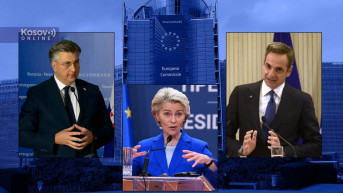
Is the destiny of the Western Balkans changing and in what direction will the already shaken dialogue between Belgrade and Pristina go if the current European Commission President Ursula von der Leyen is replaced by candidates from the region who are at completely opposite poles regarding the independence of Kosovo?
This pre-election equation with several unknowns was recently presented by the German Bild, claiming that the most serious opponents to the current European Commission President Ursula von der Leyen are Croatian and Greek Prime Ministers Andrej Plenkovic and Kyriakos Mitsotakis.
"Both Plenkovic and Mitsotakis have reportedly already expressed interest in being candidates to succeed Ursula von der Leyen. Roberta Metsola from Malta, President of the Parliament, is also rumored to be a candidate. She lacks executive experience, but has plenty of confidence and ambition, and as shown at the EPP nomination congress in Bucharest at the beginning of March, she has more talent for speeches than von der Leyen," states the Bild article.
It was at this congress of the European People's Party that von der Leyen received unequivocal support from the European People's Party (EPP) for a second term at the helm of the European Commission.
However, problems in the pre-election strategizing arose last month when the European Parliament, by a majority of votes, adopted a request from MEPs of center-left parties demanding her to revoke the decision to appoint her party colleague to a well-paid position in Brussels.
At the same time, in Germany, among the Bundestag parties, there are increasing voices that von der Leyen has not done enough for this country, nor for the EU.
Bild estimates that EPP coalition partners such as the Greens, who are dissatisfied with the pace of the EU's green transition, as well as right-wing factions that wanted at all costs to stop a left-wing candidate for EC president, are disappointed with the actions of the EC president during her current mandate.
Bild also reminds of the scandal involving the non-transparent procurement of COVID-19 vaccines from Pfizer, and the significant criticism she has received for completely siding with Israel in the current conflict with Hamas and Iran.
Post-election surprises
For long-time Brussels correspondent Erisa Zikaj, it would not be a surprise if Croatian and Greek Prime Ministers Andrej Plenkovic and Kyriakos Mitsotakis indeed disrupt Ursula von der Leyen’s plans.
"Compared to previous elections, these two names are potential candidates who could succeed and replace Ursula von der Leyen. This could happen because European elections always bring big surprises. I must remind you that no one knew or thought that Ursula von der Leyen would be the President of the European Commission. It was a big surprise for everyone because it depended on negotiations among political groups in the European Parliament, but also negotiations among states and governments in the European Commission," says Zikaj for Kosovo Online.
It is believed that the election of either Plenkovic or Mitsotakis as the President of the European Commission could partly affect the EU's approach to the Western Balkans, but it would most significantly impact the process of normalizing relations between Belgrade and Pristina because these are representatives from countries that understand the problems and needs of the region well, yet they hold opposing views on the independence of Kosovo.
"If one of them becomes the President of the European Commission, it will affect the process, not entirely, but in parts," emphasizes Zikaj.
Plenkovic, she claims, would speed up the dialogue process.
"If we get Andrej Plenkovic, who is clearly committed to the Western Balkans, he will push this region forward and will speed up the dialogue between Belgrade and Pristina. We would see a complete commitment to finish this process as soon as possible. Plenkovic knows the region very well, not just because he is from Croatia, but because he has been a Member of the European Parliament which makes it easier for him to understand each country in the Western Balkans and the problems they face. As President of the European Commission, I see no different outcome but for the dialogue between Belgrade and Pristina to be accelerated and to have a very constructive end," says Zikaj.
According to her, Greek Prime Minister Mitsotakis is also well acquainted with all the open issues in the Western Balkans, but he comes from a country that does not recognize Kosovo.
"This could be a problem because if the President of the European Commission comes from a group of countries that do not recognize Kosovo, how can we expect that this process will be accelerated and brought to an end," she emphasizes.
She notes that this is best seen in the issue of lifting restrictive measures against Kosovo, which is currently blocked in the European Commission.
"When we ask member states why this is the case, they say they would like to lift these restrictive measures, but it is up to the European commissioner, and we do not know whether it is the high representative or someone else who is stopping this. This is a concrete example of how one player in the European Commission can either block or accelerate a process. If you have a majority decision to lift restrictive measures against Kosovo, it is enough for one of the players to block it, and this will delay the entire process," explains Zikaj.
However, she adds that the example of Dora Bakoyannis has shown that representatives of EU member states or the Council of Europe do not always act in accordance with the national policies of their countries, but rather the interests of the Union.
"We have seen that in the Council of Europe, the majority of parliamentarians want Kosovo as a new member, including the Greek, Dora Bakoyannis. So, you still have examples where someone from countries that do not recognize the independence of Kosovo are still very constructive," emphasizes Zikaj.
She adds that among the potential candidates for the head of the European Commission, current President of the European Parliament Roberta Metsola and Italian Prime Minister Mario Draghi are mentioned, but it is most likely that someone from the ranks of the European People's Party, which includes not only von der Leyen but also Plenkovic and Mitsotakis, will take the position.
"We are in the midst of European elections and according to all current indicators, we know that the European People's Party will remain the leading political group in the European Parliament, and they will not give up their representative at the head of the European Commission," emphasizes Zikaj.
Von der Leyen's second term is questionable, she believes, due to numerous public criticisms of her work.
"There are many criticisms of her mandate, from the Pfizer case, how she worked during the COVID pandemic, and the latest case with a German official in the European Commission. There are several groups that are not satisfied with her work, and it might be possible, perhaps it is realistic to say that we can expect another candidate to beat her or maybe someone third. There could be surprises," believes Zikaj.
Still, she does not expect changes in the EU's positions towards the Western Balkans regardless of the fact that all analyses indicate a strengthening of right-wing parties.
"We expect a rise of ultra-rightists in the European Parliament, and they are not too fond of EU enlargement. But they will not lead processes in the European Parliament. The European People's Party will remain the first, largest, and main party, and it will be up to them, along with the Liberals or Social Democrats, to form a larger coalition with the Greens in the European Parliament. They have a practical approach to EU enlargement," explains Zikaj.
She reminds us that the issue of EU enlargement came to the agenda after almost two decades due to the war in Ukraine.
"With Russian aggression in Ukraine, expansion becomes a priority and it is currently the priority, primarily due to the geopolitical situation. This means that there will not be major changes in the political groups in the European Parliament, because the ultra-right cannot change this decision; they are not strong enough to change it," he adds.
He states that there are expectations that Montenegro could be the first country from the region to become a full member of the EU by either 2028 or 2030.
He emphasizes that this would be a very good sign for the region that EU enlargement is possible.
"In the last 15-20 years, we have seen strong opposition, nothing was happening, but now that process has begun, it is a priority and we need examples, like Montenegro, to show that the countries of the Western Balkans have a future not just on paper, but that it is indeed possible. The people of the Western Balkans must have this perspective, it is necessary for their jobs, environment, and many other things in their countries," concludes Zikaj.
Key dialogue issues
However, for research associate at the Henry Jackson Research Center, Helena Ivanov, changes at the head of the European Commission are not key regarding the normalization of relations between Belgrade and Pristina because those decisions are made at a much higher level of decision-making.
"The normalization process and the relations between Serbia and Kosovo, and resolving all unresolved issues, is something that is decided at a much higher level and this is a consistent policy that the European Union has been leading for many years so that the maneuvering space would be limited to change much there," emphasizes Ivanov.
In a discussion with Kosovo Online, Ivanov assesses that a key issue is the lack of progress in the normalization process, blaming not only the EU but also both sides for not implementing what has been agreed upon.
"As for the normalization process itself, I don't see any general changes for the better. Because the reason why the normalization process isn't working isn't necessarily tied to who is at the head of the European Union but rather how these talks are conducted and how the EU has positioned itself in these discussions. Of course, a significant problem is the failure to fulfil obligations that the parties have agreed to, including the Brussels Agreement over ten years ago and the more recent Ohrid and Brussels agreements. Simply, there are many other issues that have nothing to do with who sits at the head of the EU and complicate the normalization process between Kosovo and Serbia," says Ivanov.
She notes that the mention of Plenkovic and Mitsotakis as potential successors to Ursula von der Leyen suggests that these two options are on the table and that they are politicians looking to continue their careers in European politics.
"The fact that Plenkovic and Mitsotakis are mentioned suggests that these two options are on the table. However, when it comes to Mr. Plenkovic, his name has been mentioned several times as a potential successor to Ursula von der Leyen, but it always ultimately fell through, it did not happen. Whether that will be the case this time remains to be seen, but as long as these two names are mentioned, I would say it is being seriously considered. We also know that Plenkovic has been thinking about European politics for a long time and wants to enter European politics, and surely this is a position that would interest him. And I believe that is equally true for his potential rival," says Ivanov. She adds that both Serbia and Kosovo view the selection of the EC President from their own perspectives.
"From Serbia's perspective, it would probably be slightly better if Greece, whose candidate would replace Ursula von der Leyen, was the main one, due to the relationship between Serbia and Greece on the one hand, and Serbia and Croatia on the other - as well as the perception Greece has towards Kosovo and on the other hand, the relationship Croatia has towards Kosovo," concludes Ivanov.
Asked whether this would also lead to a de facto change in the European Commission's approach to the Western Balkans, Ivanov emphasizes that there should be no doubt.
"We can certainly expect that there would be somewhat different approaches when it comes to the Western Balkans. On one hand, the Greek candidate would be much more favorable to Serbia, much closer to the Serbian position, and this might have some implications for the relations between Serbia and Kosovo and the discussion on normalization of relations. On the other hand, Plenkovic and Croatia unequivocally recognize Kosovo as an independent state, and in that sense, these two individuals would have a slightly different approach. However, in terms of some serious decisions, I don't believe there will be any major differences because when it comes to the Western Balkans itself, the accession of the Western Balkans to the European Union, and the relationship between Kosovo and Serbia and the talks on normalization of relations between Kosovo and Serbia, I believe those are decisions that are made at a higher level. These are established policies and simply any of the two or someone else who might replace Ursula von der Leyen would have relatively limited maneuvering space to bring about any serious changes in how the EU deals with the Western Balkans," stresses Ivanov.
EU Staffing
Researcher from the Institute for European Studies, Petar Curcic, believes it is still early to speculate and enter into post-election combinations.
"It's not realistic to expect that we will have the name of the candidate until the fall of this year because after the elections, there will likely be a 'long hot summer' where people go on vacation and various political options will probably be considered. Of course, the composition of the European Parliament will largely decide the outcome of the winner: whether it will be someone from the European People's Party or another party will win, although it seems that the EPP will win these elections," Curcic tells Kosovo Online.
Curcic explains that after the June elections, a long and complicated procedure follows, which involves each of the 27 EU member states first issuing an advisory opinion, after which the European Council proposes staffing solutions to the European Parliament.
He does not rule out the possibility that von der Leyen could receive another term, as this would not be unprecedented in European practice. He recalls that Walter Hallstein, Jacques Delors, and José Manuel Barroso each served two terms at the head of the European Commission.
"Considering Germany's strength both in the European People's Party and in Europe, it seems likely that she could renew her mandate. If she remains, I do not believe things would change dramatically, especially since her Commission was the one that initiated the process of the Ohrid Agreement and a new stage in relations between Belgrade and Pristina," says Curcic. When asked how he assesses the chances of the Croatian or Greek prime minister, this researcher notes that previous practice indicates that the head of the European Commission has never been chosen from Southeast or Eastern Europe - outside the zone of EU founding countries.
"It has not happened before that the President of the European Commission was from outside the six founding countries of the European Community plus Spain, Portugal, and the United Kingdom. From Southeastern and Eastern Europe and Greece, there has been no one, so I think it is not realistic to expect that it would be Mitsotakis or Plenkovic. Regardless of what Plenkovic has done for his country in terms of European integration, such as entering the Schengen and Euro zones. However, these are primarily politicians from smaller countries. Also, Plenkovic is now very prone to collaborate with extreme right parties, and it's questionable how utilitarian this will be after the elections. The results later will show, but now this rightward shift of Croatia is not something that could be positively valued in the current constellation of forces," explains Curcic.
When asked how much the election of a candidate from this region would help or hinder the dialogue process between Belgrade and Pristina, Curcic says that it is necessary to differentiate between national and European interests.
"Greece is unlikely to change its stance on not recognizing the independence of Kosovo any time soon. However, one thing is the European perspective, and another is the perspective of national states, EU members because we have seen in the case of Dora Bakoyannis that despite being a citizen of Greece, she did not follow the national interests of her country but the interests of European institutions. One thing is the logic of national states, and another is the logic of European institutions," concluded Curcic.


0 comments