
Political oxymoron: Can Kurti form a new government without a parliamentary majority?
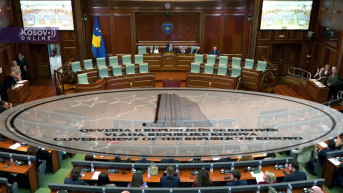
Oxymoron. This is how one might explain the logical paradox surrounding the coalition led by the Self-Determination Movement, which is aware that it lacks the necessary votes to elect the President of the Assembly but remains confident it has enough support to form a new government in Kosovo. For analysts interviewed by Kosovo Online, this constitutes “political gymnastics,” involving calculations based either on potential party defections or snap elections.
Written by: Djordje Barovic
“I’ve been to the circus 46 times, and it got boring. The Assembly is even worse,” said Eugen Cakolli of the Kosovo Democratic Institute following the failed inaugural session held on Sunday.
And he’s not the only one using such a comparison.
“I can describe it in one word: circus,” stated German Ambassador to Pristina Jörn Rohde after the 47th unsuccessful attempt to constitute the Assembly.
As in any circus, until the lights go on, the performances of jugglers, clowns, lion tamers, and magicians take turns.
In the Kosovo version, the program is supposed to end on July 26—the deadline set by the Constitutional Court.
The only thing that remains unknown is what the final “act” of this performance will be.
In the meantime, citizens are convinced that, if things continue this way, Kosovo may find itself in the Guinness Book of Records—but not for the right reasons.
Despite the evident institutional crisis in which the parties around Şelf-Determination cannot reach the magic number of 61 MPs, members of this coalition continue to insist that they have enough votes to form the “Kurti III” government.
“We don’t have enough votes for the Assembly, but we believe we have them for the government. Under Kosovo’s constitutional system, these two processes are separate,” explained MP Nezir Kraki of the Guxo party.
No matter how illogical that may sound, this line of reasoning is persistently repeated by Şelf-Determination’s coalition partners.
The leader of Alternativa, Mimoza Kusari-Lila, claims that if parliamentary committees are elected as a precondition for resolving the crisis, a new government led by Albin Kurti could be formed quickly, as there is, according to her, a simple majority available.
“As far as the executive is concerned, the numbers for ‘Kurti III’ do exist, and forming a new government with a new mandate is possible. However, we must first overcome the Assembly’s constitution process, which has been unjustifiably delayed to the detriment of citizens and other processes. We cannot force opposition MPs to vote, even though it is their legal duty,” Kusari-Lila explained.
"Changing the Rules Mid-Game"
Political analyst from Pristina, Gezim Kasapolli, says such claims “make no sense.”
In an interview with Kosovo Online, Kasapolli emphasized that the essence of the institutional crisis lies in the fact that Albin Kurti “wants everything,” even though he knows he lacks the votes for both the President of the Assembly and the new government. Therefore, Kasapolli believes Kurti is aiming for early parliamentary elections in the fall, to be held together with local elections.
To “buy time,” Kurti is deliberately blocking the constitution of the Assembly, the analyst warns.
“Kurti is blocking the process because he knows he doesn’t have the votes for the government. In this initial phase, with Albulena Haxhiu, he is obstructing things to see what comes next—his plan is to drag the process out until the local elections. He senses that he’s slowly losing his majority and wants to capitalize on simultaneous victories in both local and parliamentary elections,” Kasapolli said.
He explained that Kurti hopes the new elections will secure him not only the needed parliamentary majority but also better results at the local level.
“The last parliamentary elections were disproportionate to the local ones. In the 2021 local elections, Kurti got only 170,000 votes, while in the parliamentary elections he received 400,000. That’s a big discrepancy. Essentially, he wants to prolong this situation until the local elections and ‘sell’ both himself and Şelf-Determination at the local and parliamentary levels,” Kasapolli added.
Asked whether a possible secret vote for Şelf-Determination’s candidate for Assembly President could be applied again during the vote for the new government, Kasapolli was firm:
“You cannot change the rules in the middle of the game. Right after the elections, there was a meeting with former Assembly President Glauk Konjufca where all political parties agreed on the agenda for the new session. After six or seven failed attempts, Şelf-Determination decided to change the rules. But the Constitutional Court’s decision clearly states that the ‘rules of the game’ cannot be altered mid-play. That’s crucial,” Kasapolli emphasized.
He stressed that the Constitutional Court has ruled that the Assembly President must be elected according to the same procedures as before.
“I believe Kurti knows he lacks the votes for a government and thus wants to delay the process until the local elections, because it suits him to hold both elections on the same day,” Kasapolli reiterated.
He also doubts that there will be any “defections” from other parties to provide Kurti with either a parliamentary or government majority.
“I don't believe Kurti can find the necessary votes, especially now—not just among the Albanian majority but also from ethnic minority parties. Kurti has had problems from the start—not only with Albanian parties but also with others. That’s why I don't believe anyone will give in now, especially since Kurti has been clear about whom he is willing to negotiate with,” he said.
Kasapolli reminded that Kurti had openly invited the Democratic League of Kosovo (LDK) to form a coalition government, but the party rejected the offer.
“LDK reiterated its stance that it will not enter into a coalition with Şelf-Determination, which leaves no guarantees or hope that Kurti will find partners within the current parliamentary composition,” Kasapolli concluded.
A Policy of “Manipulation”
Srđan Barac, associate of the Center for Social Stability, is more direct.
He claims that the election of the new President of the Assembly and a new government will depend entirely on “political manipulation combined with foreign influence.”
“After the elections, it’s clear that a parliamentary majority will be hard to achieve without political manipulation, which implies shifts in who supports whom, which list they were elected from, and how they will vote when the time comes. That’s why secret voting is being discussed—it allows the mandate to potentially be ‘sold’ more than once,” Barac told Kosovo Online.
In his view, secret voting is a perfect opportunity for “negotiations and personal interests,” but also reflects the current state of politics in Kosovo.
“The idea of secret voting—for both the Assembly President and the government—is to allow negotiations that could maximize personal interests at the expense of the people and society. This alone says a lot about the current state of political consciousness in Kosovo and Metohija,” Barac pointed out.
He added that in this kind of “mathematics,” the only certainty is that the Serb List cannot be counted on and will act as a counterweight.
“The only thing certain is that they cannot count on the votes of the Serb List, which will serve as the main counterbalance,” Barac stressed.
When it comes to possible “defectors,” he says it’s usually someone least expected.
“It’s hard to speculate on names—those we least expect might be the ones to switch sides at the last minute, especially if they receive that infamous ‘phone call.’ It will be a mix of personal gain and pressure,” Barac believes.
Still, he is convinced that the votes deciding the new Assembly President will not necessarily be the same ones deciding the new government.
“I don’t think there will be a direct cause-effect link—each process will be negotiated separately, with distinct external implications,” Barac concluded.


comments