
Priorities of Kosovo’s new President: What can Shiroka Pula do, and what should she accomplish during her term?
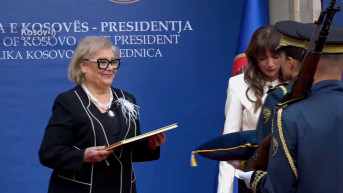
The election of Justina Shiroka Pula as President brought an end to Kosovo’s months-long institutional crisis. Less than a week into her term, the new President should, according to Pristina-based analysts, safeguard constitutionality in the functioning of institutions and work to strengthen relations with international partners. In Belgrade, however, observers do not see her as a figure capable of improving Kosovo’s international standing, although they believe she could potentially initiate dialogue among ethnic communities at home.
Written by: Katarina Saicic
The name of Justina Shiroka Pula, President of the Kosovo Academy of Sciences and Arts, emerged only in the final stage of the constitutional deadline for electing the President of Kosovo. As Prime Minister Albin Kurti’s “ace up his sleeve,” she secured the support of 81 MPs as part of an agreement on the adoption of amendments to the Law on the Specialist Chambers and, to the surprise of many, became the third woman to serve as President.
Analysts describe her as a unifying figure, while former Kosovo Deputy Prime Minister Edita Tahiri called on her to demonstrate integrity and avoid becoming “Kurti’s notary,” as she described Vjosa Osmani.
Although the office of President is largely ceremonial, the public and analysts view her first days in office as a potential stabilizing factor. Her extensive academic experience and previous ministerial tenure are regarded as key assets in easing the deep polarization within society.
Respect for the Constitution
Diplomat Albert Prenkaj said that Shiroka Pula must, above all, guarantee respect for the Constitution and ensure that institutions function in accordance with their constitutional powers.
“The President is the guarantor of the Constitution and constitutionality. That is therefore the foremost priority of any President under the Constitution. The President should strive, without compromise, to preserve constitutionality in the functioning of all Kosovo institutions. That is the main priority,” Prenkaj said.
He added that Shiroka Pula could also play a particularly important role in foreign policy and contribute to intensifying communication with international partners.
“A person with credibility and integrity, which Justina Shiroka Pula is believed to possess, can bring Kosovo back onto the international stage, given that Kosovo is currently isolated in terms of communication with the world. There is a certain form of isolation, or else we have an entirely passive foreign policy. In that sense, she can be an important figure, despite the fact that we have a foreign minister and a Ministry of Foreign Affairs. At this particular moment for Kosovo, I believe the President has a special role,” Prenkaj said.
Prenkaj also sees the new President as a figure capable of bringing together experts on issues related to the judicial proceedings against the former KLA leaders.
He believes that one of her first steps should be to establish official communication with Brussels and The Hague regarding matters related to international agreements and the Specialist Chambers.
“However, what is important, and what we have seen over the past 20 days, is that the President should become the central figure around whom experts will gather to play an important state role in the defense, that is, in proving the innocence of the KLA leaders and former senior state officials—the President, the Speaker of the Assembly and MPs. The amendments to the law that have been adopted should lead to amendments to the existing international agreement,” Prenkaj said.
Coordination with the Assembly and Government
Professor of international relations Dritero Arifi said that there should be better coordination among the President, the Government and the Kosovo Assembly because, in his view, the institutions should adopt a common approach, particularly in foreign policy, so that Kosovo presents a unified position to its international partners.
Arifi reiterated that the issue of the Specialist Chambers was particularly important, especially following the adoption of amendments to the law governing that institution, and said that a working group should be established to coordinate and monitor developments following the first-instance guilty verdicts against the four KLA leaders.
“The President should operate with a different dynamic. A stronger framework of cooperation needs to be established between the President, the Government and the Assembly, as well as with the political parties. Certainly, given the urgency of the issue of the Specialist Court, an initiative to establish a working group should be launched as early as today. Who should lead it? The President should take the helm together with the Foreign Minister—that is, they should act in a coordinated manner,” Arifi told Kosovo Press.
According to him, there must be no disagreements on this issue.
Executive Director of the American Center for Counterterrorism and Extremism Arianit Shehu believes that Shiroka Pula should focus on strengthening the strategic partnership with the United States and accelerating European integration, while also contributing to political and social unity, overcoming divisions, involving all political actors in dialogue and curbing the departure of young people.
No impact on Kosovo’s international image
Career diplomat Zoran Milivojevic, on the other hand, believes that Shiroka Pula can primarily have an impact on the domestic political scene and cannot improve Kosovo’s standing internationally.
“At one point, Vjosa Osmani was quite independent in foreign affairs, and everything Kosovo was able to achieve, or to mitigate in terms of relations with major powers or its allies, was thanks to her. The situation regarding Kosovo’s position is now less favorable than before because of Albin Kurti’s policies and his conflict with the US administration, which has no understanding for his policies. In that sense, I do not think the new President can do anything particularly significant. She does not have that kind of experience in international relations, that kind of standing, or the dynamism that Osmani had. Her primary role will therefore be on the domestic scene,” Milivojevic told Kosovo Online.
In his view, Shiroka Pula’s main contribution was that she broke the political deadlock at the last moment and enabled Kurti’s government to begin functioning.
“We can see from the reactions of foreign actors that this is important to them, particularly to countries that support Kosovo’s independence, because it serves as one of the arguments that the system functions and that it has elements of a democratic system with functioning institutions. Kurti remains in place with policies that are clearly not changing and that will continue to have the support of those centers of power that support Kosovo’s independence, insist on affirming its statehood and exert pressure on Serbia,” Milivojevic said.
On her first day in office, Shiroka Pula paid tribute in Prekaz to KLA founder Adem Jashari and then visited the graves of Ibrahim Rugova and Adem Demaci.
She did not mention the Serbian community, or any other non-majority communities, in her first and, so far, only address to MPs in parliament.
Nevertheless, given her academic background, President of the National Convention for Chapter 35 Dragisa Mijacic believes that Shiroka Pula could play a significant role because “Kosovo is crying out for someone capable of establishing dialogue between ethnic communities.” He believes that she could initiate the establishment of such dialogue.
Mijacic recalled that Vjosa Osmani had once stated that Serbs had committed a Holocaust.
“After that, there was no longer any possibility for Serbs and Albanians to sit together. We will see whether Shiroka Pula makes the same mistake. I sincerely hope she will not,” Mijacic said.


0 comments