
Punitive measures against Kosovo under Brussels’ scrutiny: The EU sends positive signals, but without blank-cheque support for Pristina
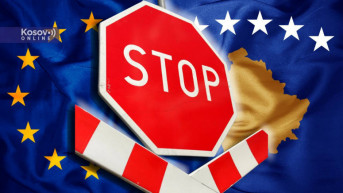
The complete lifting of the European Union’s punitive measures by the end of January was announced by Kosovo President Vjosa Osmani following the EU–Western Balkans Summit held in December last year. Today, on the final day of January, the majority of the sanctions remain in force. According to interlocutors speaking to Kosovo Online, this indicates that the EU will not extend full and unconditional support to Pristina until it is convinced that it will act in line with the Union’s interests. As they note, the lifting of sanctions will also await the outcome of the political situation, while the manner in which the Kosovo authorities treat the Serbian community in the period ahead will likewise have an impact.
Written by: Milena Miladinovic
On 17 December, Osmani announced “great news for Kosovo” – the full lifting of sanctions.
“At the end of the EU–Western Balkans Summit, following intensive talks with our partners, a decision was taken to lift all measures against Kosovo, with a large portion being lifted today and the remaining part by the end of January,” Osmani said in a video message on Facebook.
Reactions in Kosovo to this news were divided: from celebrations by the ruling structures, to opposition criticism over the damage caused, to expressions of gratitude toward Brussels from the civil sector.
A month and a half later, however, the full lifting of punitive measures has not occurred. Interlocutors of Kosovo Online describe this as the EU’s cautious approach toward the Kosovo authorities. As they emphasize, the Union seeks political stability in Kosovo and will most likely wait for the formation of new institutions—above all the Government and the Assembly, where international agreements must be ratified, as well as the election of the president—before lifting the sanctions.
Another parameter cited is the conduct of Prime Minister Albin Kurti in his technical mandate toward the Serbian community. That Kurti’s attitude toward the Serbian community and its political representatives has not changed significantly during this period is also illustrated by today’s decision of the Central
Election Commission, which did not approve the publication of the election results for the Serb List, as two members from the Self-Determination Movement, Sami Kurteshi and Alban Krasniqi, voted against it.
This was followed by a reaction from Serbian Foreign Minister Marko Djuric, who stressed that it is particularly concerning that such a move is taking place precisely at a moment when the European Union is initiating the process of lifting measures against Albin Kurti’s government.
“This has proven to be a step that clearly did not contribute to halting pressure on Serbs and other non-majority national communities in Kosovo and Metohija, nor did the announcement of lifting the measures contribute to calming the situation or respecting democratic standards,” Djuric wrote on the social network X.
Blank-Cheque Support?
Historian Stefan Radojkovic stated that the European Union does not wish to grant the Pristina administration blank-cheque support until it is convinced that it will more or less behave in accordance with the Union’s wishes and interests.
Speaking to Kosovo Online, Radojkovic noted that the EU is waiting to see how the situation in Kosovo unfolds and whether, in the event of a failure to elect a president, a new crisis will ensue, as well as what the approach toward the Serbian community will be.
“It can be said that they are cautious in their approach toward the Pristina administration; they do not fully trust that it will cooperate with EU institutions. For that reason, they are probably waiting to see whether Vjosa Osmani will be re-elected or whether another candidate for president of the Pristina institutions will emerge, and whether Albin Kurti’s government will demonstrate credibility and stability so that, at the institutional level, they have an interlocutor. Because if Vjosa Osmani is not re-elected and a new political and institutional crisis arises, then you have an increased risk of pressure, for example, on the Serbian community, especially in northern Kosovo, which has proven to be the subject of political campaigning and institutional pressure for the sake of gaining points in political campaigns,” Radojkovic said.
As he notes, the EU is showing goodwill signals regarding the lifting of sanctions, but it does not wish to provide blank-cheque support to Pristina.
“It seems to me that they are still cautious, that they are signaling readiness to lift all sanctions—which, incidentally, have not proven to be an effective means of pressure on Pristina—but that they are not prepared to grant blank-cheque support to the Pristina administration until they see that it will behave more or less in line with the wishes and interests of the European Union,” he said.
Asked whether one of the parameters for lifting sanctions could be the announced integration of education and healthcare, or whether these are unilateral moves, Radojkovic stressed that the EU wants to bring Kurti back within the framework of the Brussels agreements.
“It would be logical for them to want to return Kurti to the framework of the Brussels Agreements signed in 2013 and 2015, and later all subsequent agreements related to the so-called Franco-German plan and the Ohrid Agreement. In other words, it is not that some, conditionally speaking, integration of the Serbian education and healthcare systems is not envisaged—but within the framework of the Association of Serb-majority Municipalities. We all know that Kurti is an absolute opponent of such a framework, and now the question arises whether the EU will be able to compel him so that the pressure he is evidently exerting on the Serbian community is applied—but within the agreed frameworks of 2013 and 2015,” the historian added.
As he further notes, it is logical that the Union does not want the dialogue to remain a dead letter on paper.
“In that sense, Thaçi proved to be a far more cooperative interlocutor both to the Serbian community and to the Republic of Serbia. We shall see. If I were in the position of the European Union, it would be logical to want the Brussels dialogue to be functional rather than a dead letter. We will see how significant the role of the EU envoy, Mr. Sørensen, will be in this, but this will certainly be one of the signals as to whether Kurti is becoming more cooperative. Personally, I am very skeptical about this. He once stated, with regard to the declaration of independence of the Pristina institutions, that it was a declaration of dependence, as it arose on the basis of Ahtisaari’s Comprehensive Proposal for the Settlement of this issue, where he sees excessive interference by international actors in what he perceives as the internal issue of Kosovo and Metohija. In that sense, anything is possible,” Radojkovic emphasized.
In his view, greater pressure could be exerted by the United States in a certain format, but the question is how willing they are to engage in Balkan issues and to what extent they have left the matter to the European Union.
A Functional Political System
Researcher at the Institute for European Studies Petar Milutinovic stated that the lifting of EU sanctions against Kosovo is not unconditional, as political actors in Pristina had hoped, but that Kosovo must establish a functional political system and respect democratic principles in order to reap financial benefits.
Milutinovic recalled that Kosovo is currently in the phase of visa liberalization, which allows citizens to travel freely to EU member states, which, he adds, is one of the benefits for the economy, citizens, students, and ordinary people in Kosovo.
As he emphasized, what is new is that, following sanctions and the conditioning of EU support for Kosovo, a new space and opportunity is opening to establish an institutional system that will guarantee a definitive peaceful transfer of power across the entire territory.
“The basic precondition is the existence of a functional, operational political system that will ensure respect for at least the basic institutional order. That is, to have both a majority and a minority in parliament and in local assemblies, to establish a basic democratic principle. Once that is established, financial support from the European Union, that is, the European Commission—conditioned precisely on progress in establishing institutions—will follow. Therefore, it is not as unconditional as many political elites may have expected,” Milutinovic told Kosovo Online.
According to him, everyone in Kosovo is now aware of this, and Milutinovic sees the lifting of sanctions as an opportunity for a certain amount to be allocated from the Growth Plan to establish a stabilizing institutional mechanism of the political system in Kosovo.
“That is the primary and well-intentioned goal of Brussels, that is, the European Commission. It wants both Serbia and Kosovo to act in their best interest, in the sense of normalizing relations, but on a democratic, procedural, institutional basis,” he emphasized.
Kosovo will first have to ratify certain agreements, Milutinovic stressed, after which it can expect an inflow of financial resources.
“This again depends on the political elites in Kosovo and Metohija, on whether there is some basic consensus among all political actors. What is the fundamental strategic goal—normalization of political circumstances, or continuing with the current state where no one talks to anyone, no one wants to establish a basic institutional system, but instead abuses it,” he said.
In Milutinovic’s view, the European Commission will continue to monitor the situation in Kosovo and compliance with agreements even after sanctions are lifted and financial resources are allocated—specifically, whether the funds are going to the right place or into the grey zone.
“When a majority imposes itself, it begins to abuse its position, and the European Commission then asks why it should make certain concessions to Self-Determination. If Self-Determination, which has been given power, does not want to cooperate and establish what is in the best interest of both the party and the existing political system there, why should it receive funds? Of course, the Commission will reassess whether everything has been ratified and whether all procedures have been followed. Based on that, you may then expect to receive those funds. Even when you do receive them, the question remains whether they will be used in a procedural manner or misused. They want to know how the money is being spent, to ensure it does not end up in the grey zone. Everything is highly conditional because there is experience on the basis of which oversight is conducted,” Milutinovic concluded.
The EU Keeps Its Word
President of the Kosovo Business Alliance Agim Shahini, speaking about the final lifting of EU sanctions against Kosovo, emphasized that the Union keeps its word, but that Kosovo must also fulfill its commitments.
Shahini told Kosovo Online that the EU has so far lifted sanctions amounting to €30 million from various funds, which, according to him, is small but positive.
“We had a deadline by which we could use €400 million. The EU lifted sanctions on €30 million dating back to 2022. That is small, but good. Europe keeps its word, but Kosovo must also keep its own—to continue on the path toward EU integration and to fulfill our obligations and promises. In this situation, Kosovo has lost the most from the Growth Plan and EU funds, because the sanctions were direct,” Shahini said.
According to him, the EU is monitoring developments in Kosovo, and if Pristina stops fulfilling its obligations, the inflow of EU funds will also stop.
“The EU has its people monitoring developments in Kosovo, monitoring Kosovo’s steps toward EU integration. If we stop, finances will most likely stop as well. This must be monitored, and I believe that the Government of Kosovo and the Ministry for Integration will be cautious in this regard this year. We know that the EU makes certain decisions regarding Kosovo without consulting us,” Shahini concluded.
0 comments