
Rama’s new term, relations with Kurti and Pristina remain the same
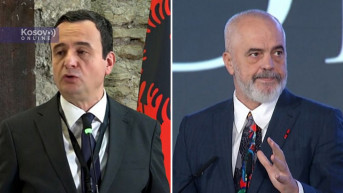
At the beginning of his fourth term as Prime Minister of Albania, Edi Rama has not, at least publicly, received congratulations from Albin Kurti. Considering the history of their relations, the absence of such a gesture is not surprising, and according to interlocutors of Kosovo Online, no major change in the behavior of the two leaders should be expected. As they note, there is a communication handicap between them, their relationship is defined by the question of “who prevails,” and the role of “big brother” that Albania has toward Kosovo will almost certainly continue.
Written by: Dusica Radeka Djordjevic
Rama’s new mandate was congratulated by the Deputy Chairman of Self-Determination, Glauk Konjufca, while Kosovo’s acting Foreign Minister Donika Gervalla sent her “warmest congratulations” to Albania’s new Foreign Minister, Elisa Spiropali. And that is where the list ends.
While Kurti remains silent, Rama never misses an opportunity to “advise” Kosovo during his speeches.
Thus, in the first days of his new term, at the “Albania, New Horizon” conference in Vienna, Rama stated that Kosovo should not be thinking about Serbia, but should instead focus on the demands of the European Union regarding dialogue and integration, otherwise it will only continue to isolate itself further.
“Kosovo needs to do its homework, hand in its completed assignments to the European Union, and ask to move forward. This has nothing to do with fulfilling or accepting Serbia’s demands. This has to do with meeting the requirements of the European Union,” Rama said.
Bledian Koka, editor-in-chief of TV Syri in Tirana, says that the cooling of relations between Kurti and Rama is not a new fact, and that their relationship is marked by a “lack of chemistry.”
“Congratulations and recognition of results are also a kind of product of the ‘chemistry’ between leaders. The absence of congratulations from Mr. Kurti to Mr. Rama is precisely something of this nature. It seems to me that even Mr. Rama did not congratulate Mr. Kurti on his election victory (in Kosovo), which has yet to produce a stable government, even though the elections were held months ago,” Koka told Kosovo Online.
Between the leaders of Albania and Kosovo, in his view, there exists a kind of communication handicap, whether institutional or personal, with many possible causes and reasons, but the coldness and tension are clearly visible.
Koka also points out that Rama’s relations with all Kosovo prime ministers, without exception, have always been very delicate and tense, even though there is no significant ideological divide between them.
“That was also the case with Mr. Haradinaj. Let us recall that after the conflict they had at the start of the Berlin Process, the matter escalated to a defamation lawsuit before the Basic Court in Pristina, initiated by Prime Minister Rama. It was the first case in history in which an Albanian prime minister sued a Kosovo prime minister. Similarly, relations were very problematic and cold with former Prime Minister Isa Mustafa. Even when Mr. Thaçi was president, Mr. Rama and Thaçi often held opposing views. Today they maintain strong unity and cooperation, with Rama supporting Thaçi in the proceedings before the Special Court in The Hague,” he said.
He describes Rama’s attitude toward Kosovo’s prime ministers as “excessive paternalism.”
“I see the problem in Mr. Rama’s excessive paternalism when it comes to making decisions about Kosovo—decisions that actually belong to Kosovo’s leaders. The conflict reached its peak when Mr. Rama decided to build an ‘economic fraternity’ not with the prime minister of Kosovo, but with the president of Serbia, which was heavily criticized both in our own country and in Kosovo,” Koka stressed.
He notes that Kurti’s congratulations to Rama were also absent after the final results of the parliamentary elections in Albania held on May 11, but emphasizes that many foreign leaders or institutions did not send congratulations either. It is believed, he said, that this was due to the way those elections were conducted, with what appears to be a kind of “international inhibition” in recognizing the electoral process as legitimate.
Afrim Hoti, a professor of international relations from Pristina, views the relations between Albania and Kosovo, and the relations between their leaders, separately. He says he sees no obstacle or problem between the two governments, while pointing out that relations between Kurti and Rama were not at a desirable level even during Rama’s previous term.
That situation, he adds, seems to be continuing into the new term of the Albanian prime minister.
“I think this is about the personal relationship between Rama and Kurti, as it is a question of leadership. It is about who prevails, who comes first. My view is that this is merely day-to-day politics and that their relations may vary depending on the moment. When it comes to general issues, however, both governments and both prime ministers cooperate and coordinate their political activities,” Hoti told Kosovo Online.
Petar Donic, associate of the New Third Way, also assesses that there is a “double dynamic” in their relationship.
“If we are talking about the two leaders, Kurti and Rama, they did not have much of a relationship in the previous period. Pristina has often faced criticism from Tirana—that it should approach dialogue with Serbia in a completely different way, that it should accept the Association of Serb-majority Municipalities and unblock it. Those were generally the negative aspects. On the positive side, however, they cooperated in the field of economy, in energy, and Kosovo’s exports to Albania increased drastically, while Albania’s exports to Kosovo slightly decreased. Croatia, Albania, and Kosovo also signed a joint defense pact as a kind of response to the increased activity of Serbia’s military industry,” Donic told Kosovo Online.
He believes that in Rama’s new term, relations will function in much the same way as before—Kosovo will continue on its own course, while criticisms of that approach will continue to come from Albania.
“Due to the strong ethnic synchronicity of the two peoples, economic cooperation will continue, along with the role of ‘big brother’ that Albania plays. Albania is now making great strides toward the European Union, and that will be its focus in the coming period. When it comes to EU integration, Albania will likely continue to advise Kosovo on what it should do—as already seen in Rama’s statement that Kosovo should focus on itself and its European path,” he concluded.


0 comments